Scoping → Pilot → Rollout
Measure first. Then decide.
Scoping, Pilot, Rollout: a graduated path from your first snapshot to full deployment, for safety-critical roles, a wellbeing program, or both.
- Days to weeks
Scoping
What happensWe start with your workforce snapshot and a scoping session to agree what to focus on and who starts. Where fatigue is a safety risk, Fatiguefit is often the place to start: an organisation-level Risk Assessment and Policy Builder with optional point-of-duty sampling, giving you a measured baseline with every figure stated alongside its denominator and confidence interval. For Health & Wellbeing, scoping goes straight to choosing the group that starts.
What we need from youA named owner and the right people in the room: safety and operations leads where fatigue is a safety risk, HR and wellbeing leads for a wellbeing program. If you sample with Fatiguefit, supervisors to run the sampling.
- 90 days in the field
Pilot
What happensA smaller group, such as a site, team or leadership group, starts at standard rates, using the solutions that fit what scoping found. Setup and calibration happen before the clock starts. Sleep assessments, point-of-duty checks and training run together, with an interim read at day 45.
What we need from youCohort lists, a communications channel, supervisor participation, and consultation with workers and their representatives before any individual assessment begins.
- On your decision
Rollout
What happensAt day 90 you decide against four things you hold, not against a forecast: your measured baseline, a count of people who reached a clinical pathway, a measured trajectory, and a fatigue tool calibrated to your roles. Open it to everyone or stop, with the focus that fits: Risk & Safety, Health & Wellbeing, or both.
What we need from youA decision. The pilot runs at standard rates, so there is nothing to convert: open it to everyone, or stop.
Points of focus
One platform. Use what you need.
Every solution is open to all your people. Focus on the people whose fatigue is a safety risk, on sleep health for everyone, or on both.
Risk & Safety
The people whose fatigue can hurt themselves or someone else, with the full Risk & Safety set where the risk is.
Both
Both together: the safety controls where the risk is, and sleep health for everyone else, on one platform.
Health & Wellbeing
Sleep health for everyone, run as a wellbeing program rather than a safety control.
| Product | Risk & Safety | Both | Health & Wellbeing |
|---|---|---|---|
| Sleepfit | Included | Included | Included |
| SleepWellBaby | Included | Included | Included |
| Fatiguefit4Duty | Included | Safety-sensitive cohort | Available |
| Awareness eLearning | Included | Safety-sensitive cohort | Available |
| Was It Fatigue? | Investigators only | Investigators only | Available |
Day 90
What you’re deciding with
Your own measured baseline
Sleep, fatigue risk and above-cut-off rates in your own cohort, with denominators and confidence intervals.
A count of people who reached a clinical pathway
How many employees reached a clinical pathway who were not already on one.
A measured trajectory
The same cohort assessed at baseline, day 45 and day 90, so you can see whether gains hold.
A calibrated fatigue tool
Task, control and consequence mapping specific to your roles, tested in the field.
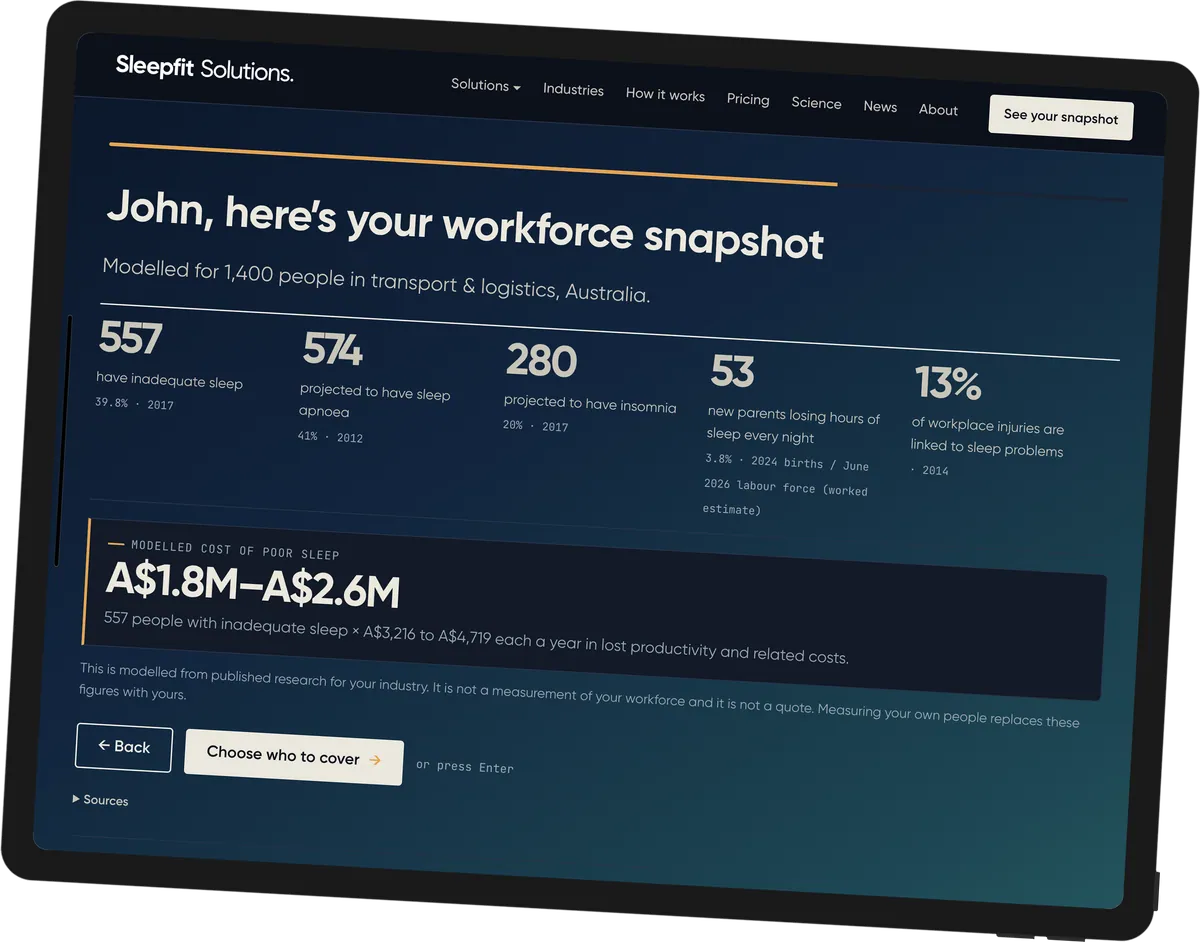
See what sleep and fatigue mean for your workforce.
Tell us your industry and roughly how many people you employ. Your snapshot models how many are likely sleeping poorly and what it costs you. Then tell us what you want to focus on, and we’ll show you how open access would work for you, and what it would cost.