Fatiguefit
Find out how your organisation manages fatigue today, and how fatigued your safety-sensitive people actually are, so you know where your fatigue risk sits.
Risk & Safety · Fatiguefit and Sleepfit
The Health and Safety at Work etc. Act 1974 expects you to manage fatigue like any other risk: assess it, control it so far as is reasonably practicable, and be able to show you did. Fatiguefit and Sleepfit give you the assessment, sleep-health indicators for safety-critical roles, the point-of-duty control, the training record and the investigation method, each producing evidence you can file.
The liability question
A compliant roster can still put a fatigued crew to work: what predicts impairment is the sleep people actually got, not the hours on the roster.
Beyond sector rules such as the Working Time Regulations and the rail safety regulations, the duty is risk-based: you must be able to show how your rosters, monitoring and training actually manage fatigue, and prove it after the event.
Directors and managers can be prosecuted personally where an offence involves their consent, connivance or neglect, and fines for organisations are unlimited.
Nothing we provide discharges that obligation. What each product does is produce evidence that an element of your fatigue risk management programme was carried out, to a standard you can show.
Through the year
Season alone moves fatigue risk modestly. The sharper effects come from specific weeks and workloads: clocks springing forward, the hottest nights, harvest, peak trading and flu season. These are the dates that matter in the United Kingdom in 2027.
Injury and crash risk rise the following week
Northern-hemisphere sleep is 15 to 20 minutes shorter than in winter
Farm injuries peak at harvest
Overtime and new starters
Occupancy surge and overtime
Measured: a published study found a change in sleep, injuries or crashes. Documented: a recorded change in workload or exposure, such as overtime or deployments. Dates are for 2027 and move each year. Our reading of published evidence, refreshed every November.
Where we sit
The roster does not allow enough time for adequate sleep. The failure is in the work pattern, before anyone has slept badly.
Hours-of-service rules and roster design, supported by bio-mathematical modelling of work patterns.
* Optionally, we work with a partner to review your rosters as part of the Fatiguefit risk assessment.
The opportunity to sleep existed, but the sleep did not follow: an undiagnosed disorder, psychological distress, life stage, environment or habit.
Measuring the sleep actually obtained across a workforce, and acting on what it shows.
Fatigue is present in the shift and is showing in behaviour, whether or not the person has recognised it.
Structured assessment at role and task level: sleepiness scales, symptom checklists and trained observation.
Fatigue is present and has produced an error. The only question left is whether the system catches it before it reaches the operation.
Fatigue-proofing: task design, cross-checking, error-tolerant procedures and timing critical work away from the circadian low.
Provided by othersFatigue-proofing is designed into equipment, tasks and procedures by others. We don’t supply it; we refer, and list the control types that apply to each industry. Control types by industry
It has already happened. The value now is in what the organisation learns from it.
Structured investigation of whether fatigue contributed and through which pathway, feeding back into the levels above.
Framework: Dawson D & McCulloch K, "Managing fatigue: it's about sleep", Sleep Medicine Reviews, 2005. Level 4 fatigue-proofing after Dawson, Chapman & Thomas, 2012.
The products
Find out how your organisation manages fatigue today, and how fatigued your safety-sensitive people actually are, so you know where your fatigue risk sits.
Measurement of the sleep your workforce is actually getting, with established sleep-health questionnaires that identify employees who may benefit from clinical evaluation, including people who would not otherwise present to a health service.
Structured assessment at the point of duty, combining the sleep a person actually got in the last 24 and 48 hours with how alert they feel now.
Fatigue training for employees and managers: what makes the controls at Levels 2 and 3 usable by the people running them.
Structured post-incident analysis of whether fatigue contributed to an event, and through which pathway.
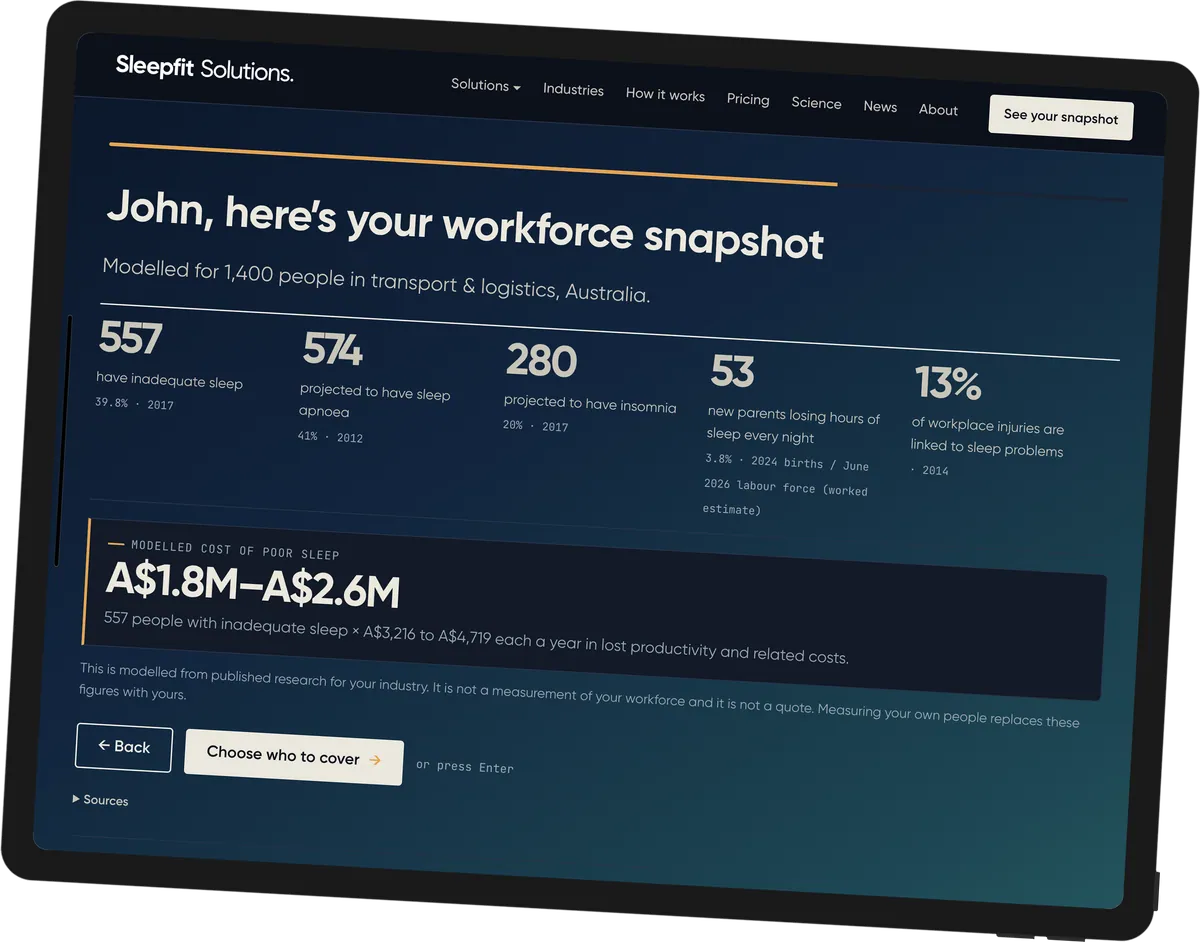
Tell us your industry and roughly how many people you employ. Your snapshot models how many are likely sleeping poorly and what it costs you. Then tell us what you want to focus on, and we’ll show you how open access would work for you, and what it would cost.