Sleepfit
The same private Sleepfit assessment and plan, with a referral route for case managers and a repeat assessment every six weeks while the claim is open.
On-claim Recovery · Sleepfit on-claim
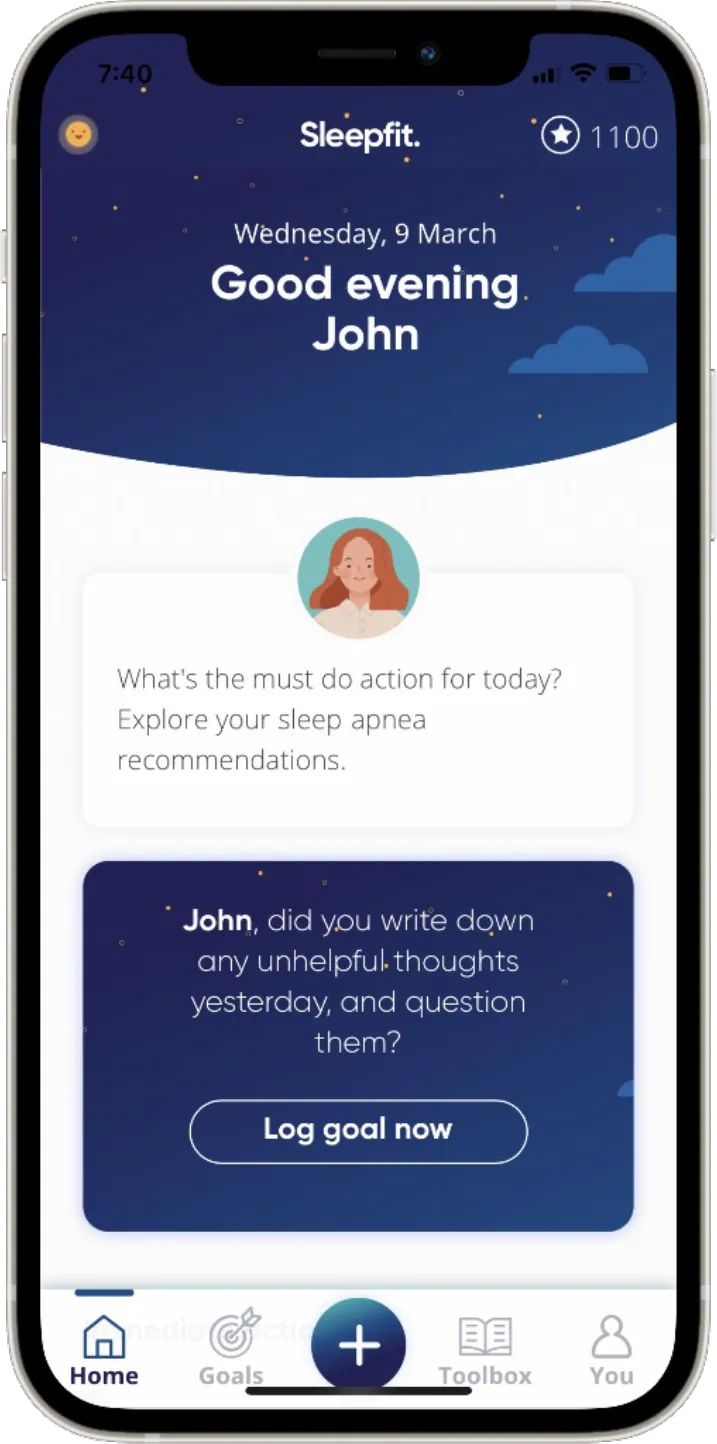
When an injury or illness is affecting someone’s sleep, the case manager can refer them to Sleepfit on-claim. The claimant completes a private sleep assessment on their phone, gets a personal plan and support, and repeats the assessment every six weeks while the claim is open. Nothing about how the claim is run changes. Built for workers’ comp and disability insurers.
Used by claims teams in Australia






Why sleep, on a claim
Pain, medication, worry and time away from work all disrupt sleep. Poor sleep wears down mood, energy and concentration, the things rehabilitation relies on, yet it is rarely measured on a claim.
When 80 life-insurance claimants started Sleepfit on-claim in the Recovre pilot, 94% were in the high-risk band for insomnia, 58% for anxiety and 34% for sleep apnea.
In Australia, work-related injuries and illnesses linked to stress or mental health have the highest average time off work (ABS, 2023). Sleep and mental health are closely linked.
How it works
The case manager or rehabilitation consultant refers a claimant whose sleep is affected. It sits alongside the claim: nothing about how the claim is managed changes.
The claimant completes a private sleep assessment on their phone, using published questionnaires: STOP-Bang for sleep apnea risk, the Regensburg Insomnia Scale, and the PHQ-4 for anxiety and depression.
They get a personal report across five areas (sleep apnea, insomnia, anxiety, depression and their sleep environment), a program matched to their results and, where a score is above a questionnaire’s cut-off, a letter they can choose to take to their own doctor.
The assessment repeats every six weeks while the claim is open, so the change in their sleep is tracked through recovery.
Sleepfit on-claim does not diagnose any condition. Only a health professional can do that. It identifies claimants who may benefit from clinical evaluation; diagnosis and treatment stay with their own clinicians.
Taking part is voluntary. The claimant gives informed consent before they start, and completes the assessment privately on their own phone.
Claimants can work through it on their own, or with a rehabilitation consultant or health coach who talks through their results. In the pilot, coached claimants were twice as likely to repeat the assessment.
You pay for each claim referred, with a cap, so the cost of a referral is known up front. No lock-in: keep going, or stop when you’re done.
The evidence
Recovre, a Marsh McLennan business, ran Sleepfit on-claim in Australia with 80 MetLife life-insurance claimants who had been off work for more than three months. All 80 completed the first assessment and 23 repeated it at least once. Among those 23, the share in the high-risk band fell:
Source: Recovre, The Power of Sleep, July 2024. Ask us for the full report when we meet: we share it with Recovre’s agreement.

Product partner
Recovre runs its Sleep Health Program on Sleepfit for people recovering on insurance claims. A Recovre health coach refers each claimant, talks through their sleep results and repeats the sleep measure at the end.
The product
The same private Sleepfit assessment and plan, with a referral route for case managers and a repeat assessment every six weeks while the claim is open.
We’ll show you how referral fits your claims process, walk you through the Recovre pilot, and set out what per-claim pricing would look like for you.