
Real-time Fatigue Risk Assessment

Fatiguefit4Duty

Structured assessment at the point of duty, combining the sleep a person actually got in the last 24 and 48 hours with how alert they feel now.

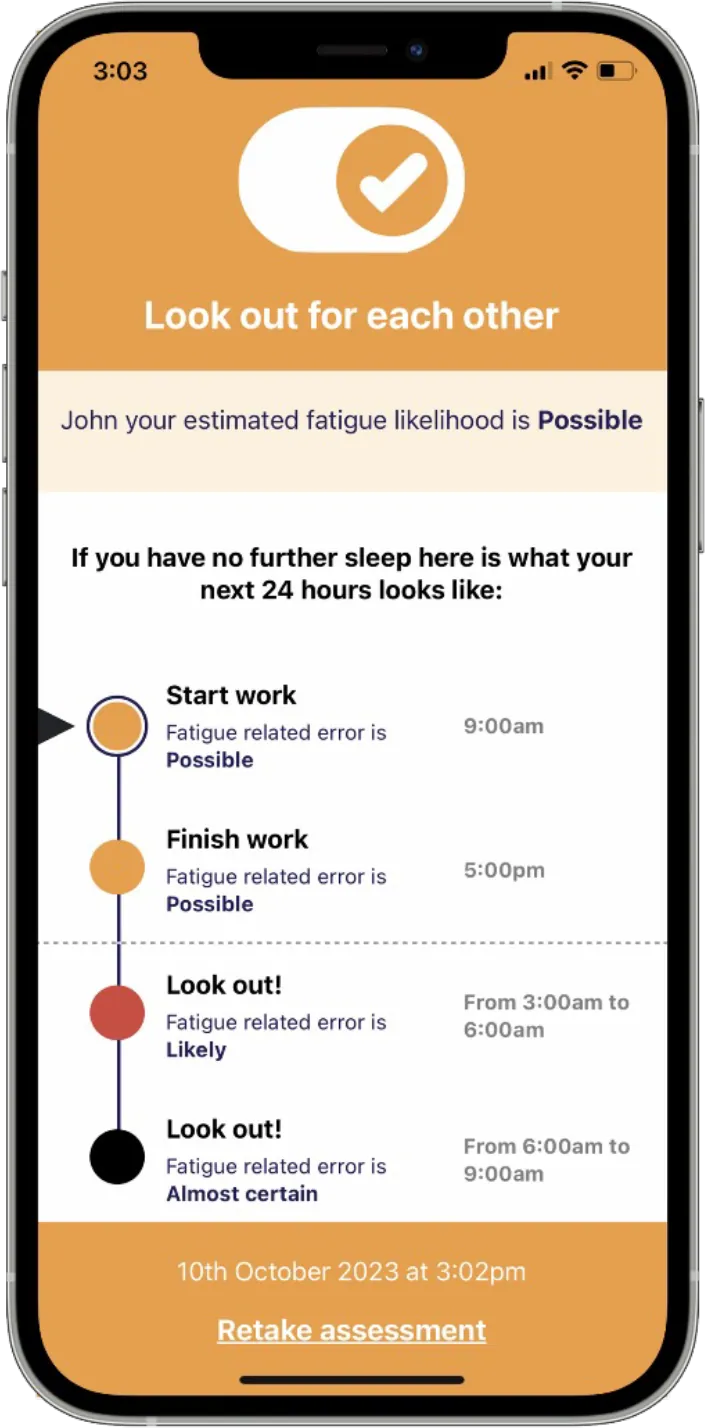
A Fatiguefit4Duty result on a phone: John’s estimated fatigue likelihood is Possible, with his fatigue-related error risk over the next 24 hours if he gets no further sleep.

The problem

A compliant roster can still put a fatigued crew to work

The operational predictor of fatigue impairment is prior sleep and wake history, not hours on duty. Hours-of-service rules cannot see the night someone spent with a sick child or the sleep disorder nobody has diagnosed.

Fatiguefit4Duty asks, at the start of duty, the questions that do predict impairment, and puts the answer in front of the person who has to make the call.

How do you know your employees are fit to start work? Watch the video · 1:45
Presented by Professor Drew Dawson

The size of the problem

National figures for the United States, from published research. They are modeled, not measured in your workforce.

  • 33.2%get less than 7 hours' sleep2023
  • 13%of workplace injuries are linked to sleep problems2014
  • US$1,970lost productivity per affected employee each year
Sources
  1. Pankowska MM, Lu H, Wheaton AG, Liu Y, Lee B, Greenlund KJ, Carlson SA. Prevalence and Geographic Patterns of Self-Reported Short Sleep Duration Among US Adults, 2020. Preventing Chronic Disease (CDC), 2023;20:220400.
  2. Uehli K, Mehta AJ, Miedinger D, et al. Sleep Problems and Work Injuries: A Systematic Review and Meta-Analysis. Sleep Medicine Reviews, 2014;18(1):61-73.
  3. Rosekind MR, et al. The Cost of Poor Sleep: Workplace Productivity Loss and Associated Costs. Journal of Occupational and Environmental Medicine, 2010;52(1):91-98. N=4,188 US employees; Work Limitations Questionnaire. Weighted incremental cost per affected employee, net of the good-sleeper baseline, in 2007 USD adjusted to July 2026 by CPI-U (207.342 to 333.918).

Stories

When no one checked who was fit for duty

Published cases from the United States where people started or kept working without enough sleep, and fatigue was never measured or treated as a hazard.

  • Mar 2005 · Texas, United States

    Refinery explosion: operators on 29+ straight 12-hour shifts

    • Safety
    • Legal
    • Financial

    Explosions during restart of the isomerization unit at an oil refinery in Texas killed 15 workers and injured 180. The US Chemical Safety Board found the operators were likely fatigued from working 12-hour shifts for 29 or more consecutive days, and that the oil company had no fatigue prevention policy. It treated fatigue as a contributing factor within wider organizational failures.

    Case US-oilgas-01Report an issue
See all fatigue news

How it works

A fitness-for-duty check at the start of the shift

Each person records the sleep they actually got in the last 24 and 48 hours and how alert they feel now. That covers two levels of defense at once: whether the sleep was obtained, and whether fatigue is showing at work. Elevated risk goes to the leader with the controls you have set for the role and task, before the work starts.

  1. Step 01

    Prompt

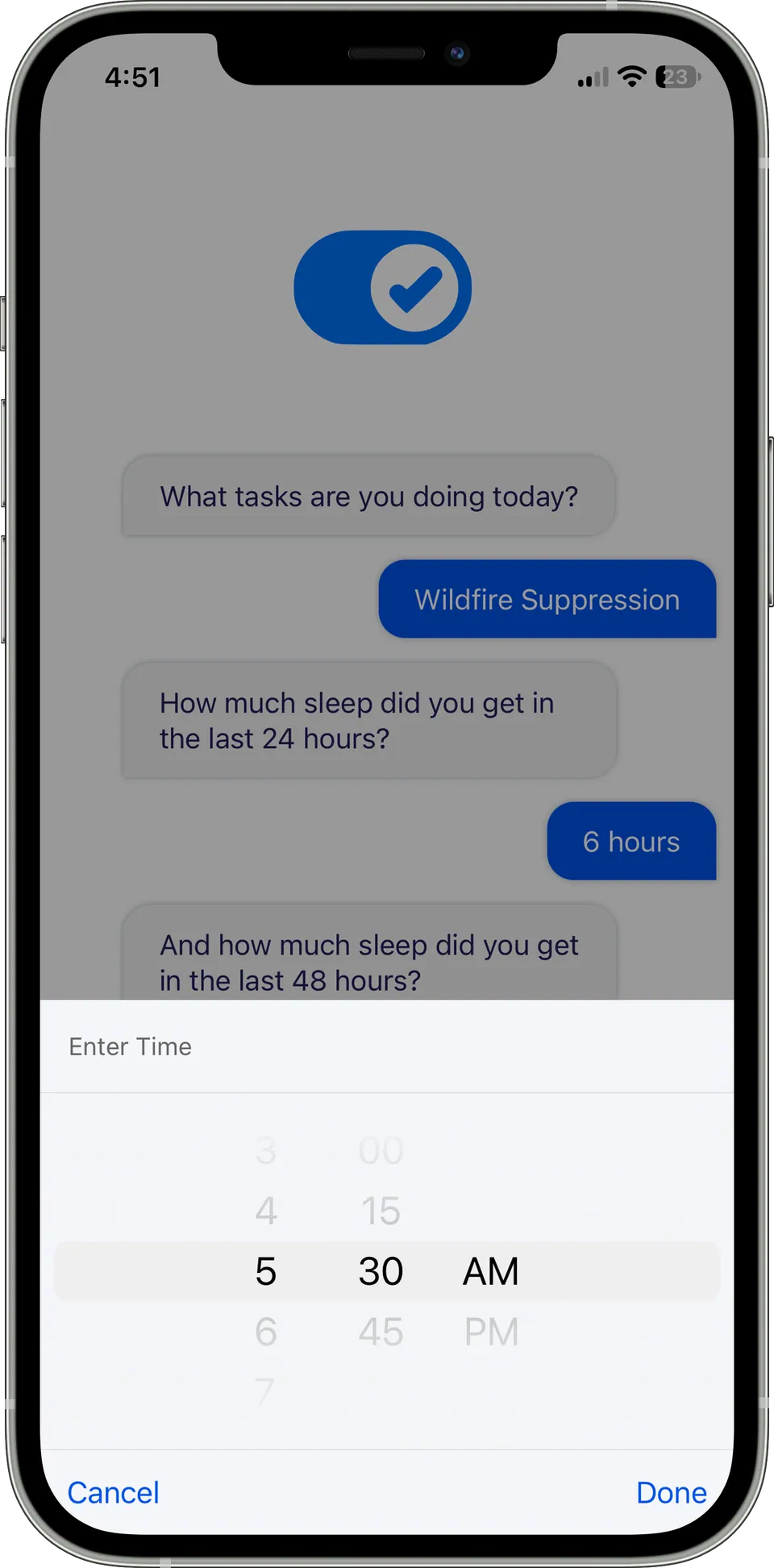
    A supervisor prompts the assessment at the start of duty. Around thirty seconds, on a phone, and it works offline.

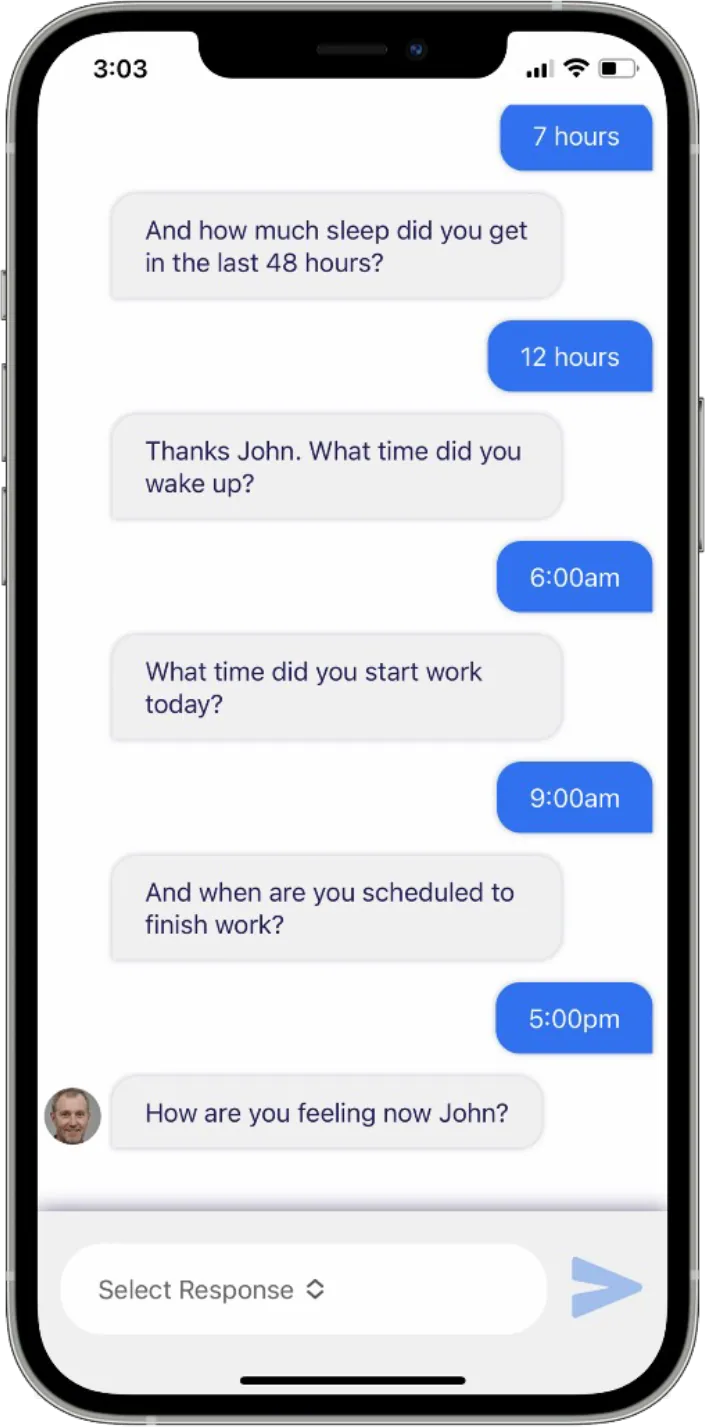
    A Fatiguefit4Duty assessment starting on a phone: which tasks are you doing today (wildfire suppression), how much sleep in the last 24 and 48 hours, and when did you wake.
  2. Step 02

    Sleep and alertness

    Prior sleep in the last 24 and 48 hours, time awake, and current sleepiness on the Karolinska Sleepiness Scale.

    Fatiguefit4Duty asking about sleep in the last 24 and 48 hours, wake time and start time, with answers chosen from a list.
  3. Step 03

    Risk indication

    Likelihood from prior sleep and wake history, combined with a consequence rating assigned by role, in an ISO 31000 calculation.

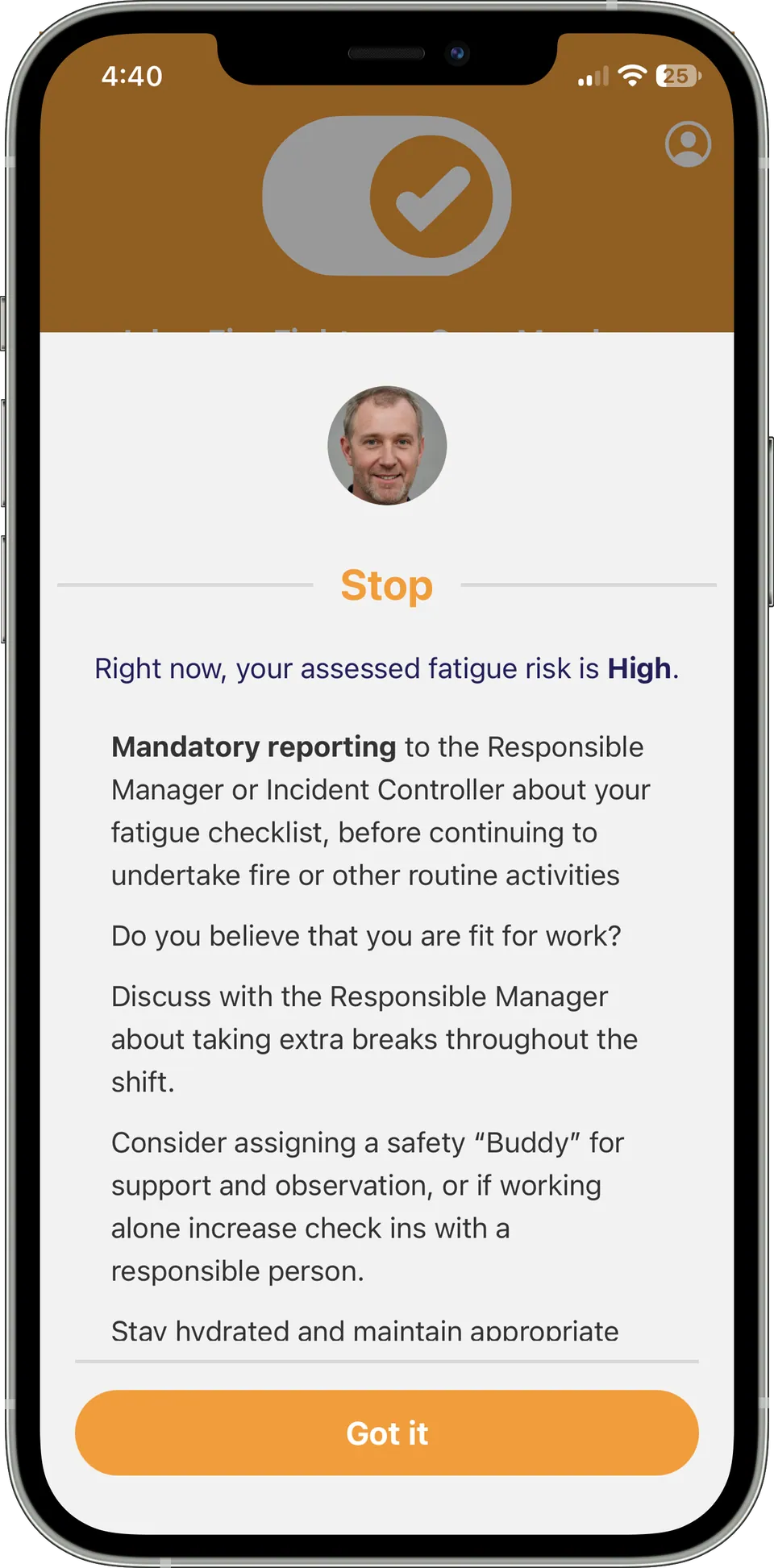
    A Fatiguefit4Duty result on a phone: Stop, the assessed fatigue risk right now is High, with mandatory reporting to the responsible manager and controls such as extra breaks and a safety buddy.
  4. Step 04

    Shown to the leader

    The result goes to the team leader or safety manager, with the role- and task-based controls you have configured. The decision stays with you.

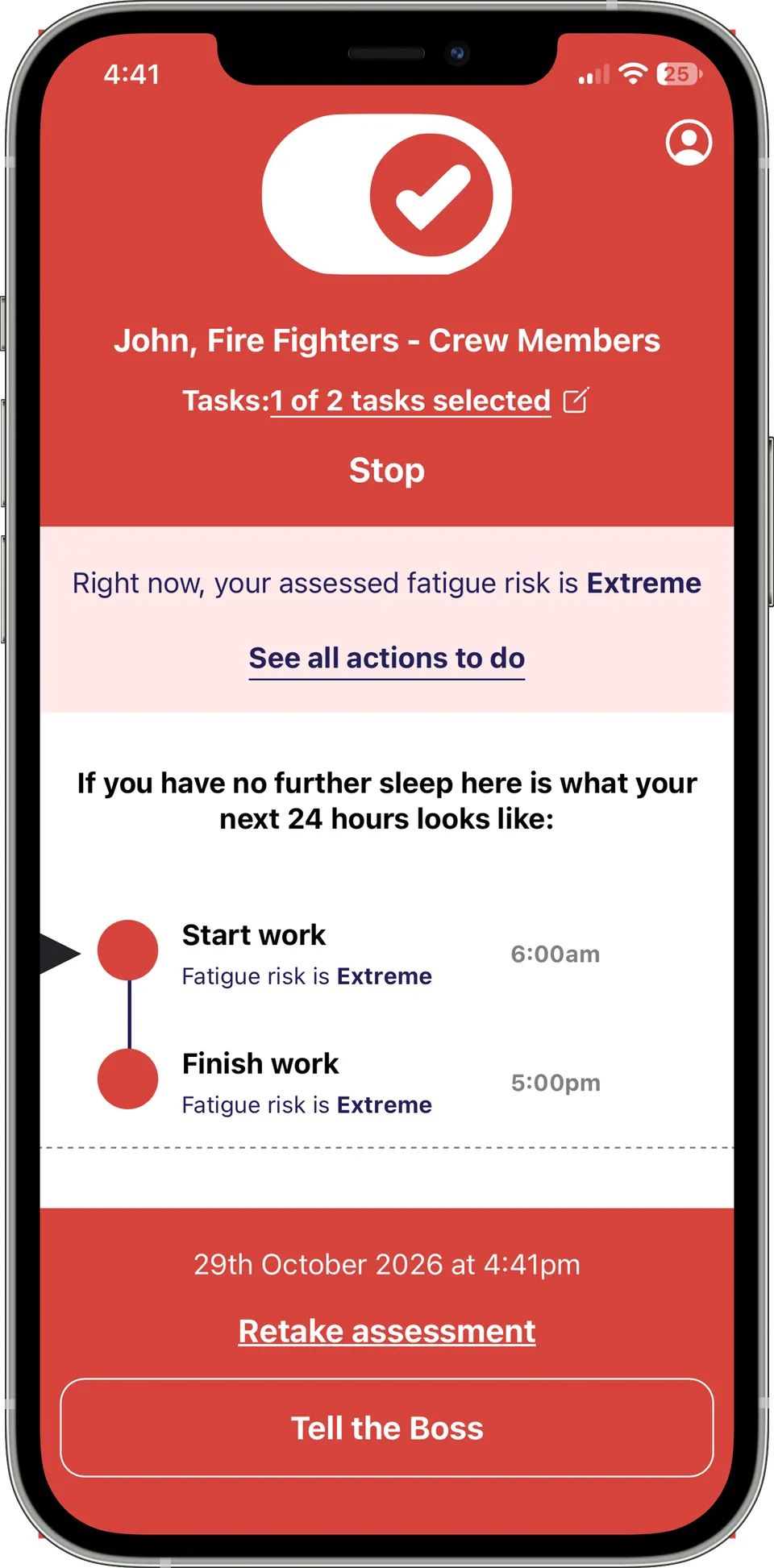
    A Fatiguefit4Duty result for a fire-fighting crew member: Stop, the assessed fatigue risk right now is Extreme for the next 24 hours, with the actions to take and a Tell the Boss button.

Most workplaces check whether someone is fit for duty without asking how they slept. A roster can’t see a night with a sick child. Thirty seconds at the start of a shift asks, and puts the answer in front of whoever makes the call.

Daniel PlattCo-founder and CEO

Rollout

How we roll it out

  1. Scope

    Agree the roles in scope and a consequence rating for each.

  2. Configure

    Set the controls for each band and who sees each result.

  3. Train and launch

    Supervisors learn to prompt the assessment and act on the result.

  4. Review

    Aggregate reporting by cohort, location and craft, and tune the controls.

What the client sees

Who sees what

Unlike Sleepfit, this result is not private to the worker: it exists to inform a control decision at the start of duty. Band thresholds and their derivation are published to you.

Priced on prevalence, not headcount. How pricing works.

  • The worker

    Answers about their own sleep

    • The thirty-second assessment, on a phone
  • Team leader or safety manager

    The risk indication, by design

    • Each person’s risk indication at the start of duty
    • The role- and task-based controls you configured
  • The employer

    Patterns across the operation

    • Aggregate reporting by cohort, location and craft
    • Band thresholds and how they were derived

Evidence

What we can show

The likelihood limb rests on prior sleep and wake history, the best-evidenced individual fitness-for-duty input available.

The approach follows the published fatigue risk management literature (Dawson & McCulloch, 2005; Dawson & Sprajcer, 2020). The scoring, bands and thresholds are our own, and no validation study is claimed for them.

What it does not establish

It produces a risk indication at role and task level. It does not make a fitness-for-duty determination, does not diagnose, and does not clear or stand down an employee. That decision stays with you, under your own procedure. It is a defensible method, not a validated instrument, and we do not describe it as one.

FAQs

Questions we’re often asked

Does it decide whether someone can work?

No. It gives a risk indication at role and task level, shown to the team leader or safety manager with the controls you have configured. It does not clear or stand down an employee: that decision stays with you, under your own procedure.

How long does it take, and does it need a signal?

Around thirty seconds on a phone at the start of duty, and it works offline.

What does it ask?

The sleep a person got in the last 24 and 48 hours, how long they have been awake, and how sleepy they feel now on the Karolinska Sleepiness Scale, combined with a consequence rating set for each role.

Is it a validated instrument?

No, and we don’t describe it as one. It follows the published fatigue risk management literature, but the scoring, bands and thresholds are our own and no validation study is claimed for them. The thresholds and how they were derived are published to you.

Who sees an individual’s result?

The team leader or safety manager, by design: the result exists to inform a control decision at the start of duty, so it is not private to the worker. You also get aggregate reporting by cohort, location and craft.

Can someone delete their account?

Yes. Anyone can ask for their account and its personal data to be deleted; the steps are on its delete-account page. Deletion can’t be undone.

Pathways

Where to go next

Fatiguefit4Duty and regulation across 33 industries in the United States

1 / 33

The regulation names this step

2 / 33

Supports a named obligation

25 / 33

Supports your general duty of care

5 / 33

A voluntary benefit, not a regulatory requirement

See how Fatiguefit4Duty fits the regulation in your industry, and what else we would start with there.

All 33 industries

Other solutions interconnected with Fatiguefit4Duty

Interested in Fatiguefit4Duty for your organization?

Tell us a little about your organization and which solutions you’re looking at, and our team will be in touch.

A Fatiguefit4Duty result on a phone: John’s estimated fatigue likelihood is Possible, with his fatigue-related error risk over the next 24 hours if he gets no further sleep.