
Evaluación del riesgo de fatiga en tiempo real

Fatiguefit4Duty

Evaluación estructurada al inicio del turno, que combina el sueño que la persona realmente obtuvo en las últimas 24 y 48 horas con qué tan alerta se siente ahora.

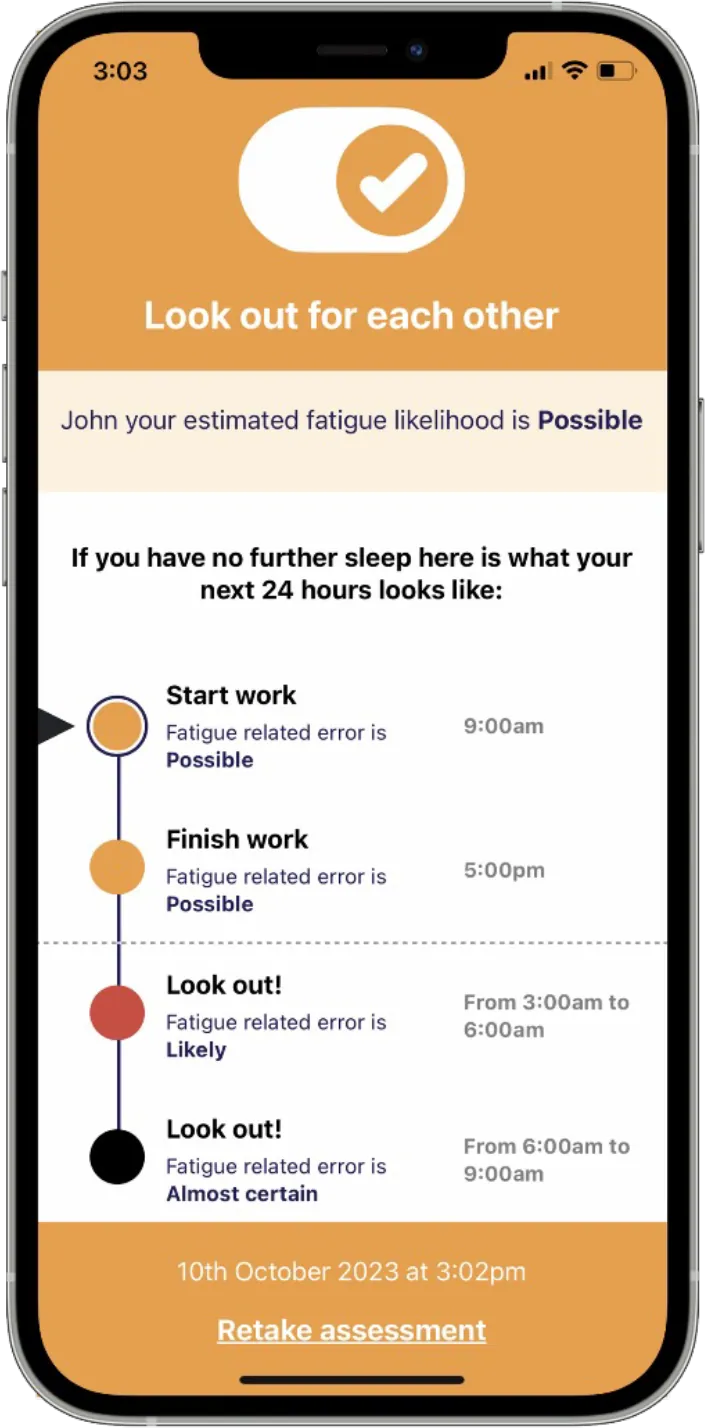
A Fatiguefit4Duty result on a phone: John’s estimated fatigue likelihood is Possible, with his fatigue-related error risk over the next 24 hours if he gets no further sleep.

El problema

Un turno que cumple las normas aún puede poner a trabajar a una cuadrilla fatigada

El predictor operativo del deterioro por fatiga es el historial previo de sueño y vigilia, no las horas de servicio. Las reglas de horas de servicio no pueden ver la noche que alguien pasó con un hijo enfermo ni el trastorno del sueño que nadie ha diagnosticado.

Fatiguefit4Duty hace, al inicio del turno, las preguntas que sí predicen el deterioro, y pone la respuesta frente a la persona que tiene que tomar la decisión.

How do you know your employees are fit to start work? Ver el video · 1:45
Presentado por Professor Drew Dawson

La dimensión del problema

Cifras nacionales de Estados Unidos, de investigaciones publicadas. Son modeladas, no medidas en su fuerza laboral.

  • 33.2%get less than 7 hours' sleep2023
  • 13%of workplace injuries are linked to sleep problems2014
  • US$1,970de productividad perdida por empleado afectado al año
Fuentes
  1. Pankowska MM, Lu H, Wheaton AG, Liu Y, Lee B, Greenlund KJ, Carlson SA. Prevalence and Geographic Patterns of Self-Reported Short Sleep Duration Among US Adults, 2020. Preventing Chronic Disease (CDC), 2023;20:220400.
  2. Uehli K, Mehta AJ, Miedinger D, et al. Sleep Problems and Work Injuries: A Systematic Review and Meta-Analysis. Sleep Medicine Reviews, 2014;18(1):61-73.
  3. Rosekind MR, et al. The Cost of Poor Sleep: Workplace Productivity Loss and Associated Costs. Journal of Occupational and Environmental Medicine, 2010;52(1):91-98. N=4,188 US employees; Work Limitations Questionnaire. Weighted incremental cost per affected employee, net of the good-sleeper baseline, in 2007 USD adjusted to July 2026 by CPI-U (207.342 to 333.918).

Casos

When no one checked who was fit for duty

Published cases from Estados Unidos where people started or kept working without enough sleep, and fatigue was never measured or treated as a hazard.

Los casos se muestran en inglés.

  • mar 2005 · Texas, United States

    Refinery explosion: operators on 29+ straight 12-hour shifts

    • Seguridad
    • Legal
    • Financiero

    Explosions during restart of the isomerization unit at an oil refinery in Texas killed 15 workers and injured 180. The US Chemical Safety Board found the operators were likely fatigued from working 12-hour shifts for 29 or more consecutive days, and that the oil company had no fatigue prevention policy. It treated fatigue as a contributing factor within wider organizational failures.

    Caso US-oilgas-01Informar de un error
Ver todas las noticias sobre fatiga

Cómo funciona

A fitness-for-duty check at the start of the shift

Each person records the sleep they actually got in the last 24 and 48 hours and how alert they feel now. That covers two levels of defence at once: whether the sleep was obtained, and whether fatigue is showing at work. Elevated risk goes to the leader with the controls you have set for the role and task, before the work starts.

  1. Paso 01

    Solicitud

    Un supervisor solicita la evaluación al inicio del turno. Unos treinta segundos, en un teléfono, y funciona sin conexión.

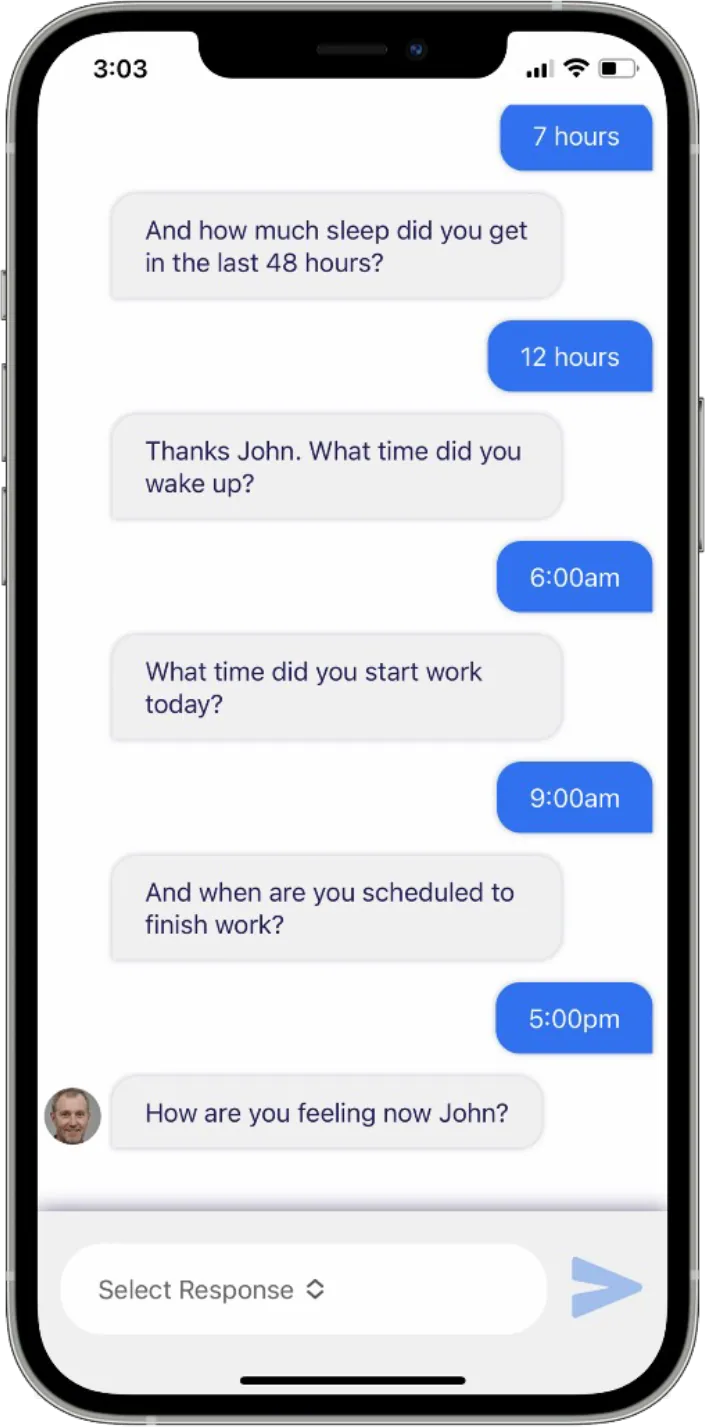
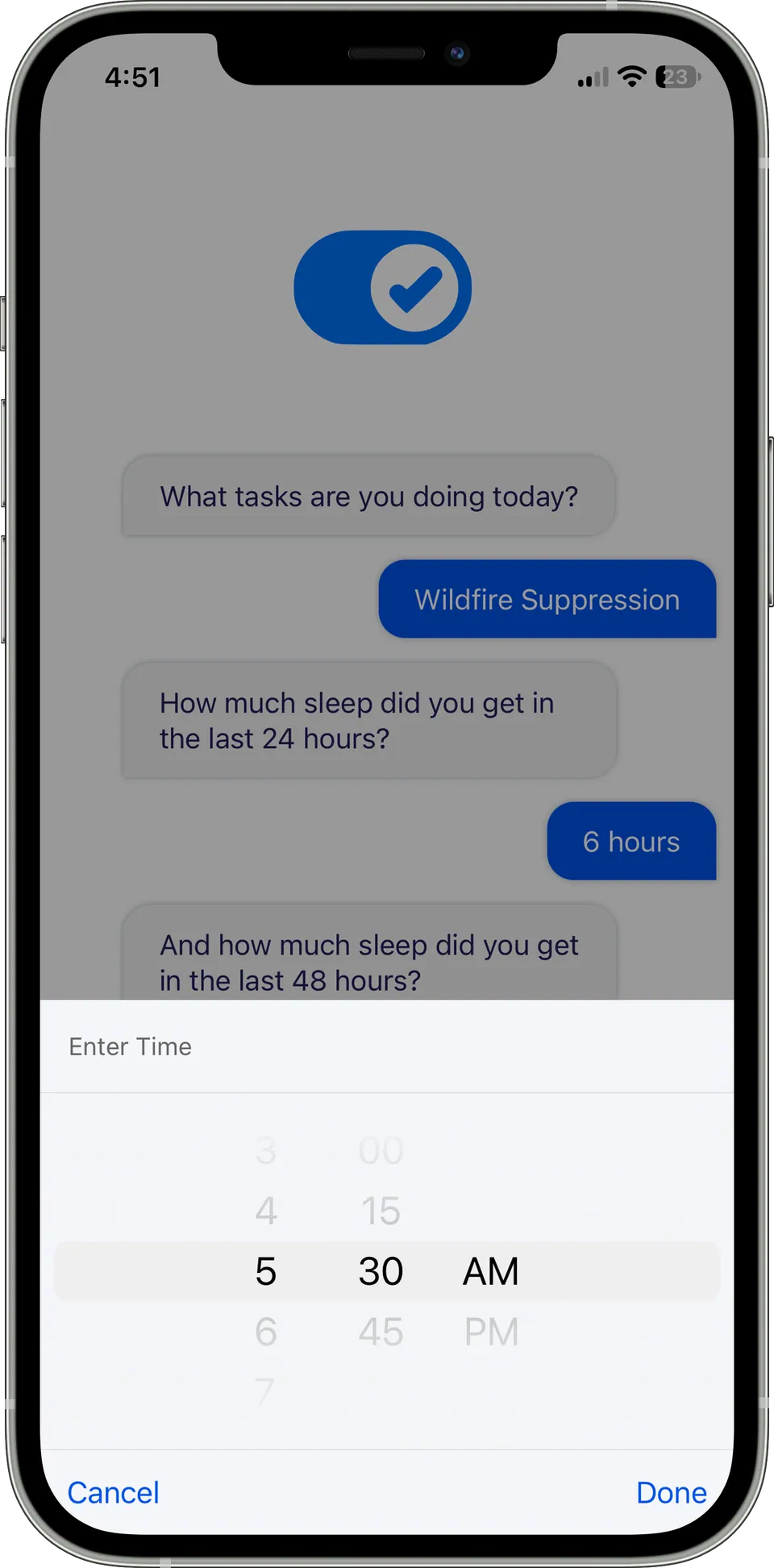
    A Fatiguefit4Duty assessment starting on a phone: which tasks are you doing today (wildfire suppression), how much sleep in the last 24 and 48 hours, and when did you wake.
  2. Paso 02

    Sueño y estado de alerta

    Sueño previo en las últimas 24 y 48 horas, tiempo despierto y somnolencia actual en la Karolinska Sleepiness Scale.

    Fatiguefit4Duty asking about sleep in the last 24 and 48 hours, wake time and start time, with answers chosen from a list.
  3. Paso 03

    Indicación de riesgo

    Probabilidad a partir del historial previo de sueño y vigilia, combinada con una calificación de consecuencias asignada según el puesto, en un cálculo conforme a ISO 31000.

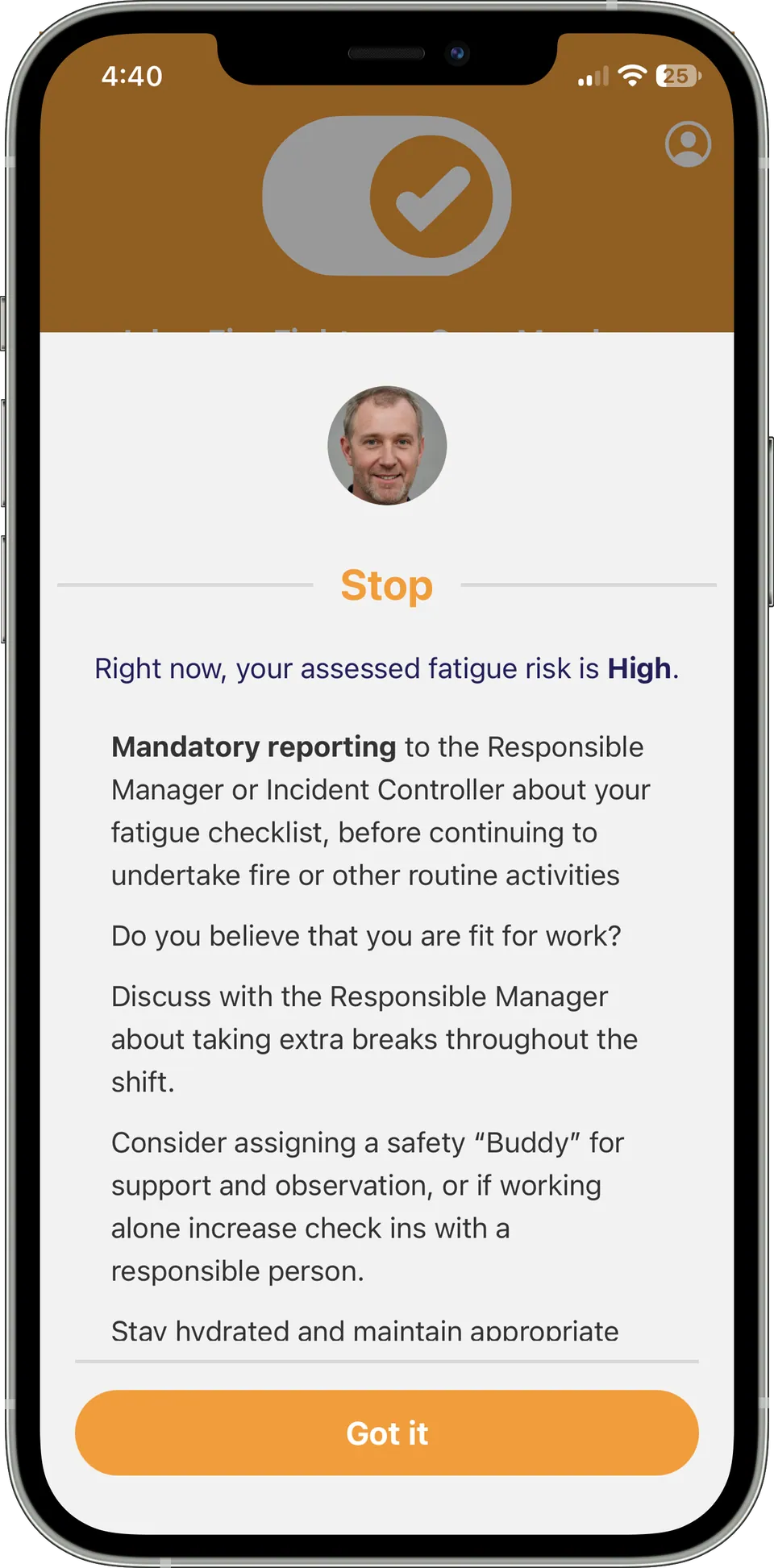
    A Fatiguefit4Duty result on a phone: Stop, the assessed fatigue risk right now is High, with mandatory reporting to the responsible manager and controls such as extra breaks and a safety buddy.
  4. Paso 04

    Se muestra al responsable

    El resultado llega al líder del equipo o al gerente de seguridad, con los controles por puesto y por tarea que usted haya configurado. La decisión sigue siendo suya.

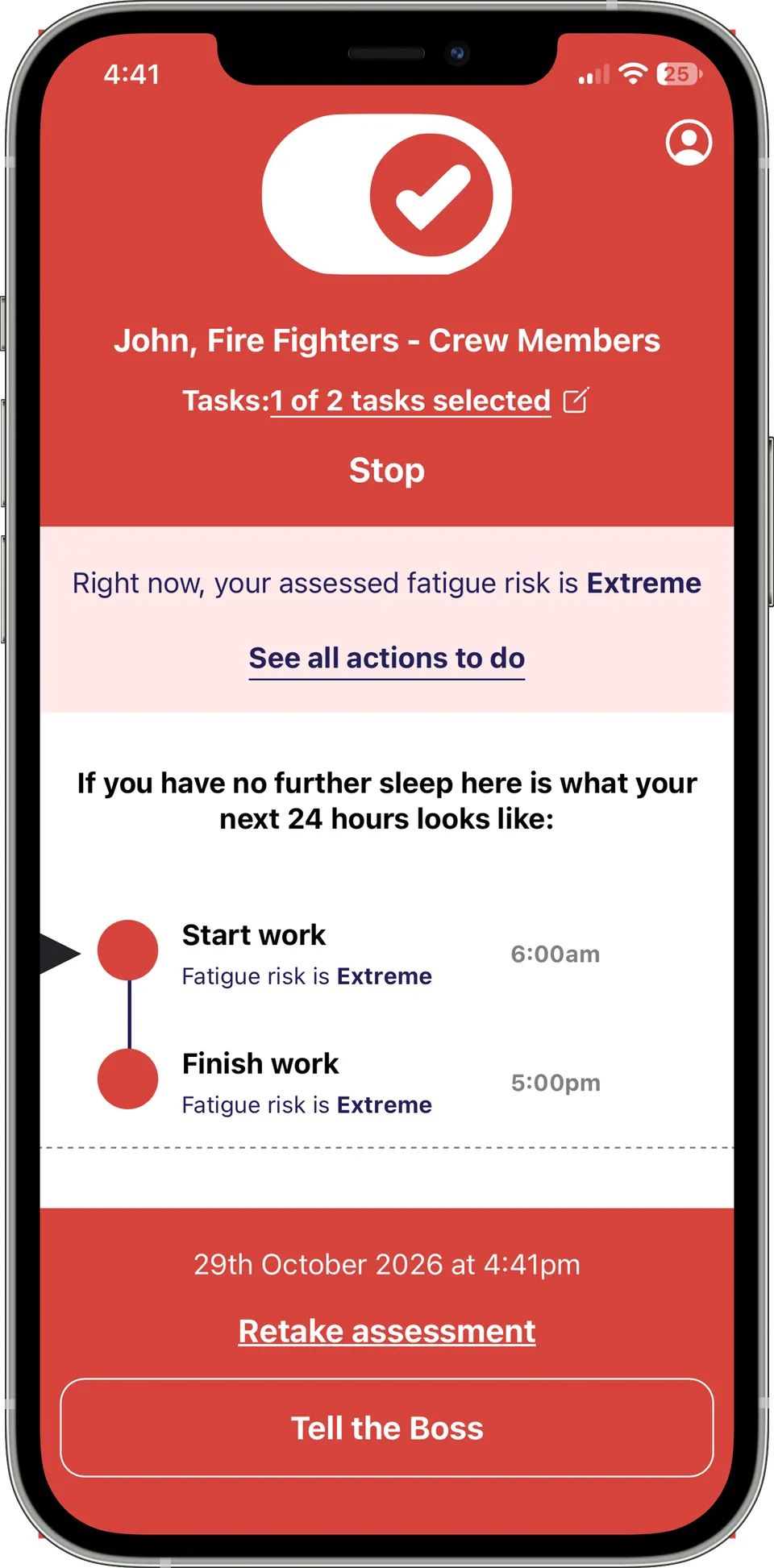
    A Fatiguefit4Duty result for a fire-fighting crew member: Stop, the assessed fatigue risk right now is Extreme for the next 24 hours, with the actions to take and a Tell the Boss button.

Most workplaces check whether someone is fit for duty without asking how they slept. A roster can’t see a night with a sick child. Thirty seconds at the start of a shift asks, and puts the answer in front of whoever makes the call.

Daniel PlattCofundador y director ejecutivo

Implementación

Cómo lo implementamos

  1. Scope

    Agree the roles in scope and a consequence rating for each.

  2. Configure

    Set the controls for each band and who sees each result.

  3. Train and launch

    Supervisors learn to prompt the assessment and act on the result.

  4. Review

    Aggregate reporting by cohort, location and craft, and tune the controls.

Lo que ve el cliente

Quién ve qué

A diferencia de Sleepfit, este resultado no es privado para el trabajador: existe para fundamentar una decisión de control al inicio del turno. Los umbrales de las bandas y su derivación se le entregan publicados.

Con precio según la prevalencia, no según la plantilla. Cómo funcionan los precios.

  • The worker

    Answers about their own sleep

    • The thirty-second assessment, on a phone
  • Team leader or safety manager

    The risk indication, by design

    • Each person’s risk indication at the start of duty
    • The role- and task-based controls you configured
  • The employer

    Patterns across the operation

    • Aggregate reporting by cohort, location and craft
    • Band thresholds and how they were derived

Evidencia

Lo que podemos demostrar

El componente de probabilidad se basa en el historial previo de sueño y vigilia, el dato individual sobre aptitud para el trabajo con mejor respaldo en la evidencia disponible.

El enfoque sigue la literatura publicada sobre gestión del riesgo de fatiga (Dawson & McCulloch, 2005; Dawson & Sprajcer, 2020). La puntuación, las bandas y los umbrales son propios, y no se afirma ningún estudio de validación para ellos.

Lo que no establece

Produce una indicación de riesgo a nivel de puesto y tarea. No determina la aptitud para el trabajo, no diagnostica y no habilita ni retira a un empleado de sus funciones. Esa decisión sigue siendo suya, conforme a su propio procedimiento. Es un método defendible, no un instrumento validado, y no lo describimos como tal.

Preguntas frecuentes

Las preguntas que más nos hacen

Does it decide whether someone can work?

No. It gives a risk indication at role and task level, shown to the team leader or safety manager with the controls you have configured. It does not clear or stand down an employee: that decision stays with you, under your own procedure.

How long does it take, and does it need a signal?

Around thirty seconds on a phone at the start of duty, and it works offline.

What does it ask?

The sleep a person got in the last 24 and 48 hours, how long they have been awake, and how sleepy they feel now on the Karolinska Sleepiness Scale, combined with a consequence rating set for each role.

Is it a validated instrument?

No, and we don’t describe it as one. It follows the published fatigue risk management literature, but the scoring, bands and thresholds are our own and no validation study is claimed for them. The thresholds and how they were derived are published to you.

Who sees an individual’s result?

The team leader or safety manager, by design: the result exists to inform a control decision at the start of duty, so it is not private to the worker. You also get aggregate reporting by cohort, location and craft.

Can someone delete their account?

Yes. Anyone can ask for their account and its personal data to be deleted; the steps are on its delete-account page. Deletion can’t be undone.

Vías de acción

Adónde ir ahora

Fatiguefit4Duty y la regulación en 33 industrias de Estados Unidos

1 / 33

La regulación nombra este paso

2 / 33

Apoya una obligación específica

25 / 33

Apoya su deber general de cuidado

5 / 33

Un beneficio voluntario, no un requisito normativo

Vea cómo encaja Fatiguefit4Duty en la regulación de su industria y con qué más empezaríamos allí.

Las 33 industrias

Otras soluciones conectadas con Fatiguefit4Duty

¿Le interesa Fatiguefit4Duty para su organización?

Cuéntenos un poco sobre su organización y qué soluciones está considerando, y nuestro equipo se pondrá en contacto.

A Fatiguefit4Duty result on a phone: John’s estimated fatigue likelihood is Possible, with his fatigue-related error risk over the next 24 hours if he gets no further sleep.