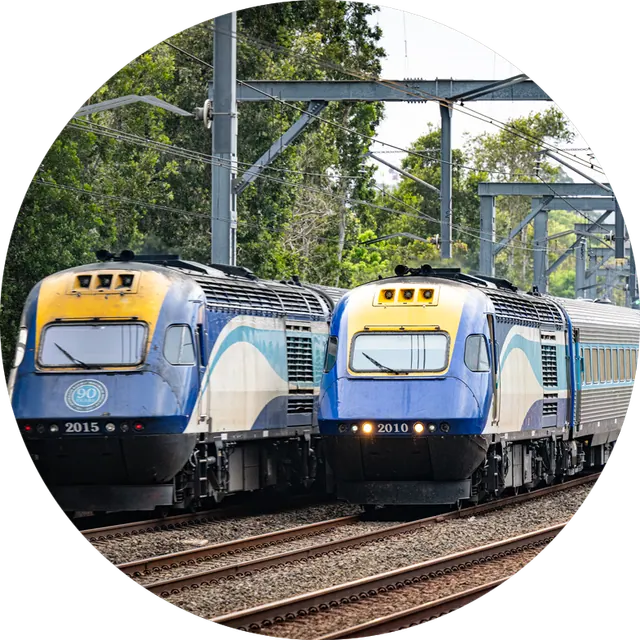
Rail · New Zealand

A 24/7 railway runs on well-rested people.

Drivers, signallers and controllers work 24/7 rotating rosters with early starts and nights. A fatigue lapse can mean a signal passed at danger, a collision or a derailment.

Regulation changed 9 Jul 2026Change coming 1 Apr 2027

Rail workforce

Who this page covers

  • Light rail and trams
  • Mining company railways (also see Mining & Resources)
  • Passenger rail - metro, suburban and intercity
  • Rail freight - heavy haul and intermodal
  • Rail infrastructure managers and track maintenance
  • Rolling stock maintenance depots
  • Short line and regional railroads

Reg Watch

What’s changed, and what’s coming

Regulatory change that affects how you manage fatigue in rail: what has changed in the last 12 months, and what is on the way.

Recent changeFrom 9 July 2026

Applies across industries in New Zealand

The Health and Safety at Work Amendment Act 2026 became law on 9 July 2026. Your duties do not change until most of it commences on 1 April 2027, so use the lead time to evidence fatigue as a serious-harm risk.

Read the change

Upcoming changeExpected from 1 April 2027Within 12 months

From 1 April 2027 HSWA centres on 'critical risks'. Fatigue is not on the Schedule 1A list, so it counts only where it is likely to cause death or notifiable harm. Firms under 20 workers manage critical risks only; following an approved code is deemed compliance; officer duties become governance-level.

Regulatory changes checked as at 1 October 2026.

Regulation

Who regulates it, and what they expect

New Zealand rail has its own dedicated safety regulator and licensing system, which most industries lack - genuinely different. But the key finding: this system has no fixed rules on driver hours, shift lengths, or rest periods, unlike Australia's rail industry. The regulator requires each operator to have an approved safety plan covering risks generally, with fatigue expected to be part of it, but how is left to the company. KiwiRail runs its own fatigue program with Massey University sleep researchers, under the general safety duty every employer has.

Regulated by
  • NZ Transport Agency Waka KotahiNZTA

Logos identify the regulator and don’t imply endorsement.

Who regulates it

Rail in New Zealand has one extra regulator beyond the bodies every employer deals with: NZ Transport Agency Waka Kotahi, the rail safety regulator, which licenses operators, reviews safety systems, and can suspend a licence. There's also an independent investigator, the Transport Accident Investigation Commission, examining rail accidents for root causes. WorkSafe still applies to rail workers as to any industry.

Your obligations

Rail operators in New Zealand must hold a licence from the national rail safety regulator and have an approved safety plan covering how they manage risks - including, in practice, fatigue, even though it isn't spelled out in the law. They must also report and cooperate with investigations into any accidents or incidents. Beyond that, rail companies carry exactly the same fatigue, disability accommodation, rest-break and injury-compensation obligations as every other New Zealand employer - there's no special exemption or reduced standard for rail.

Consequences

Breach your licence or safety case conditions and the rail safety regulator can impose conditions, restrict or suspend your operations, or revoke the licence - a consequence with no equivalent in most industries. Separately, a fatigue-related incident is prosecuted by WorkSafe under the same general safety law and the same three-tier penalty scale that binds every employer, with reparation on top of any fine. The Transport Accident Investigation Commission can also open an independent inquiry and publish findings; its reports are no-fault and cannot prove liability, but a finding that roster design or fatigue contributed draws regulatory attention and shapes how culpability is assessed if a prosecution follows.

Penalties

There is no rail-specific fatigue fine schedule - a fatigue-caused incident is prosecuted on the same scale as any other safety failure: up to $500,000, $1.5 million or $3 million for a company by tier, and $100,000 to $600,000 for an officer personally, with reparation on top. In May 2026 KiwiRail was fined $290,000 and ordered to pay about $42,000 reparation after two workers were shocked by a live 25,000-volt line. Licence suspension carries no dollar figure.

Sources: Railways Act 2005; NZ Transport Agency Waka Kotahi rail safety guidance; Transport Accident Investigation Commission (TAIC); WorkSafe New Zealand court summaries and Health and Safety at Work Act 2015 penalty guidance; KiwiRail public safety statements.

Fatigue-critical roles

Where fatigue matters most in rail

The roles where a fatigued worker is most likely to cause serious harm, the tasks that carry the risk, and why fatigue builds up in them.

RoleRiskHigh-risk tasksWhy fatigue builds
Locomotive engineer (KiwiRail); train driver (Auckland and Wellington metro)
Rules
Regulatory designation
Rail personnel under the licence holder's approved safety case (Railways Act 2005 s 30(1)(g), (k))
Hours and rest
No statutory hours cap: safety-case fatigue and fitness-for-duty policies (s 30(1)(k)); ERA 2000 rest and meal breaks
Critical riskDriving a loaded train on a single-driver roster through the 02:00-06:00 window; signal sighting and SPAD avoidance; station stopping and speed restrictionsRotating 24/7 rosters, early sign-ons before 04:00, back-to-back night turns, away-from-home rest on long runs
Train controller (KiwiRail National Train Control Centre)
Rules
Regulatory designation
Rail personnel under the licence holder's approved safety case (Railways Act 2005 s 30(1)(g), (k))
Hours and rest
No statutory hours cap: safety-case fatigue and fitness-for-duty policies (s 30(1)(k)); ERA 2000 rest and meal breaks
Critical riskSetting routes and controlling train movements overnight; issuing manual authorities and track occupancy permits in degraded working; protecting worksites12 h night shifts in 24/7 signal boxes and control centres; low-traffic vigilance overnight then morning peak
Rail protection officer; person in charge (PIC)
Rules
Regulatory designation
Rail personnel under the licence holder's approved safety case (Railways Act 2005 s 30(1)(g), (k))
Hours and rest
No statutory hours cap: safety-case fatigue and fitness-for-duty policies (s 30(1)(k)); ERA 2000 rest and meal breaks
Critical riskEstablishing track protection or lookout working for track gangs; calling workers clear of approaching trains; handing back possessions on timeNight and weekend possessions, back-to-back shutdown shifts, travel to remote worksites, drive home after nights
Track maintainer; on-track machine operator
Rules
Regulatory designation
Rail personnel under the licence holder's approved safety case (Railways Act 2005 s 30(1)(g), (k))
Hours and rest
No statutory hours cap: safety-case fatigue and fitness-for-duty policies (s 30(1)(k)); ERA 2000 rest and meal breaks
High riskOperating tampers, ballast regulators and road-rail vehicles in night possessions; working near live lines; machine travel to and from siteNight possessions, long shutdown shifts, remote work and travel, drive home after nights
Train manager (Auckland and Wellington metro)
Rules
Regulatory designation
Rail personnel under the licence holder's approved safety case (Railways Act 2005 s 30(1)(g), (k))
Hours and rest
No statutory hours cap: safety-case fatigue and fitness-for-duty policies (s 30(1)(k)); ERA 2000 rest and meal breaks
High riskTrain dispatch and door operation at platforms; protecting the train after a failure or collision; coupling and brake testsRotating shifts, early and late turns, long days with layovers
Rail operator (shunting)
Rules
Regulatory designation
Rail personnel under the licence holder's approved safety case (Railways Act 2005 s 30(1)(g), (k))
Hours and rest
No statutory hours cap: safety-case fatigue and fitness-for-duty policies (s 30(1)(k)); ERA 2000 rest and meal breaks
High riskCoupling and uncoupling, riding and controlling moves in yards at night; remote-control locomotive operation; hand points24/7 yard shifts, night work, short-notice overtime, outdoor work in all weather

Stories

When fatigue made the record

Published findings and prosecutions from regulators, courts and investigators in New Zealand.

  • Sept 2023 · New Zealand

    Container terminal operator with severe sleep apnoea medically retired without specialist review; interim reinstatement ordered

    • Legal

    A container terminal operator employed by the national rail operator in a category 2 safety-critical role was found to have severe obstructive sleep apnoea in a 2023 sleep study, and in 2025 was assessed unfit because of poor diabetes control and untreated sleep apnoea. The employer medically retired him in 2026 without the sleep physician opinion and specialist diabetes review its own chief medical officer had said were needed. The Employment Relations Authority found a seriously arguable case of unjustified dismissal and ordered interim reinstatement, noting he could return to active duty only once cleared under the rail health standards.

    Case NZ-rail-18Report an issue

Story 1 of 18

See all rail news

How the suite fits

How each product connects to your obligations

Grades describe how strongly a product connects to an obligation. None discharges an obligation, and none carries a compliance warranty.

Sleepfit

Supports a named obligation

Section 30(1)(k) of the Railways Act 2005 requires your safety case to set out policies ensuring rail personnel are fit for duty and not impaired by fatigue or illness. Sleepfit supports that policy. It screens; diagnosis stays with your clinicians.

About Sleepfit

Fatiguefit4Duty

Supports a named obligation

Your safety case must set out policies ensuring rail personnel are fit for duty and not impaired by fatigue (s 30(1)(k), Railways Act 2005), and s 11 requires you to comply with it. A fitness-for-duty check, not a fitness-for-duty decision - the duty call stays with you.

About Fatiguefit4Duty

Awareness eLearning

Supports a named obligation

Section 30(1)(k) of the Railways Act 2005 requires your safety case to set out policies keeping rail personnel free of fatigue impairment; it does not name training. Awareness eLearning supports that policy with fatigue and sleep content.

About Awareness eLearning

Was It Fatigue?

Supports your general duty of care

Section 30(1)(h) of the Railways Act 2005 requires your safety case to monitor and record accidents and incidents; no New Zealand rail rule requires a fatigue assessment. Was It Fatigue? supports that review. A structured judgement aid, not a determination of cause.

About Was It Fatigue?

SleepWellBaby

No New Zealand rail rule reaches sleep in new-parent households; s 30(1)(k) of the Railways Act 2005 concerns rail personnel on duty. SleepWellBaby is offered to parents of infants in your workforce as a benefit.

About SleepWellBaby

Recommended bundle

Where we’d start in rail

Every bundle is priced on prevalence: your whole cohort gets access, and you pay for the share predicted to need each product. How pricing works.

Why this pairing in New Zealand

Railways Act 2005 s 30(1)(k) requires your safety case to keep rail personnel fit for duty and free of fatigue impairment. Sleepfit screens, Fatiguefit4Duty adds a pre-duty check and Awareness eLearning trains, all supporting that policy. Fatigue Lifecycle adds incident review under s 30(1)(h).

See what sleep and fatigue mean for your rail workforce.

Tell us roughly how many people you employ. Your snapshot models how many are likely sleeping poorly and what it costs, from published research for rail. Then choose who you’d cover, and we’ll take you to the right next step.

A sample workforce snapshot on a tablet: modelled sleep problems and the cost of poor sleep for 1,400 people in transport and logistics.