
Education · United States

Lessons land better when teachers have slept.

Daytime teaching plus long hours of preparation and marking outside class. Fatigue affects wellbeing, retention and teaching quality more than physical safety; school bus drivers are the exception.

Education workforce

Who this page covers

  • Boarding schools - residential staff
  • Primary and secondary schools
  • TAFE and vocational training
  • Universities

Regulation

Who regulates it, and what they expect

No federal or state law sets fatigue or hours rules for teachers and school administrators, and safety coverage is thinner than most districts assume: federal OSHA does not reach public employers at all, so a district is covered only in the 27 states with an approved plan that includes them. The one safety-critical fatigue population is school transport, and federal law steps back from it. Home-to-school routes are exempt from federal hours of service, and so is everything a district drives itself. State rules fill the gap, or do not.

Regulated by
  • Occupational Safety and Health AdministrationOSHA

Logos identify the regulator and don’t imply endorsement.

Who regulates it

Public school staff sit outside federal OSHA: the OSH Act excludes state and local government employers, and public employees are covered only in the 29 states and territories with an approved plan. Private schools are covered directly. The EEOC administers the ADA and the Department of Labor the FMLA. School bus drivers answer to the Federal Motor Carrier Safety Administration and to state pupil-transportation agencies.

Your obligations

There is no hours cap and no fatigue duty for teaching and administrative staff. Where federal OSHA reaches you - private schools everywhere, public districts in 27 states - you owe the general duty to keep the workplace free of recognized hazards. The ADA requires accommodation and the FMLA protected leave once a sleep disorder is diagnosed, whoever regulates you. Your drivers need a commercial license with a school bus endorsement in every state, and federal law then sets no limit at all on the hours they drive for you.

Consequences

For teaching and administrative staff, exposure runs through failure-to-accommodate and leave-interference claims and workers compensation for a fatigue-linked injury. An OSHA citation is only in play where OSHA has jurisdiction over you. In 23 states and the District of Columbia it has none, and the duty comes instead from state law that varies widely. School transport is different: where a state sets driving-hours rules, a breach draws state enforcement against the district and the driver, and a contractor running interstate charter work faces federal enforcement as well.

Penalties

OSHA maximums are at 2025 levels and remain in force for 2026: $16,550 per serious or other-than-serious violation, $165,514 per willful or repeat violation, reaching private schools and public districts in approved plan states. A contractor breaching federal hours of service on interstate charter work faces $19,246 per violation, or $4,812 where the driver commits it. No penalty attaches to a teacher's hours, because no rule governs them.

Sources: OSH Act general duty clause and its public-employer exclusion; OSHA State Plans; Americans with Disabilities Act; Family and Medical Leave Act; the school bus exemption from the federal motor carrier rules (49 CFR 390.3(f)(1)); state pupil-transportation rules.

Fatigue-critical roles

Where fatigue matters most in education

The roles where a fatigued worker is most likely to cause serious harm, the tasks that carry the risk, and why fatigue builds up in them.

RoleRiskHigh-risk tasksWhy fatigue builds
School bus driver
Rules
Regulatory designation
CDL holder with P and S endorsements (49 CFR Part 383); 'safety-sensitive function' under 49 CFR Part 382 drug and alcohol testing
Hours and rest
Home-to-school runs exempt from the FMCSRs incl. Part 395 hours (49 CFR 390.3(f)(1)); state pupil-transport rules; interstate activity trips under Part 395
High riskDriving 40-70 students on rural and highway routes at dawn, rail level crossings, roadside loading and unloading, managing behavior while drivingSplit shift about 06:00-09:00 and 14:30-17:30, very early starts, second jobs between runs, monotony on rural routes
Dorm parent / residential faculty
Rules
Regulatory designation
None specific - general duty (OSH Act s 5(a)(1); public employers only in State Plan states)
Hours and rest
No federal hours cap for adults; FLSA prices overtime only
High riskOvernight duty for 30-60 boarders: night checks, fire evacuation lead, medical emergencies and medication, safeguarding disclosures; teaching next daySleep-in duty nights with interruptions, back-to-back duty and teaching days, weekend duties; resident on site
Outdoor educator / camp counselor / trip leader
Rules
Regulatory designation
None specific - general duty (OSH Act s 5(a)(1); public employers only in State Plan states); state youth camp licensing varies
Hours and rest
No federal hours cap for adults; FLSA prices overtime only
High riskLeading water, rope and remote-area activities with students, river crossings and weather calls, driving minibuses and towing trailers after multi-day campsMulti-day camps with 24 h responsibility and broken sleep, early starts, long drives home at the end of a program
Custodian / groundskeeper
Rules
Regulatory designation
None specific - general duty (OSH Act s 5(a)(1); public employers only in State Plan states)
Hours and rest
No federal hours cap for adults; FLSA prices overtime only
Elevated riskRide-on mowers on slopes, chainsaws and brushcutters, roof and gutter work at height, lone early unlocking and alarm call-outs06:00 starts before students arrive, lone work, weekend and evening call-outs for alarms and events

Seasonal fatigue risk

When fatigue risk rises in education.

Season alone moves fatigue risk modestly. The sharper effects come from specific weeks and workloads. These are the periods that matter for education in the United States in 2027, including the ones that affect every workforce.

  1. 14 Mar · Measured

    Clocks spring forward

    Fatal crashes up about 6% the following week; mining injuries up 5.7% the next Monday

  2. Jun to Aug · Measured

    Hottest nights, longest days

    Warm nights and long days shorten sleep

  3. 7 Nov · Measured

    Clocks go back

    No net change in crash risk; pedestrian risk rises in dark evenings

Measured: a published study found a change in sleep, injuries or crashes. Documented: a recorded change in workload or exposure, such as overtime or deployments. Dates are for 2027 and move each year. Our reading of published evidence, refreshed every November.

Stories

When fatigue made the record

Published findings and prosecutions from regulators, courts and investigators in the United States.

Mar 2024 · Illinois, United States

School bus driver impaired by medications and fatigue crosses centreline on preschool run; five killed

  • Safety

A school district bus carrying three preschool children crossed the centreline of a highway in Illinois into an oncoming truck combination. The National Transportation Safety Board found the cause was the bus driver's impairment and fatigue from multiple prescription medications; she had woken early with at most six hours' sleep opportunity, the day after the daylight saving time change. The driver, the three children and the truck driver were killed, and the NTSB also found the district had no bus-specific policies or random video review.

Case US-education-01Report an issue

See all education news

How the platform fits

How each product connects to your obligations

Grades describe how strongly a product connects to an obligation. None discharges an obligation, and none carries a compliance warranty.

Sleepfit

Supports your general duty of care

No US rule requires sleep-health checks of teachers or school bus drivers, and most school bus work sits outside the federal motor carrier rules. Sleepfit supports your general duty case. It identifies employees who may benefit from clinical evaluation; diagnosis stays with your clinicians.

About Sleepfit

Fatiguefit4Duty

Supports your general duty of care

Your state may cap how long a bus driver can drive, but nothing anywhere asks whether that driver has slept. Fatiguefit4Duty supports a check before the route for the cohort where it matters.

About Fatiguefit4Duty

Awareness eLearning

Supports your general duty of care

No rule names fatigue training for school staff or for your drivers. eLearning supports one documented standard across a workforce spread over many sites and doing two very different jobs.

About Awareness eLearning

Was It Fatigue?

Supports your general duty of care

After a school transport incident you will be asked what you knew and what you checked. Was It Fatigue? supports a structured record showing that fatigue was examined as a possible contributor.

About Was It Fatigue?

SleepWellBaby

No rule asks for this, and none is in prospect. SleepWellBaby supports teachers and support staff whose sleep is broken by an infant at home, which is a retention question rather than a compliance one.

About SleepWellBaby

Level 4: fatigue-related errors

When fatigue gets through, catch the error.

Level 4 controls trap or detect fatigue-related errors before they cause harm. They are designed into equipment, tasks and procedures by others: we don’t supply or endorse them, and we can point you to providers. These are the types that apply in education.

  • Procedural cross-check

    Two-person checks

    A second qualified person checks critical actions so one tired person's slip is caught.

    What it doesn’t do: Both people may be fatigued on the same roster, so it relies on fatigue-aware rostering behind it.

    Examples: Rail: two-person crews and call-outs. Aviation: two-pilot cross-checks. Utilities: switching verification. Hospitals: double checks.

  • Remove exposure

    Scheduling critical tasks away from the early-morning low

    Moves the highest-risk tasks out of the early-morning hours when errors are most likely.

    What it doesn’t do: It reduces exposure but does not trap the error; it depends on planners knowing when fatigue peaks.

    Examples: Maintenance: critical work scheduled off night shift. Hospitals: elective procedures in daytime.

Most of the evidence for fatigue-detection technology comes from the vendors themselves. Ask for independent evaluation before you rely on it.

In education and related industries, trusted by

See what sleep and fatigue mean for your education workforce.

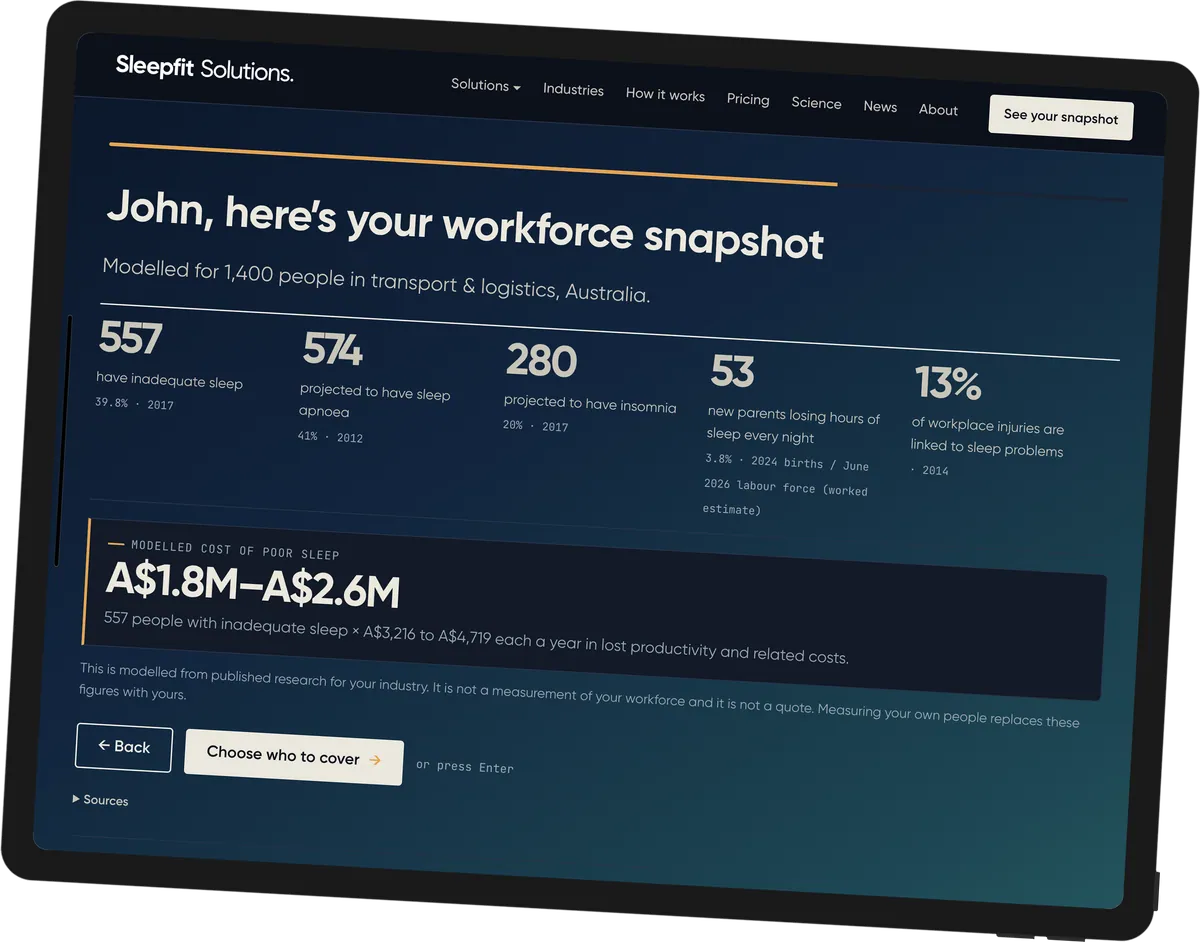
Tell us roughly how many people you employ. Your snapshot models how many are likely sleeping poorly and what it costs, from published research for education. Then tell us what you want to focus on, and we’ll show you how open access would work for you, and what it would cost.

A sample workforce snapshot on a tablet: modeled sleep problems and the cost of poor sleep for 1,400 people in transport and logistics.