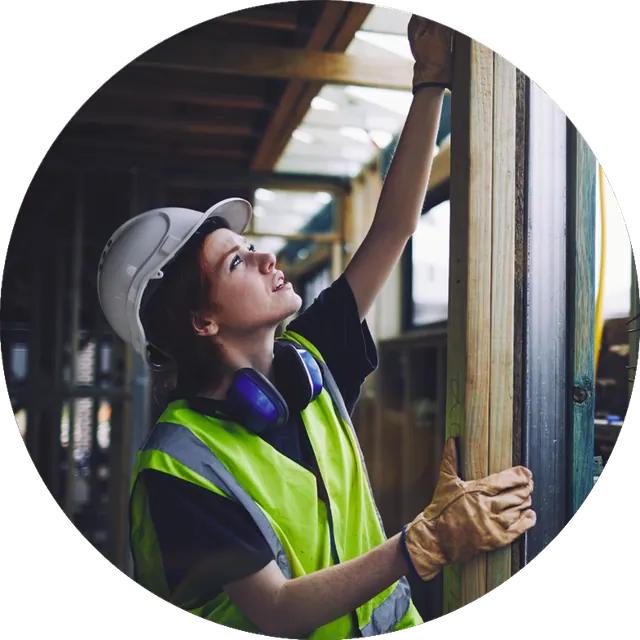
Construction · Australia

Construction is built on early starts, and on the sleep behind them.

Mostly day work with early starts, long hours, overtime and long commutes, plus night works on roads and rail. Fatigue near heavy plant, at heights and on the drive home can be fatal.

Regulation changed 12 Dec 2025

Construction workforce

Who this page covers

  • Civil and infrastructure - roads, bridges, tunnels
  • Commercial building
  • Electrical, plumbing and trade contractors
  • Mine and plant construction (project phase)
  • Residential building
  • Road maintenance and traffic control

Reg Watch

What’s changed, and what’s coming

Regulatory change that affects how you manage fatigue in construction: what has changed in the last 12 months, and what is on the way.

Recent changeFrom 12 December 2025

Specific to construction

NSW's Moving plant on construction sites code (December 2025) lists fatigue in operator fitness for work, and from 1 July 2026 you must follow NSW approved codes, including fatigue, or match their standard.

Read the change

Upcoming changeNo date set yet

Safe Work Australia's Best Practice Review of the model WHS laws was due to go to WHS ministers in August 2026. It is not yet public and no amendments are proposed, so no change date is set.

Regulatory changes checked as at 1 October 2026.

Regulation

Who regulates it, and what they expect

Construction has no dedicated fatigue statute in Australia. Your duty is the general one: eliminate or minimise fatigue risk so far as is reasonably practicable, and your state matters. New South Wales approved a code of practice on managing the risk of fatigue at work on 20 February 2026, and since 1 July 2026 an approved NSW code is enforceable: comply with it or manage the hazard to an equivalent or higher standard. The Northern Territory approved the same code in March 2026; Tasmania publishes it without stating it is approved. NSW's 2025 moving plant code names operator fatigue.

Regulated by
  • Safe Work AustraliaSWA

Logos identify the regulator and don’t imply endorsement.

Who regulates it

Your state or territory work health and safety regulator enforces construction fatigue duties - SafeWork NSW, WorkSafe Queensland, WorkSafe WA, SafeWork SA and their counterparts. Safe Work Australia writes the model codes of practice but does not enforce them, and each jurisdiction decides separately whether to approve them. The Fair Work Ombudsman covers hours and overtime under the on-site construction award.

Your obligations

Manage fatigue as a work health and safety risk: identify what your rosters, shift lengths, travel and night work do to your workers, and control that risk so far as is reasonably practicable. Before high risk construction work starts, prepare a safe work method statement, work to it and keep it. In New South Wales the fatigue code sets the standard you are measured against - no more than three successive night shifts, not less than twelve hours between shifts, at least one full day off a week - and where moving plant is used you must treat operator fatigue and alertness as a factor that raises the risk.

Consequences

A fatigue-related incident on your site is investigated by your state regulator like any other serious incident, and inspectors can issue improvement and prohibition notices that stop work immediately. In New South Wales, from 1 July 2026, failing to follow an approved code is no longer merely admissible evidence - you must comply with it or show you managed the hazard to an equivalent or higher standard. Everywhere else an approved code is admissible against you. Officers carry a separate due-diligence duty, and every jurisdiction now has industrial or workplace manslaughter.

Penalties

Work health and safety penalties are set by each jurisdiction. At 1 July 2026 levels, a category 1 offence runs to $17,728,000 for a body corporate under the Commonwealth Act, $12,321,000 in the ACT, $11,606,824 in NSW, $3,500,000 in WA and $3,000,000 in Queensland, South Australia, Tasmania and the Northern Territory. Commonwealth, NSW and ACT figures index each 1 July. Industrial manslaughter carries 20 to 25 years.

Sources: Your state's Work Health and Safety Act and Regulations; Safe Work Australia's model Code of Practice: Managing the risk of fatigue at work (September 2025) and the approved-code lists of SafeWork NSW, SafeWork SA, WorkSafe Qld and WorkSafe WA; WorkSafe WA's FIFO code of practice.

Fatigue-critical roles

Where fatigue matters most in construction

The roles where a fatigued worker is most likely to cause serious harm, the tasks that carry the risk, and why fatigue builds up in them.

RoleRiskHigh-risk tasksWhy fatigue builds
Civil construction worker (night works) / rail corridor worker
Rules
Regulatory designation
Rail corridor: rail safety worker (RSNL s 4); roads: None specific - general duty (WHS Act s 19; WHS Regs psychosocial hazards incl. fatigue)
Hours and rest
Rail: the rail transport operator's fatigue management in its SMS (RSNL); roads: No statutory cap: FW Act s 62; Building and Construction General On-site Award / EA terms
Critical riskWorking beside live traffic or inside rail possessions overnight; plant movements in the dark; setting out and lifting traffic management at 04:00-06:00Night shifts (often 22:00-06:00) bolted onto day weeks, weekend possessions, rapid day/night switches, long travel to site
Crane operator (crane driver)
Rules
Regulatory designation
High risk work licence holder - crane class (WHS Regs reg 81, Sch 3)
Hours and rest
No statutory cap: FW Act s 62; Building and Construction General On-site Award / EA terms
Critical riskBlind lifts on radio, heavy and tandem lifts, night lifts on infrastructure projects, long hours alone in the cab; driving the mobile crane to siteEarly starts (06:00 or earlier), 10-12 h days in the cab with few breaks, night lifts, weekend work
Tipper driver / concrete agitator driver / float driver
Rules
Regulatory designation
Fatigue-regulated heavy vehicle driver (HVNL s 7, GVM > 12 t); WA: commercial vehicle driver (WHS (General) Regs 2022 Pt 4.10)
Hours and rest
HVNL standard hours (solo truck): max 12 h work and min 7 h continuous stationary rest in any 24 h; BFM/AFM by accreditation
Critical riskEarly-start tipper runs to quarries and tip sites, concrete agitator deliveries to pours, low-loader plant floats; reversing on congested sitesStarts at 04:00-05:00, 12 h+ days, load-rate pay, queuing at quarries
Plant operator (excavator / dozer / roller)
Rules
Regulatory designation
None specific - general duty (WHS Act s 19; WHS Regs psychosocial hazards incl. fatigue); civil plant needs no HRW licence (skid steer etc. by VOC)
Hours and rest
No statutory cap: FW Act s 62; Building and Construction General On-site Award / EA terms
High riskExcavator lifting and trenching near buried services, roller and dozer work on batters, reversing near spotters; night paving and profiling runsLong summer days, early starts, travel to remote projects, seasonal night paving
Concreter / concrete pump operator / formworker
Rules
Regulatory designation
Concrete placing boom: HRW licence class PC (WHS Regs Sch 3); others None specific - general duty (WHS Act s 19; WHS Regs psychosocial hazards incl. fatigue)
Hours and rest
No statutory cap: FW Act s 62; Building and Construction General On-site Award / EA terms
High riskContinuous slab and bridge-deck pours running through the night, concrete pump and boom operation, finishing; formwork stripping at heightPours starting before 04:00 to beat heat and traffic, 14-18 h continuous pours, early starts all week
Scaffolder / steel erector (rigger)
Rules
Regulatory designation
HRW licence - scaffolding SB/SI/SA, rigging RB/RI/RA (WHS Regs Sch 3)
Hours and rest
No statutory cap: FW Act s 62; Building and Construction General On-site Award / EA terms
High riskErecting and dismantling scaffold and structural steel at height, connecting beams, edge work, manual handling of heavy componentsEarly starts, long days in heat, physically demanding work, piece-rate or schedule pressure
Traffic controller
Rules
Regulatory designation
Accredited traffic controller (state road-authority accreditation, e.g. TfNSW)
Hours and rest
No statutory cap: FW Act s 62; Building and Construction General On-site Award / EA terms
High riskStop-slow bat or portable signals beside live traffic, lane closures on high-speed roads at night, long static vigilance with no stand-downNight shifts and early starts, 10-12 h days standing, monotony with intermittent high threat, travel between sites

Stories

When fatigue made the record

Published findings and prosecutions from regulators, courts and investigators in Australia.

  • Jan 2026 · New South Wales, Australia

    Plant operator sacked for driving home fatigued after 12-hour shift in heat: dismissal unfair

    • Legal
    • Financial

    An elevated work platform operator working 12-hour shifts from 6 am in summer heat at a city construction site drove the company hire car straight home instead of returning it to the yard, saying he was too fatigued. The Fair Work Commission found that 'any person would be fatigued' working those conditions, and that the return-to-yard routine left only about eight hours before the next 4:30 am departure for meals, hygiene and sleep across consecutive days. The dismissal was held harsh, unjust and unreasonable and about 10 weeks' pay was ordered as compensation.

    Case AU-construction-02Report an issue

See all construction news

How the suite fits

How each product connects to your obligations

Grades describe how strongly a product connects to an obligation. None discharges an obligation, and none carries a compliance warranty.

Sleepfit

Supports your general duty of care

The NSW fatigue code names sleep disorders as a factor and expects you to support workers who have one. No instrument is named. Sleepfit supports that with cohort-level data on sleep actually obtained.

About Sleepfit

Fatiguefit4Duty

Supports your general duty of care

The NSW fatigue code says a pre-work fatigue self-assessment may be reasonably practicable where risk is high, and the moving plant code names fatigue. Fatiguefit4Duty supports both. A fitness-for-duty check, not a fitness-for-duty decision - the duty call stays with you.

About Fatiguefit4Duty

Awareness eLearning

Supports your general duty of care

Your WHS duty to train does not name fatigue nationally; in NSW the approved fatigue code requires suitable and adequate fatigue information and training, and must be followed or matched. Awareness eLearning supplies that content for your site workforce.

About Awareness eLearning

Was It Fatigue?

Supports your general duty of care

The NSW code says the risk assessment after an injury or incident can identify whether further fatigue measures are needed. Was It Fatigue? supports that with a structured account of sleep and work history.

About Was It Fatigue?

SleepWellBaby

No Australian construction rule reaches sleep in new-parent households. This is a workforce decision rather than a compliance one, and it supports the fatigue evidence your risk assessment already rests on.

About SleepWellBaby

Recommended bundle

Where we’d start in construction

Every bundle is priced on prevalence: your whole cohort gets access, and you pay for the share predicted to need each product. How pricing works.

Recommended · Levels 2 and 3

Shift Worker Bundle

Sleep screening and a point-of-duty check for the workers who need it most.

Why this pairing in Australia

Section 19 of the WHS Act names no tool; the NSW fatigue code suggests a pre-work self-check where risk is high. Sleepfit screens your site workforce for sleep disorders; Fatiguefit4Duty adds a point-of-duty self-check with a record. Prevention adds Awareness eLearning with a completion record.

See what sleep and fatigue mean for your construction workforce.

Tell us roughly how many people you employ. Your snapshot models how many are likely sleeping poorly and what it costs, from published research for construction. Then choose who you’d cover, and we’ll take you to the right next step.

A sample workforce snapshot on a tablet: modelled sleep problems and the cost of poor sleep for 1,400 people in transport and logistics.