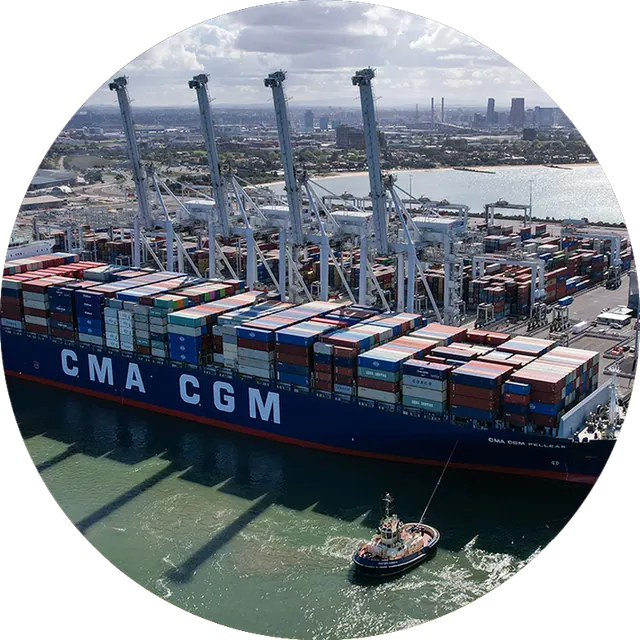
Maritime & Shipping · Canada

Weeks of watches at sea test sleep like nothing else.

Seafarers stand watch systems such as six-on/six-off for weeks at a time, with broken sleep, noise and motion. Fatigue on watch raises the risk of grounding, collision and injury.

Regulation changed Jan 30, 2026Change coming Jan 30, 2027

Maritime & Shipping workforce

Who this page covers

  • Coastal and domestic commercial vessels
  • Commercial fishing
  • Cruise lines
  • Dredging
  • Ferries and passenger vessels
  • Marine pilots, tugs and towage
  • Offshore supply and construction vessels (also see Oil & Gas)
  • Shipping lines - deep sea

Reg Watch

What’s changed, and what’s coming

Regulatory change that affects how you manage fatigue in maritime & shipping: what has changed in the last 12 months, and what is on the way.

Recent changeFrom January 30, 2026

Applies across industries in Canada

If you are federally regulated, amendments registered 30 January 2026 add thermal stress duties - controls including work-rest cycles, worker training and committee consultation - in force 30 January 2027.

Read the change

Upcoming changeExpected from January 30, 2027Within 12 months

Federally regulated employers must apply the thermal stress amendments (SOR/2026-10), including the Maritime OHS Regulations, from 30 January 2027. Transport Canada plans to pre-publish new Marine Personnel Regulations in Fall 2026 for 60 days' comment; hours-of-rest content is unconfirmed.

Regulatory changes checked as at October 1, 2026.

Regulation

Who regulates it, and what they expect

Canada sets numeric, legally binding rest hours for seafarers. On sheltered-waters and near-coastal voyages in Canadian waters, each crew member needs at least 6 consecutive hours' rest in every 24 hours and 16 hours' rest in every 48. On unlimited voyages, and in the waters of other states party to the convention, the standard is either no more than 14 hours' work in 24 and 72 in 7 days, or at least 10 hours' rest in 24 and 77 hours in 7 days. These bind Canadian vessels, including fishing vessels of 100 gross tonnage or more. Transport Canada recommends, but does not yet require, a fatigue management system beyond the bare hours.

Regulated by
  • Transport CanadaTransport Canada

Logos identify the regulator and don’t imply endorsement.

Who regulates it

Maritime differs from Canada's general workplace rules: Transport Canada, under the Canada Shipping Act, sets specific, legally binding minimum rest hours for seafarers on Canadian vessels, enforced through vessel inspections, detention powers and prosecution - a dedicated marine regulator with its own hours-of-rest law. It also runs its own fatigue program, including a mandatory training course for seafarers.

Your obligations

Masters must apply the rest-hour set that matches the voyage: at least 6 consecutive hours' rest in every 24 hours and 16 hours in every 48 on sheltered-waters and near-coastal voyages in Canadian waters, or at least 10 hours' rest in every 24 and 77 in every 7 days on unlimited and foreign-waters voyages. Keep a record of each crew member's daily hours of work or rest for inspection, and post a table of shipboard working arrangements. Masters must weigh the danger of crew fatigue in every scheduling decision. Seafarers must now also complete Transport Canada's Fatigue Management at Sea e-course alongside Marine Emergency Duties training.

Consequences

Contravening the rest-hour rules is an offence under the Canada Shipping Act, 2001, not just a safety-culture failure. Transport Canada marine safety inspectors can detain a vessel, suspend or cancel certificates and prosecute, and each day a contravention continues counts as a separate offence. The hours-of-rest record is how compliance is proved, so a missing or falsified record is itself what inspectors act on. Canadian vessels found deficient abroad can be detained by foreign port state control against the same international rest standard, and the general federal health and safety track applies on top.

Penalties

Contravening the Marine Personnel Regulations is an offence under the Canada Shipping Act, 2001, punishable on summary conviction by a fine of up to $1,000,000 or up to 18 months' imprisonment, or both, with each day a contravention continues a separate offence. Detention and certificate suspension carry their own commercial cost, and the general Canada Labor Code exposure - fines to $1,000,000, penalties to $250,000 per violation - applies as well. 2026 figures.

Sources: Canada Shipping Act, 2001; Marine Personnel Regulations, SOR/2007-115 (hours of work and rest); Transport Canada, 'Managing fatigue at sea in Canada'; Maritime Labour Convention, 2006.

Fatigue-critical roles

Where fatigue matters most in maritime & shipping

The roles where a fatigued worker is most likely to cause serious harm, the tasks that carry the risk, and why fatigue builds up in them.

RoleRiskHigh-risk tasksWhy fatigue builds
Officer in charge of a navigational watch
Rules
Regulatory designation
Crew member under the Marine Personnel Regulations (SOR/2007-115) Part 3; certificate of competency
Hours and rest
MPR s 320 domestic: 6 h consecutive rest/24 h, 16 h/48 h; s 321 international: 10 h rest in any 24 h and 77 h in any 7 days; at most 2 periods, one of at least 6 h
Critical riskKeeping a bridge watch alone in the 00:00-04:00 or 04:00-08:00 watch; collision avoidance in coastal traffic; port arrival straight after cargo work6-on/6-off or 4-on/8-off watches, port-call cargo work eating rest, time-zone changes, months-long tours
Engineer officer (engineering watch)
Rules
Regulatory designation
Crew member under the Marine Personnel Regulations (SOR/2007-115) Part 3; certificate of competency
Hours and rest
MPR s 320 domestic: 6 h consecutive rest/24 h, 16 h/48 h; s 321 international: 10 h rest in any 24 h and 77 h in any 7 days; at most 2 periods, one of at least 6 h
Critical riskUnmanned machinery space on-call alarm response at night; engine-room watch; bunkering, fuel changeover and blackout recovery after broken sleepUMS on-call nights with repeated alarms, port maintenance during rest periods, heat and noise
Marine pilot (Pacific, Laurentian, Great Lakes or Atlantic Pilotage Authority)
Rules
Regulatory designation
Licensed pilot (Pilotage Act)
Hours and rest
Pilotage Authority regulations and service contracts
Critical riskConning large ships through pilotage waters at night; boarding by pilot ladder in swell; back-to-back jobs and long coastal pilotages24/7 on-call job lists, night jobs, long transits and travel between jobs, irregular rest
Tug master
Rules
Regulatory designation
Crew member under the Marine Personnel Regulations (SOR/2007-115) Part 3; certificate of competency
Hours and rest
MPR s 320 domestic: 6 h consecutive rest/24 h, 16 h/48 h; s 321 international: 10 h rest in any 24 h and 77 h in any 7 days; at most 2 periods, one of at least 6 h
Critical riskShip-assist and harbour towage at night on short notice; towline handling near girting risk; coastal barge towing on two-watch systemsOn-call 24 h harbour rosters, two-watch towing (6-on/6-off), back-to-back jobs
Master (domestic passenger vessel); fishing master
Rules
Regulatory designation
Master under the Marine Personnel Regulations; Fishing Vessel Safety Regulations
Hours and rest
MPR s 320 domestic: 6 h consecutive rest/24 h, 16 h/48 h
Critical riskSkippering a ferry or workboat with minimum crew on long days; night fishing then steaming home after hauling; lone watch on small vesselsLong seasonal days, early starts, split shifts on commuter ferries, multi-day trips with fragmented sleep
Able seafarer / bridge watchman
Rules
Regulatory designation
Crew member under the Marine Personnel Regulations (SOR/2007-115) Part 3; certificate of competency
Hours and rest
MPR s 320 domestic: 6 h consecutive rest/24 h, 16 h/48 h; s 321 international: 10 h rest in any 24 h and 77 h in any 7 days; at most 2 periods, one of at least 6 h
High riskLookout and helm on night watches; mooring and anchor work during port calls that cut into rest; fire roundsWatch rotations, port-call work in rest periods, long tours

Stories

When fatigue made the record

Published findings and prosecutions from regulators, courts and investigators in Canada.

  • Sep 2022 · Newfoundland and Labrador, Canada

    Pilot boat deckhand on day 7 of 7, awake 18 hours, likely fatigued when he went overboard and died

    • Safety

    Near midnight, during a pilot transfer off a harbour entrance, the deckhand of a pilot boat went overboard while untethered and died. The Transportation Safety Board found that the tether system design and the vessel's limited recovery capability caused the death. It also found that the deckhand, on the last day of a 7-day shift and awake for 18 hours, faced multiple fatigue risk factors and was likely fatigued, and that crews on irregular schedules without effective fatigue risk management are at increased risk of impairment.

    Case CA-maritime-18Report an issue

Story 1 of 18

See all maritime & shipping news

How the suite fits

How each product connects to your obligations

Grades describe how strongly a product connects to an obligation. None discharges an obligation, and none carries a compliance warranty.

Sleepfit

Supports a named obligation

Seafarer medicals follow Transport Canada guidance that uses the Epworth Sleepiness Scale, a tool Sleepfit does not administer. Sleepfit supports that regime by screening for sleep apnea and insomnia between medicals. It screens; diagnosis stays with your clinicians.

Assessed by reference to US regulation.

About Sleepfit

Awareness eLearning

Supports a named obligation

Transport Canada requires seafarers to complete its Fatigue Management at Sea e-course before a Marine Emergency Duties certificate issues (Ship Safety Bulletin 01/2026). Awareness eLearning supports the fatigue knowledge behind it; it does not replace that course.

About Awareness eLearning

Fatiguefit4Duty

Supports your general duty of care

The Marine Personnel Regulations limit hours and, at s 322(1), make fatigue a scheduling consideration. No point-of-duty check is named; Fatiguefit4Duty supports your general duty. A fitness-for-duty check, not a fitness-for-duty decision - the duty call stays with you.

About Fatiguefit4Duty

Was It Fatigue?

Supports your general duty of care

Your duty to investigate hazardous occurrences under Canada Labor Code Part II does not name fatigue, and Transportation Safety Board investigations are the Board's own. Was It Fatigue? supports your internal review. A structured judgment aid, not a determination of cause.

About Was It Fatigue?

SleepWellBaby

No Canadian marine rule reaches sleep in new-parent households. SleepWellBaby is offered as a benefit to parents in your seagoing and shore workforce, not as a compliance step under the Marine Personnel Regulations.

About SleepWellBaby

Recommended bundle

Where we’d start in maritime & shipping

Every bundle is priced on prevalence: your whole cohort gets access, and you pay for the share predicted to need each product. How pricing works.

Why this pairing in Canada

Seafarer medicals follow Transport Canada guidance using the Epworth scale; Sleepfit screens between them. Transport Canada requires its Fatigue Management at Sea course; Awareness eLearning supports, not replaces, it. Fatiguefit4Duty adds a pre-watch check. Fatigue Lifecycle adds review.

See what sleep and fatigue mean for your maritime & shipping workforce.

Tell us roughly how many people you employ. Your snapshot models how many are likely sleeping poorly and what it costs, from published research for maritime & shipping. Then choose who you’d cover, and we’ll take you to the right next step.

A sample workforce snapshot on a tablet: modeled sleep problems and the cost of poor sleep for 1,400 people in transport and logistics.