
For employees & managers

Awareness eLearning

Fatigue training for employees and managers: what makes the controls at Levels 2 and 3 usable by the people running them.

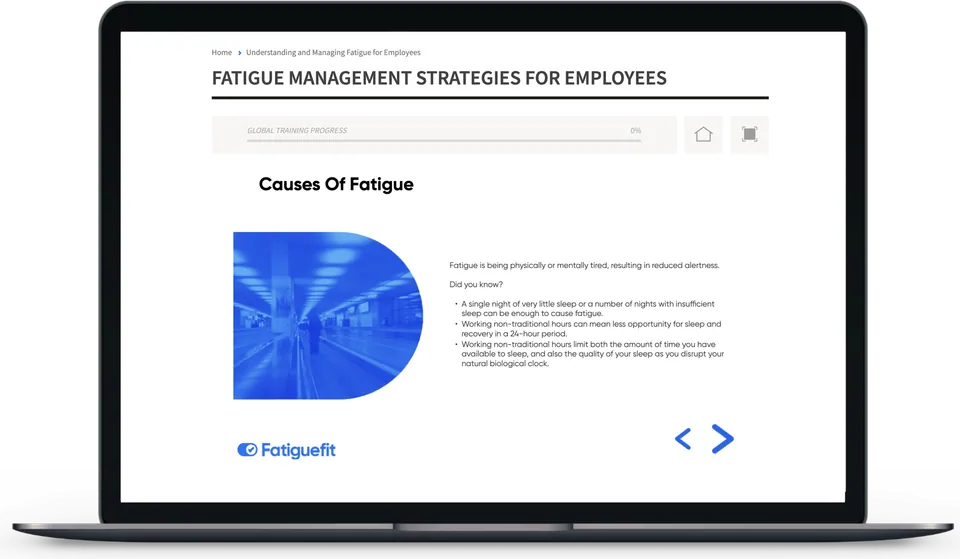
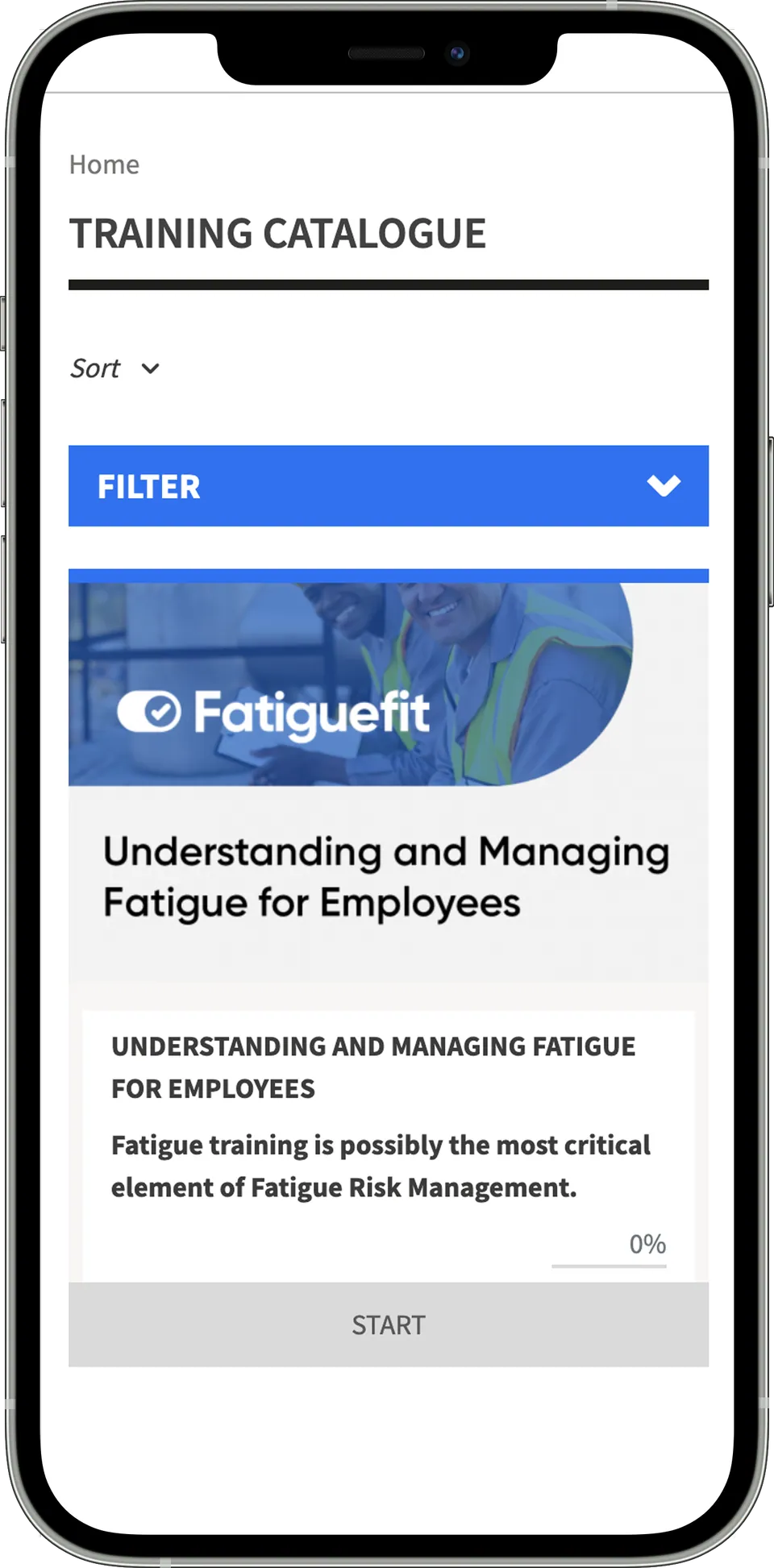
A Fatiguefit eLearning module on a laptop: Fatigue Management Strategies for Employees, on the causes of fatigue.The training catalog on a phone, with Understanding and Managing Fatigue for Employees ready to start.

The problem

Controls only work if people can recognize fatigue

You must give workers information and training about the risks you manage, and fatigue is increasingly named as one of them. Generic sleep-hygiene content rarely meets the published expectation for fatigue training.

Awareness eLearning is built against that expectation, and teaches the one behavior that makes in-shift observation work: recognizing fatigue in yourself and in a colleague.

What are employees’ responsibilities for fatigue? Watch the video · 1:22
Presented by Professor Drew Dawson

The size of the problem

National figures for Canada, from published research. They are modeled, not measured in your workforce.

  • 33%get less than 7 hours' sleep2017 (CHMS 2007-2013)
  • 23.8%projected to have insomnia2018 (CHMS 2014-2015)
  • 13%of workplace injuries are linked to sleep problems2014
Sources
  1. Chaput J-P, Wong SL, Michaud I. Duration and quality of sleep among Canadians aged 18 to 79. Health Reports (Statistics Canada), 2017.
  2. Chaput J-P, Yau J, Rao DP, Morin CM. Prevalence of insomnia for Canadians aged 6 to 79. Health Reports (Statistics Canada), 2018.
  3. Uehli K, et al. Sleep problems and work injuries: a systematic review and meta-analysis. Sleep Medicine Reviews, 2014.

Stories

When the cost of fatigue fell on the employee

Employees in Canada charged, jailed, fined, dismissed or struck off over fatigue at work, often after pushing on while they knew they were tired.

  • Jun 2016 · Ontario, Canada

    Long-haul trucker on two hours' sleep falsifies logbook; four killed in highway pile-up

    • Safety
    • Legal

    A long-haul truck driver on a 28-hour run drove into stopped traffic on a major urban highway, causing an 11-vehicle pile-up that killed four people. The court found he had slept no more than about two hours after 13.5 hours of driving, had falsified his logbook to hide the missing rest, and was either distracted or falling asleep. He was convicted of criminal negligence causing death and jailed for eight years; the judge said a reasonable commercial truck driver would never have taken these risks.

    Case CA-transport-01Report an issue
See all fatigue news

How it works

Training that makes the other controls work

Short modules teach employees and managers what fatigue is, where it comes from, how to recognize it in themselves and others, and what to do about it. It is not a control on its own: it supports the two levels of defense that rely on people, getting enough sleep and spotting fatigue on shift, and every completion is recorded.

  1. Step 01

    Assigned

    Assigned to the whole nominated cohort. Access is open to everyone in it, not to a selected group.

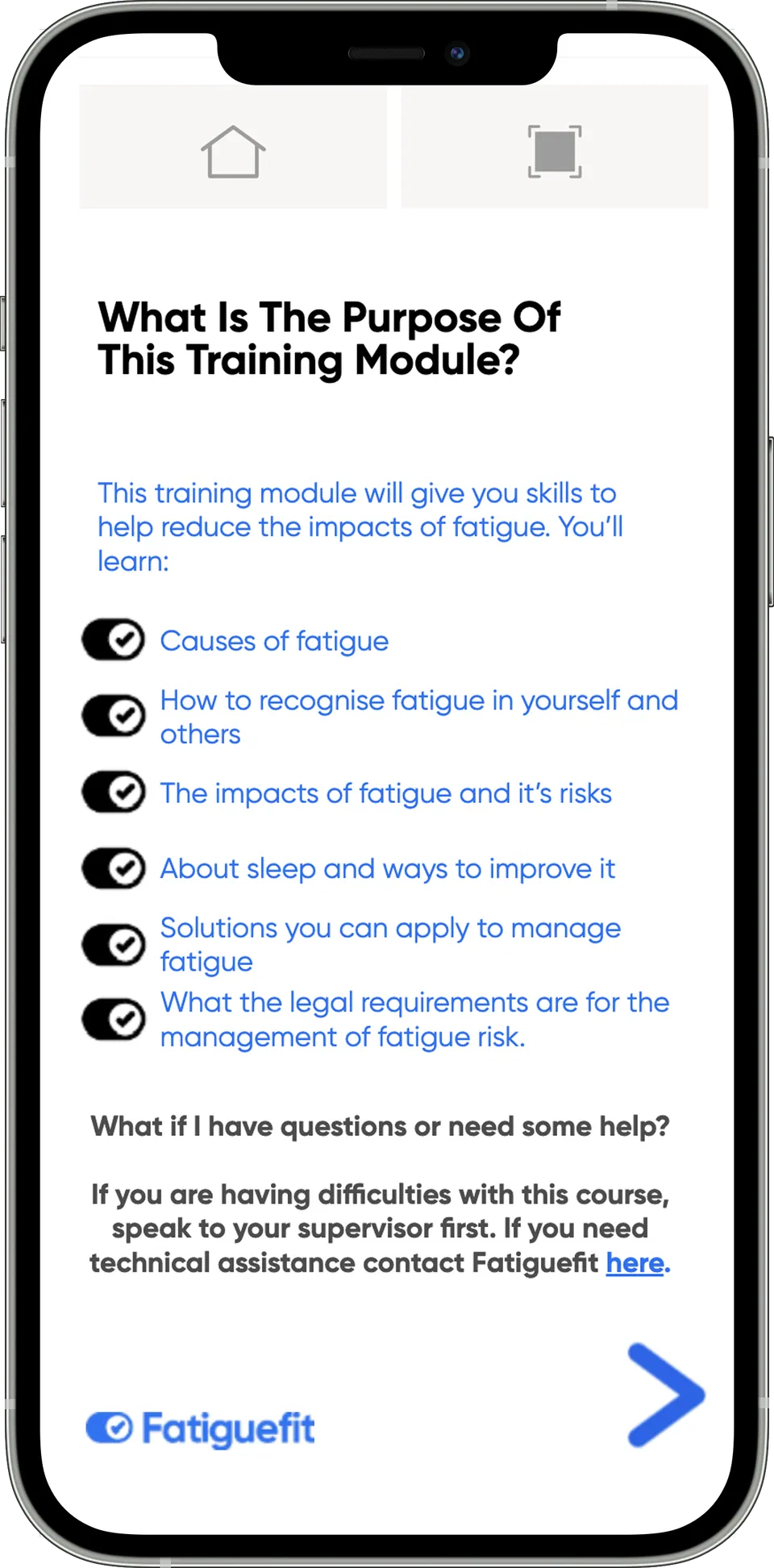
    The start of a module on a phone: what the training will teach, from the causes of fatigue and how to recognize it to the legal requirements for managing it.
  2. Step 02

    Modules

    Fatigue physiology and circadian science, industry-specific hazards, sleep-disorder education, coping with shift work, and your own fatigue risk management program.

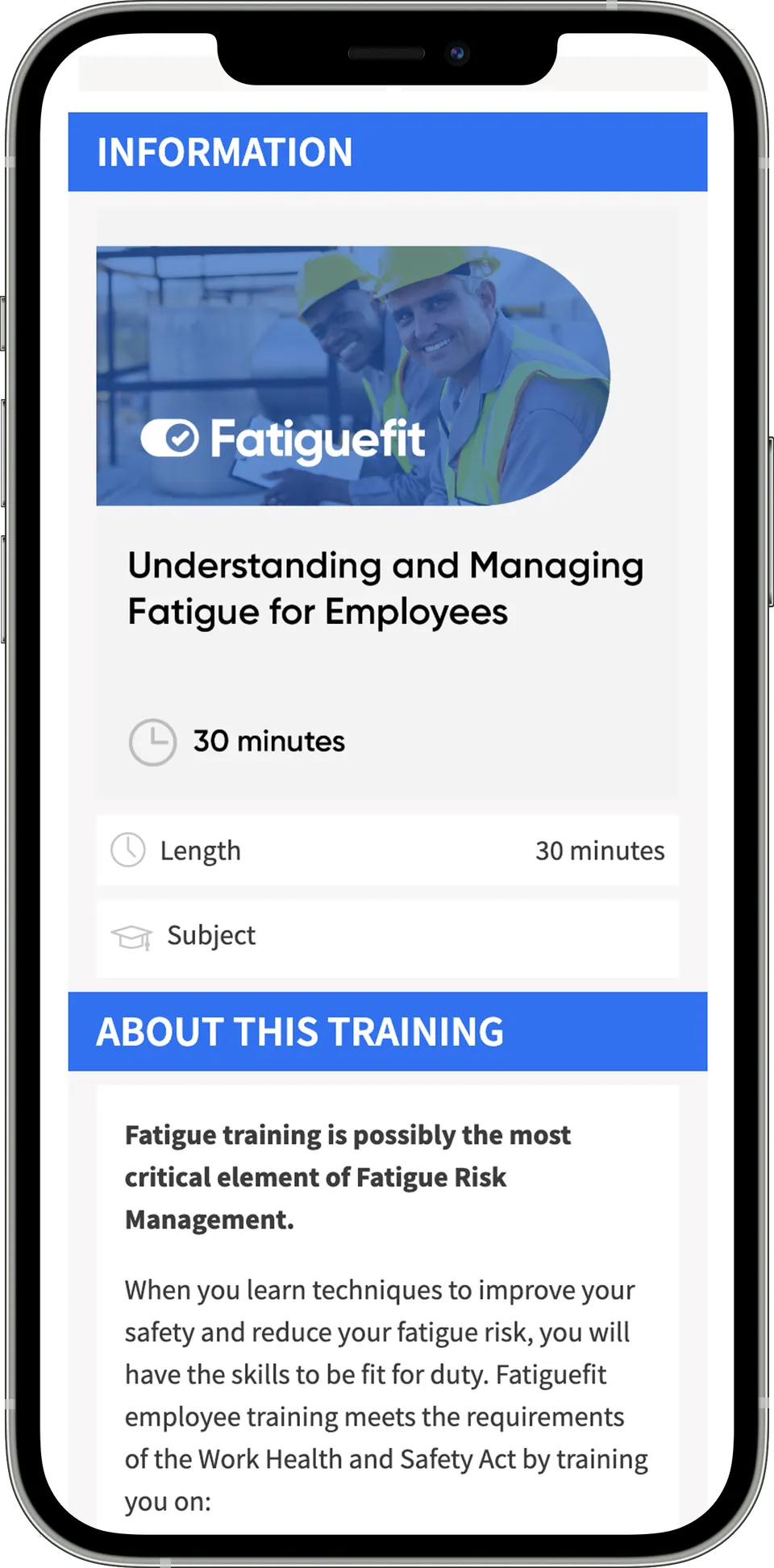
    The course page on a phone: Understanding and Managing Fatigue for Employees, 30 minutes, with what the training covers.
  3. Step 03

    Recognition

    Recognizing fatigue in yourself and in a colleague: the behavior that makes observation at Level 3 work.

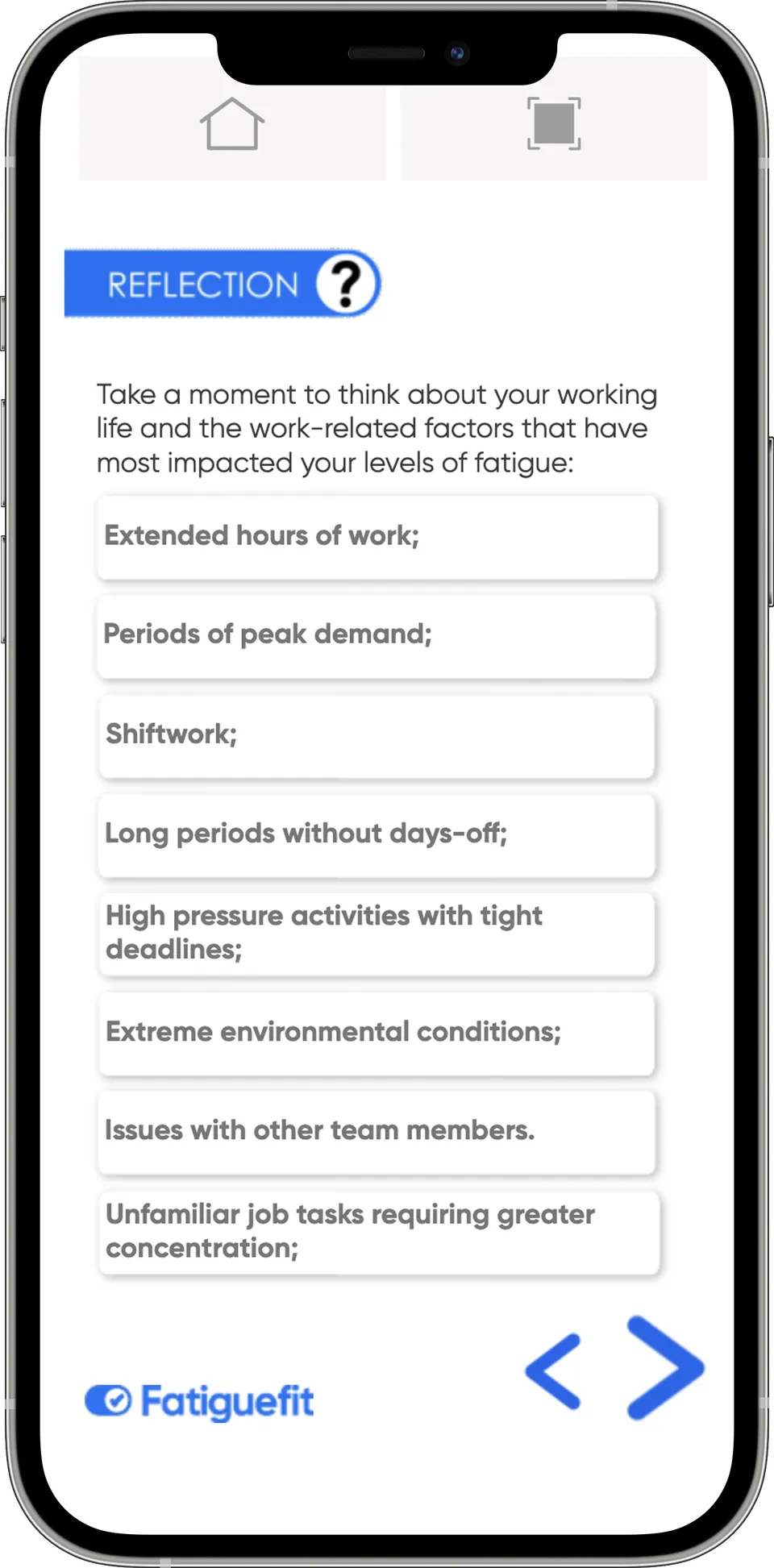
    A reflection exercise on a phone: the work factors that have most affected your own fatigue, such as extended hours, shiftwork and peak demand.
  4. Step 04

    Completion record

    Completion, knowledge check and self-reported behavior change, recorded for your evidence file.

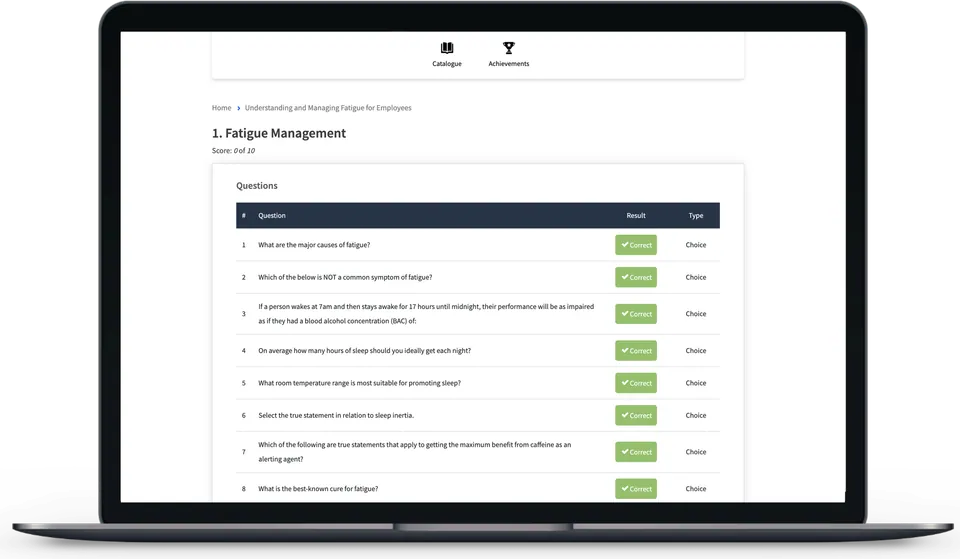
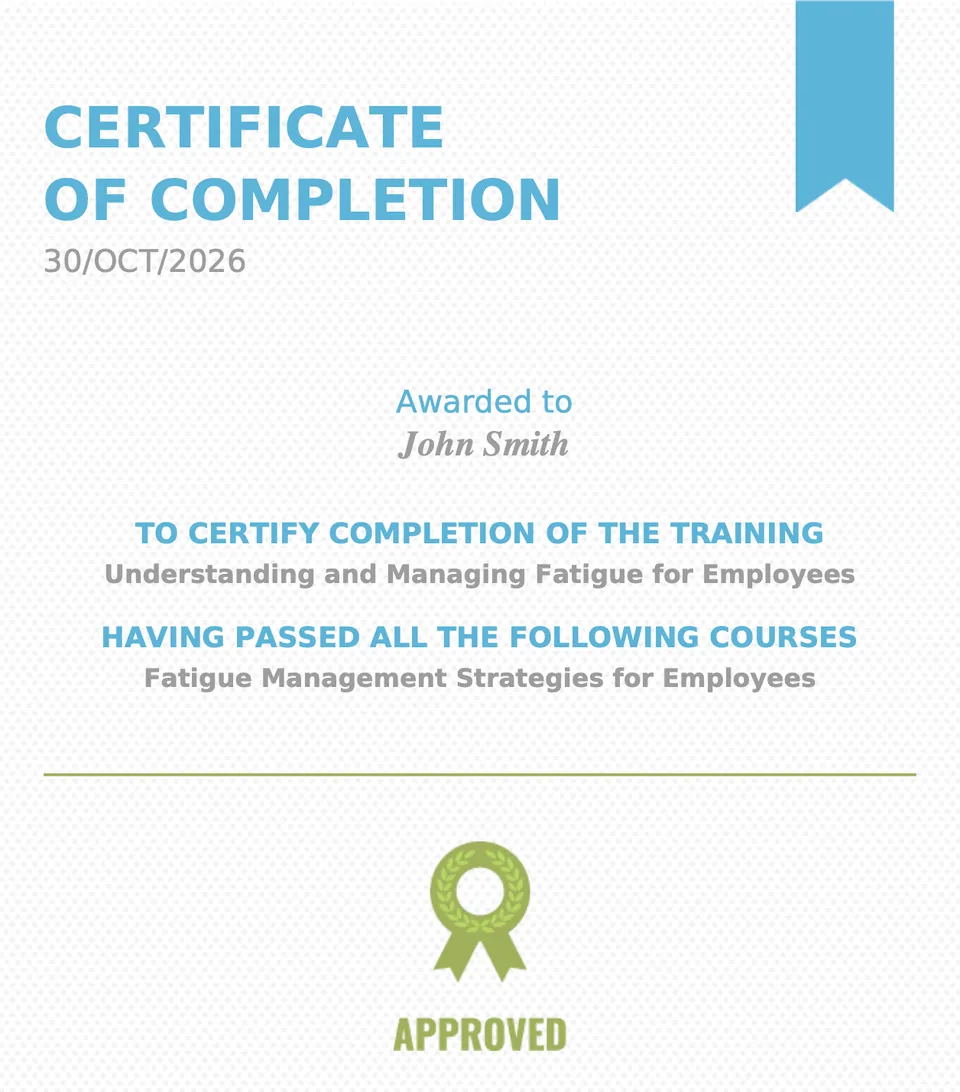
    Knowledge-check results on a laptop: each question in a fatigue management module with its result.A certificate of completion for Understanding and Managing Fatigue for Employees, listing the courses passed.

A fatigue control only works if someone recognizes fatigue, in themselves or in the person beside them. Generic sleep tips don’t teach that. I wanted training that does, for everyone on the roster and the managers who run it.

Daniel PlattCo-founder and CEO

Rollout

How we roll it out

  1. Scope

    Name the cohort, and the managers who run the roster.

  2. Tailor

    Your industry’s hazards and your own fatigue risk management program go into the course.

  3. Assign

    Everyone in the cohort gets access, at the same time.

  4. Report

    Completion and knowledge-check reporting you can file as training evidence.

What the client sees

Who sees what

Reporting comes in a form you can file as training evidence. No clinical or screening result is produced.

Priced on prevalence, not headcount. How pricing works.

  • Employees and managers

    The training

    • The modules
    • Their own knowledge check
  • The employer

    A training record

    • Individual completion
    • Aggregate knowledge-check results by cohort, location and craft

Evidence

What we can show

A review of operator fatigue training against the published benchmark, by Professor Drew Dawson, found typical material strong on general fatigue awareness and sleep hygiene and short of the benchmark on seven counts. The gap register from that review is the specification for this curriculum.

What it does not establish

Completion is not competence, and competence is not error reduction. It is not a Level 4 control: trapping fatigue-related errors is a matter of task design, cross-checking and error-tolerant procedure, and training is not a substitute for it.

FAQs

Questions we’re often asked

Who is it for?

Employees and managers. It is assigned to the whole nominated cohort, not a selected group.

What does it cover?

Fatigue physiology and circadian science, the hazards in your industry, sleep-disorder education, coping with shift work, and your own fatigue risk management program, with a focus on recognizing fatigue in yourself and in a colleague.

What do we get for our records?

Individual completion and aggregate knowledge-check reporting by cohort, location and craft, in a form you can file as training evidence.

Will training on its own reduce fatigue-related errors?

No. Completion is not competence, and training is not a substitute for task design, cross-checking and error-tolerant procedure. It makes the controls at Levels 2 and 3 usable by the people running them.

Does it collect any health information?

No clinical or screening result is produced.

Can someone delete their account?

Yes. Anyone can ask for their account and its personal data to be deleted; the steps are on its delete-account page. Deletion can’t be undone.

Pathways

Where to go next

Awareness eLearning and regulation across 33 industries in Canada

2 / 33

The regulation names this step

1 / 33

Supports a named obligation

30 / 33

Supports your general duty of care

See how Awareness eLearning fits the regulation in your industry, and what else we would start with there.

All 33 industries

Other solutions interconnected with Awareness eLearning

Interested in Awareness eLearning for your organization?

Tell us a little about your organization and which solutions you’re looking at, and our team will be in touch.

A Fatiguefit eLearning module on a laptop: Fatigue Management Strategies for Employees, on the causes of fatigue.The training catalog on a phone, with Understanding and Managing Fatigue for Employees ready to start.