
Upcoming changeNo date set yet
EASA was reported in August 2026 to have proposed extending its flight time limitation rules to further types of operation. Treat this as a proposal: scope, adoption and application dates are not yet confirmed.
Aviation · Ireland
Pilots, cabin crew and controllers work early starts, nights and time-zone changes. Duty limits cap hours, not sleep obtained, and a fatigue lapse in flight or on the ground can be catastrophic.
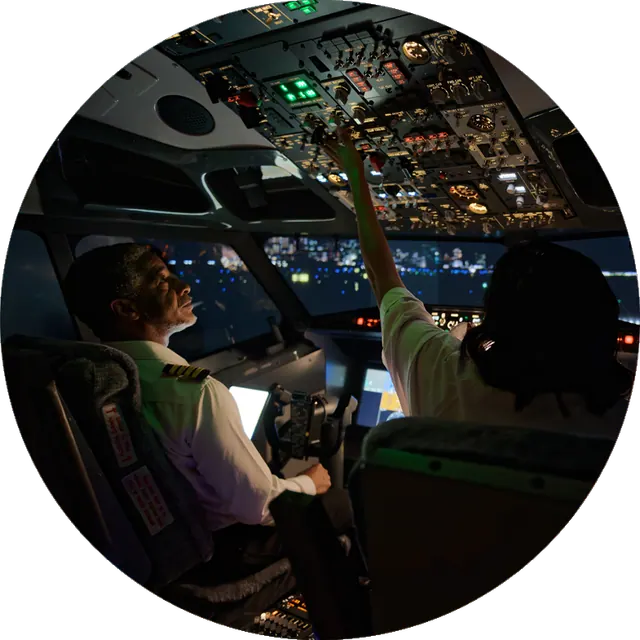
Reg Watch
Regulatory change that affects how you manage fatigue in aviation: what has changed in the last 12 months, and what is on the way.
Upcoming changeNo date set yet
EASA was reported in August 2026 to have proposed extending its flight time limitation rules to further types of operation. Treat this as a proposal: scope, adoption and application dates are not yet confirmed.
Regulatory changes checked as at 1 October 2026.
Regulation
Aviation has a detailed, industry-specific fatigue law. European rules applying directly in Ireland set exact limits on how long flight and cabin crew can be on duty, how many hours they may fly over a week, a fortnight, four weeks and a year, and how much rest they must get - and require formal fatigue risk management wherever an operator uses the flexibility provisions. They cover commercial aeroplane operations; helicopter, air taxi and air ambulance work still runs on national Irish limits. Being EU-wide, the rule stays current, while the UK now runs its own version.
 IAA
Logos identify the regulator and don’t imply endorsement.
Ireland's national aviation safety regulator is the Irish Aviation Authority (IAA), which oversees airlines operating out of Ireland under European Union-wide aviation safety rules set by EASA (the European Union Aviation Safety Agency) - the same rulebook applies across the whole EU, not just Ireland.
Airlines flying out of Ireland must operate a flight time limitation scheme approved by the Irish Aviation Authority. Basic daily flight duty periods run from 9 to 13 hours depending on report time, sectors and acclimatisation, extendable by an hour twice in seven days with extra rest. Duty is capped at 60 hours in 7 days, 110 in 14 and 190 in 28; flight time at 100 hours in 28 days, 900 in a calendar year and 1,000 in any 12 months. Rest must at least match the preceding duty, with a floor of 12 hours at home base and 10 away. Crew also carry a personal duty not to operate when they know they are too fatigued to do so safely.
If an airline doesn't comply, the Irish Aviation Authority can take action against its operating certificate - from requiring fixes to restricting or suspending operations - usually a bigger business risk than any fine. The airline still faces the same general safety-law and employment-law consequences as any Irish employer for its non-flying staff. An individual pilot or crew member who flies while knowingly too fatigued also risks their own licence, and any fatigue-related safety event must be formally reported under EU rules.
Enforcement of flight and duty limits runs through the operator's certificate and the crew licence rather than a published schedule of fines, so the cost is operational: audit findings, corrective action, restrictions on how you may roster and, in serious cases, certificate action that grounds capacity. As an Irish employer the airline still carries the general safety penalties - €5,000 summarily, €3,000,000 on indictment - for its ground staff.
Sources: Commission Regulation (EU) No 965/2012 (Air Operations Regulation), Annex III Part-ORO Subpart FTL; Irish Aviation Authority; European Union Aviation Safety Agency (EASA); Regulation (EU) No 376/2014 on occurrence reporting.
Fatigue-critical roles
The roles where a fatigued worker is most likely to cause serious harm, the tasks that carry the risk, and why fatigue builds up in them.
| Role | Risk | High-risk tasks | Why fatigue builds |
|---|---|---|---|
Pilot (captain / first officer)Rules
| Critical risk | Flying approaches and landings after extended duty or through the window of circadian low; multi-sector days; managing non-normal events at the end of a duty | Early report times, overnight flights, time-zone crossing, reserve and standby, short-notice roster changes |
Air traffic controller (AirNav Ireland)Rules
| Critical risk | Separating traffic on low-workload overnight positions, sometimes single-person; handling the morning surge at the end of a night shift; coordination and handovers | 24/7 rotating shifts with quick returns, night shifts, single-person night operations at some units |
B1/B2 certifying engineerRules
| Critical risk | Night-shift line and base maintenance; flight-control rigging, torque and duplicate-inspection tasks; certifying release to service at the end of a long shift | Night shifts to meet first-wave departures, AOG overtime, 12 h shifts, rotating rosters |
Air ambulance / helicopter pilotRules
| Critical risk | Single-pilot night aeromedical or charter flights after an on-call call-out; helicopter landings at unlit sites; IFR approaches at the end of duty | On-call and standby with night call-outs, single-pilot operations, remote bases |
Cabin crew memberRules
| High risk | Safety and emergency duties, evacuation command and in-flight incident response after long or overnight duties; door arming and cross-checks | Early starts, overnight and long-haul duties, multi-sector days, time-zone crossing, standby |
Ground handler (ramp)Rules
| High risk | Aircraft pushback and towing; baggage tug driving and loading near engines and stairs; refuelling hook-ups on overnight turns | Split shifts and starts from 04:00, night freight turns, overtime in peaks, outdoor work |
Stories
Published findings and prosecutions from regulators, courts and investigators in Ireland.
Feb 2011 · Ireland
A commuter aircraft on a scheduled regional flight crashed during an attempted go-around in poor visibility at an Irish airport; six of the 12 people on board died. Ireland's Air Accident Investigation Unit listed tiredness and fatigue of both pilots as a contributory cause, reporting they had insufficient rest before starting duty, alongside training, crew-pairing and oversight failures.
Case IE-aviation-01Report an issue
How the suite fits
Grades describe how strongly a product connects to an obligation. None discharges an obligation, and none carries a compliance warranty.
ORO.FTL.250 of Regulation (EU) 965/2012 requires initial and recurrent training for crew and rostering staff on the causes and effects of fatigue and countermeasures. Awareness eLearning supplies the content named at ORO.FTL.250; your programme stays yours.
About Awareness eLearningRegulation 7 of S.I. 507/2006 entitles your aircrew to a free health assessment before assignment and at regular intervals, and ORO.FTL.120 requires fatigue hazard identification where FRM applies. Sleepfit supports both. It screens; diagnosis stays with your clinicians.
About SleepfitCAT.GEN.MPA.100(c) of Regulation (EU) 965/2012 bars crew from duty when they know or suspect they are fatigued. Fatiguefit4Duty gives that judgement a consistent, recorded form. A fitness-for-duty check, not a fitness-for-duty decision - the duty call stays with you.
About Fatiguefit4DutyWhere your flight time scheme requires fatigue risk management, ORO.FTL.120 requires safety assurance processes within it. Was It Fatigue? supports that assurance after an occurrence. A structured judgement aid, not a determination of cause.
About Was It Fatigue?No Irish aviation rule reaches sleep in new-parent households. SleepWellBaby is offered to the working parents among your crew and controllers as a wellbeing benefit, not as a step any Irish regulation requires.
About SleepWellBabyRecommended bundle
Every bundle is priced on prevalence: your whole cohort gets access, and you pay for the share predicted to need each product. How pricing works.
Proactive fatigue risk: assess, manage and train, with sleep screening underneath.
Assess, manage, investigate: from the Census to the point of duty to the post-incident review.
Why this pairing in Ireland
ORO.FTL.250 of Regulation (EU) 965/2012 names fatigue training; Awareness eLearning supplies it with a record. Fatiguefit4Duty supports CAT.GEN.MPA.100(c); Sleepfit supports the S.I. 507/2006 health assessment. Fatigue Lifecycle adds Was It Fatigue? for ORO.FTL.120 assurance.
Tell us roughly how many people you employ. Your snapshot models how many are likely sleeping poorly and what it costs, from published research for aviation. Then choose who you’d cover, and we’ll take you to the right next step.
