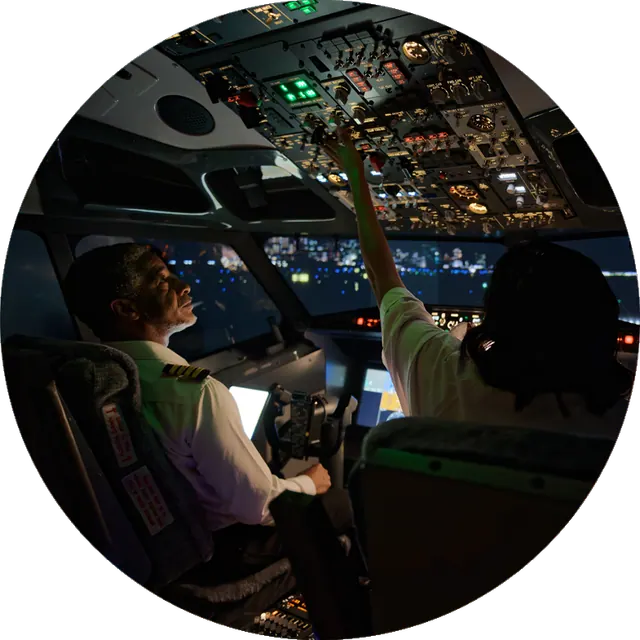
Aviation · New Zealand

Aviation counts duty hours. Its people run on sleep.

Pilots, cabin crew and controllers work early starts, nights and time-zone changes. Duty limits cap hours, not sleep obtained, and a fatigue lapse in flight or on the ground can be catastrophic.

Regulation changed 9 Jul 2026Change coming 1 Apr 2027

Aviation workforce

Who this page covers

  • Aeromedical retrieval services (also see Healthcare & Nursing)
  • Air freight and express airlines
  • Air traffic control
  • Aircraft maintenance (MRO) and line engineering
  • Airlines - cabin crew
  • Airlines - flight crew (pilots)
  • Airport operators (also see Emergency Services, Retail & Hospitality, Security Services)
  • Charter, regional, helicopter and offshore helicopter operators
  • Ground handling - ramp, baggage, fuel, cargo

Reg Watch

What’s changed, and what’s coming

Regulatory change that affects how you manage fatigue in aviation: what has changed in the last 12 months, and what is on the way.

Recent changeFrom 9 July 2026

Applies across industries in New Zealand

The Health and Safety at Work Amendment Act 2026 became law on 9 July 2026. Your duties do not change until most of it commences on 1 April 2027, so use the lead time to evidence fatigue as a serious-harm risk.

Read the change

Upcoming changeExpected from 1 April 2027Within 12 months

From 1 April 2027 HSWA centres on 'critical risks'; fatigue is not on the Schedule 1A list, so it counts only where likely to cause death or notifiable harm. Where the Civil Aviation Act manages the same risk, complying with it can satisfy the matching HSWA duty. Small firms (under 20 workers) manage critical risks only.

Regulatory changes checked as at 1 October 2026.

Regulation

Who regulates it, and what they expect

Aviation is one of the few New Zealand industries with government-mandated fatigue rules beyond general safety law, and they are built differently from Australian or American ones. Rather than one national duty-time table, each operator designs its own flight and duty time scheme covering rest before flight, time-zone acclimatisation, night operations, standby and reserve duty and days off, and the Director of Civil Aviation must approve it first. Fixed cumulative caps sit on top, and they differ by operation - aeroplane and helicopter operators work to different numbers. Every flight crew member also has a personal duty to refuse duty when fatigued.

Regulated by
  • Civil Aviation Authority of New ZealandCAA
  • WorkSafe New ZealandWorkSafe

Logos identify the regulator and don’t imply endorsement.

Who regulates it

The Civil Aviation Authority sets and enforces flight crew fatigue rules and is also the designated health and safety regulator for work preparing an aircraft for imminent flight, work on board an aircraft in operation, and aircraft as workplaces. WorkSafe New Zealand regulates the rest of your operation - hangars, ground handling, offices - so two regulators cover fatigue across one workforce.

Your obligations

You must design a flight and duty time scheme covering rest before flight, time-zone acclimatisation, night operations, standby and reserve duty and days off, and have the Director of Civil Aviation approve it - you cannot self-certify your own limits. Fixed caps apply on top. For large and medium aeroplane operations under Rule Parts 121 and 125, no flight crew member may exceed 100 flight hours in any 28 consecutive days or 1,000 hours in any 365. Helicopter and small aeroplane operators under Part 135 work to different limits - 160 hours in any 30 days, plus minimum days free of duty. Flight and duty records must be kept 12 months.

Consequences

The Civil Aviation Authority enforces the fatigue rules through certificate action rather than a published fine tariff: it can require corrective action, impose conditions, and suspend or revoke your air operator certificate or an individual crew licence. For an operator, that is existential. Because the Authority is also the designated health and safety regulator for work on aircraft in operation, the same failure can be pursued under general safety law with its full three-tier penalty scale and reparation orders, while WorkSafe covers the rest of your operation. Flight crew carry a personal duty to stand down, so a scheme that pressures crew to fly fatigued creates exposure at both ends.

Penalties

There is no published fine tariff for a flight and duty time breach - the regulator's main lever is certificate action, and a suspended or revoked air operator certificate costs more than any fine. Where the same failure is pursued under general safety law, the ceilings for a company are $500,000, $1.5 million and $3 million across the three offence tiers, and $100,000 to $600,000 for an officer, with up to 5 years' imprisonment at the top tier and reparation on top.

Sources: Civil Aviation Rules Parts 121, 125 and 135, Subpart K (Fatigue of Flight Crew); CAA Advisory Circular AC119-2 Revision 2 (31 March 2022); Civil Aviation Act 2023; Health and Safety at Work Act 2015 and the Civil Aviation Authority agency designation 2015; TAIC inquiry AO-2024-005.

Fatigue-critical roles

Where fatigue matters most in aviation

The roles where a fatigued worker is most likely to cause serious harm, the tasks that carry the risk, and why fatigue builds up in them.

RoleRiskHigh-risk tasksWhy fatigue builds
Airline pilot (captain / first officer)
Rules
Regulatory designation
Flight crew member (CAR Part 121 Subpart K; 121.803(b) fatigue bar); Class 1 medical (CAR Part 67)
Hours and rest
Operator flight and duty time scheme (CAR 121.803(a)); 100 h/28 days and 1,000 h/365 days flight time
Critical riskFlying approaches and landings after extended duty or through the window of circadian low; multi-sector days; managing non-normal events at the end of a dutyEarly report times, overnight flights, time-zone crossing, reserve and standby, short-notice roster changes
Air traffic controller (Airways New Zealand)
Rules
Regulatory designation
ATC licence (CAR Part 65); Class 3 medical (CAR Part 67)
Hours and rest
No CAR rest rule for controllers; certificate holder's rostering (CAR Part 172)
Critical riskSeparating traffic on low-workload overnight positions, sometimes single-person; handling the morning surge at the end of a night shift; coordination and handovers24/7 rotating shifts with quick returns, night shifts, single-person night operations at some units
Licensed aircraft maintenance engineer (LAME)
Rules
Regulatory designation
AME licence holder (CAR Part 66)
Hours and rest
ERA 2000 rest and meal breaks
Critical riskNight-shift line and base maintenance; flight-control rigging, torque and duplicate-inspection tasks; certifying release to service at the end of a long shiftNight shifts to meet first-wave departures, AOG overtime, 12 h shifts, rotating rosters
Air ambulance / charter pilot (Part 135)
Rules
Regulatory designation
Flight crew member (CAR Part 135 Subpart K)
Hours and rest
Part 135 Subpart K scheme: 160 h/30 days, 2 days off in 14
Critical riskSingle-pilot night aeromedical or charter flights after an on-call call-out; helicopter landings at unlit sites; IFR approaches at the end of dutyOn-call and standby with night call-outs, single-pilot operations, remote bases
Flight attendant / cabin crew
Rules
Regulatory designation
Crew member (CAR 121.803(b) fatigue bar; cabin-crew scope to verify)
Hours and rest
Operator flight and duty time scheme; collective agreements
High riskSafety and emergency duties, evacuation command and in-flight incident response after long or overnight duties; door arming and cross-checksEarly starts, overnight and long-haul duties, multi-sector days, time-zone crossing, standby
Ground handler / ramp operator
Rules
Regulatory designation
None specific - general duty (HSWA 2015 s 36)
Hours and rest
ERA 2000 rest and meal breaks
High riskAircraft pushback and towing; baggage tug driving and loading near engines and stairs; refuelling hook-ups on overnight turnsSplit shifts and starts from 04:00, night freight turns, overtime in peaks, outdoor work

Stories

When fatigue made the record

Published findings and prosecutions from regulators, courts and investigators in New Zealand.

  • Jul 2024 · New Zealand

    Fatigued engineer misses loose servo bolt in duplicate inspection

    • Safety

    A light helicopter rolled and hit terrain while landing after a bolt securing a hydraulic servo came loose in flight; both occupants had minor injuries. TAIC found the engineer who certified the second half of the independent duplicate inspection was likely experiencing cumulative fatigue, linked to disrupted sleep, that contributed to the error.

    Case NZ-aviation-01Report an issue

See all aviation news

How the suite fits

How each product connects to your obligations

Grades describe how strongly a product connects to an obligation. None discharges an obligation, and none carries a compliance warranty.

Sleepfit

Supports a named obligation

Rule 121.803(b) bars you from letting a crew member fly if you have reason to believe fatigue is likely. CAA medical examiners refer pilots scoring 3 or more on STOP-Bang to a sleep physician; Sleepfit uses the same questionnaire. It screens; diagnosis stays with your clinicians.

About Sleepfit

Fatiguefit4Duty

Supports a named obligation

Rule 121.803(b) bars you from letting a crew member fly if you know or have reason to believe they are, or are likely to be, fatigued; rule 121.805 puts a matching duty on crew. A fitness-for-duty check, not a fitness-for-duty decision - the duty call stays with you.

About Fatiguefit4Duty

Awareness eLearning

Supports your general duty of care

Part 121 Subpart K sets flight and duty schemes and a fatigue duty but names no fatigue training. Awareness eLearning supports your general training duty under s 36(3)(f) of the Health and Safety at Work Act 2015 with fatigue content.

About Awareness eLearning

Was It Fatigue?

Supports your general duty of care

Rule 12.59 requires you to investigate an incident and establish its causes, but names no fatigue assessment. Was It Fatigue? supports that investigation with a structured fatigue account. A structured judgement aid, not a determination of cause.

About Was It Fatigue?

SleepWellBaby

No New Zealand aviation rule reaches sleep in new-parent households; the Part 121 fatigue rules concern crew on duty. SleepWellBaby is offered to parents of infants in your workforce as a benefit.

About SleepWellBaby

Recommended bundle

Where we’d start in aviation

Every bundle is priced on prevalence: your whole cohort gets access, and you pay for the share predicted to need each product. How pricing works.

Why this pairing in New Zealand

CAR 121.803(b) bars you from letting a crew member fly if fatigue is likely; Fatiguefit4Duty supports that call with a check. CAA examiners use STOP-Bang, as Sleepfit does. Awareness eLearning trains under s 36(3)(f). Fatigue Lifecycle adds Was It Fatigue? for rule 12.59 investigations.

See what sleep and fatigue mean for your aviation workforce.

Tell us roughly how many people you employ. Your snapshot models how many are likely sleeping poorly and what it costs, from published research for aviation. Then choose who you’d cover, and we’ll take you to the right next step.

A sample workforce snapshot on a tablet: modelled sleep problems and the cost of poor sleep for 1,400 people in transport and logistics.