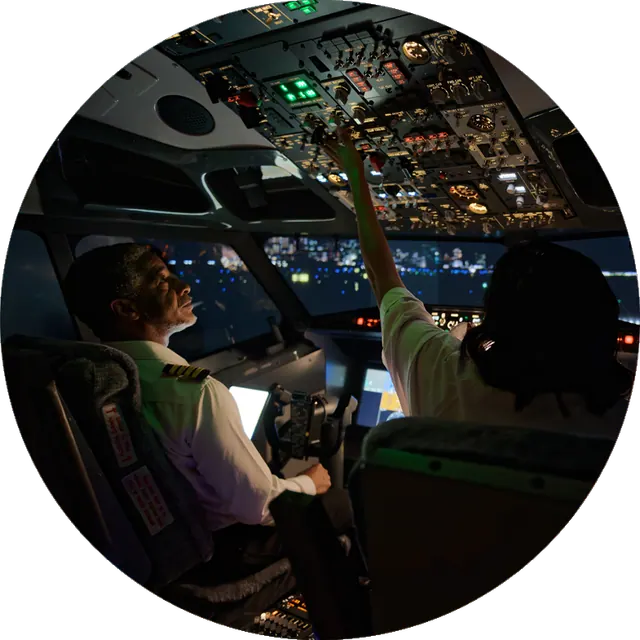
Aviation · United Kingdom

Aviation counts duty hours. Its people run on sleep.

Pilots, cabin crew and controllers work early starts, nights and time-zone changes. Duty limits cap hours, not sleep obtained, and a fatigue lapse in flight or on the ground can be catastrophic.

Regulation changed 6 Apr 2026Change coming 30 Oct 2026

Aviation workforce

Who this page covers

  • Aeromedical retrieval services (also see Healthcare & Nursing)
  • Air freight and express airlines
  • Air traffic control
  • Aircraft maintenance (MRO) and line engineering
  • Airlines - cabin crew
  • Airlines - flight crew (pilots)
  • Airport operators (also see Emergency Services, Retail & Hospitality, Security Services)
  • Charter, regional, helicopter and offshore helicopter operators
  • Ground handling - ramp, baggage, fuel, cargo

Reg Watch

What’s changed, and what’s coming

Regulatory change that affects how you manage fatigue in aviation: what has changed in the last 12 months, and what is on the way.

Recent changeFrom 6 April 2026

Applies across industries in the United Kingdom

In Great Britain, from 6 Apr 2026 sick pay is due from the first day of sickness and you must keep holiday records for 6 years; from 1 Oct 2026 most tribunal claims can be brought up to 6 months after the event.

Read the change

Upcoming changeExpected from 30 October 2026Within 12 months

From October 2026 (expected 30 Oct) you must take all reasonable steps to prevent sexual harassment of staff, including by customers and other third parties. From 1 Jan 2027 unfair dismissal protection starts after 6 months' service. Guaranteed hours and shift-notice rights for zero-hours workers are listed for 2027, timing to follow consultation.

Regulatory changes checked as at 1 October 2026.

Regulation

Who regulates it, and what they expect

Flight and cabin crew sit outside the general working-hours rules and under a prescriptive aviation regime instead. UK-retained Subpart FTL, enforced by the CAA, sets maximum flight duty periods that shorten as sectors increase and as duties start in the body-clock low, minimum rest between duties, cumulative caps on flying and duty over rolling weeks, months and the year, and recurring extended recovery rest. Variations such as extended two-pilot duty or reduced rest are available only with approved fatigue risk management. These are duties on the operator: no crew member can sign them away, and no signed form moves the risk to the individual.

Regulated by
  • UK Civil Aviation AuthorityCAA

Logos identify the regulator and don’t imply endorsement.

Who regulates it

Aviation has its own dedicated regulator on top of the general baseline: the Civil Aviation Authority (CAA). The CAA controls pilot and cabin crew licensing, airline operating certificates, and - crucially for fatigue - flight and duty time rules, carried over from EU law after Brexit into UK law. This sits alongside, not instead of, the general safety regulator (HSE) and Employment Tribunal system that covers everyone else.

Your obligations

Airlines must build rosters around strict, regulator-approved limits: how long a duty period can run (shorter with more flights packed in, or for early/overnight starts), minimum rest between duties, and caps on total flying and duty hours over a week, month and year, plus guaranteed recovery periods on a regular cycle. Airlines must keep detailed crew records and report fatigue-related safety incidents. An airline can instead run its own approved fatigue management system, but it must be continuously monitored with real data. None of this can be opted out of by individual staff.

Consequences

The sanction that bites in aviation is the licence, not the fine. The CAA can vary, suspend or revoke an Air Operator Certificate, restrict how you may operate until the problem is fixed, and act against individual crew licences; a restriction grounds aircraft and cancels flights the same day. Fatigue occurrences are reportable, and that report history sits in front of the regulator at every audit. Where fatigue contributes to an accident or serious incident the Air Accidents Investigation Branch investigates and publishes independently of the CAA, putting your rostering data into the public record. Ground and engineering staff stay under general safety law, with prosecution and turnover-scaled fines on top.

Penalties

An FTL failure is priced in cancelled flights and displaced crew while an AOC is restricted or suspended, not a court fine. On the ground the general regime applies: fines follow the 2016 sentencing guideline and scale with turnover, reaching a £4 million starting point and a £2.6m-£10m range at turnover of £50m or more, with courts going higher for very large organisations, and up to two years' imprisonment for a director whose neglect caused the offence.

Sources: UK Air Navigation Order 2016; retained EU flight time limitation rules (Reg 965/2012, Subpart FTL); Civil Aviation Act 1982; Civil Aviation Authority guidance (CAP 371, CAP 719); Air Accidents Investigation Branch.

Fatigue-critical roles

Where fatigue matters most in aviation

The roles where a fatigued worker is most likely to cause serious harm, the tasks that carry the risk, and why fatigue builds up in them.

RoleRiskHigh-risk tasksWhy fatigue builds
Airline pilot (captain / first officer)
Rules
Regulatory designation
Flight crew member (UK Reg 965/2012 Annex III Subpart FTL); Class 1 medical (UK Part-MED, MED.B.015 sleep apnoea)
Hours and rest
ORO.FTL.205-235: FDP 9-13 h by start time and sectors; rest at least the preceding duty or 12 h at home base (10 h away)
Critical riskFlying approaches and landings after extended duty or through the window of circadian low; multi-sector days; managing non-normal events at the end of a dutyEarly report times, overnight flights, time-zone crossing, reserve and standby, short-notice roster changes
Air traffic controller (NATS, airport ANSPs)
Rules
Regulatory designation
Licensed ATCO (UK Reg 2015/340); provider duties ATS.OR.315 fatigue programme and ATS.OR.320 rostering (UK Reg 2017/373)
Hours and rest
ATS.OR.320 rostering system; CAA SRATCOH hours scheme (CAP 670) on duty and break limits
Critical riskSeparating traffic on low-workload overnight positions, sometimes single-person; handling the morning surge at the end of a night shift; coordination and handovers24/7 rotating shifts with quick returns, night shifts, single-person night operations at some units
B1/B2 licensed aircraft engineer (certifying staff)
Rules
Regulatory designation
Certifying staff (UK Part-66 licence; Part-145.A.35); shift planning must reflect human performance limits (145.A.47)
Hours and rest
WTR 1998: 48 h average (opt-out possible), 11 h daily rest; reg 7 night-worker health assessment
Critical riskNight-shift line and base maintenance; flight-control rigging, torque and duplicate-inspection tasks; certifying release to service at the end of a long shiftNight shifts to meet first-wave departures, AOG overtime, 12 h shifts, rotating rosters
Air ambulance / HEMS pilot
Rules
Regulatory designation
Flight crew member (UK AOC); outside Subpart FTL - national scheme (CAP 371)
Hours and rest
CAA-approved national FTL scheme (CAP 371) for HEMS and air taxi
Critical riskSingle-pilot night aeromedical or charter flights after an on-call call-out; helicopter landings at unlit sites; IFR approaches at the end of dutyOn-call and standby with night call-outs, single-pilot operations, remote bases
Cabin crew member
Rules
Regulatory designation
Cabin crew (UK Reg 965/2012 Subpart FTL); crew member (Civil Aviation (Working Time) Regs 2004 reg 5 health assessment)
Hours and rest
ORO.FTL limits; CAWTR 2004: 900 block hours and 2,000 duty hours a year
High riskSafety and emergency duties, evacuation command and in-flight incident response after long or overnight duties; door arming and cross-checksEarly starts, overnight and long-haul duties, multi-sector days, time-zone crossing, standby
Ramp agent / baggage handler
Rules
Regulatory designation
None specific - general duty (HSWA s 2); night worker (WTR 1998 reg 2)
Hours and rest
WTR 1998: 48 h average (opt-out possible), 11 h daily rest; reg 7 night-worker health assessment
High riskAircraft pushback and towing; baggage tug driving and loading near engines and stairs; refuelling hook-ups on overnight turnsSplit shifts and starts from 04:00, night freight turns, overtime in peaks, outdoor work

Stories

When fatigue made the record

Published findings and prosecutions from regulators, courts and investigators in the United Kingdom.

  • Mar 2022 · England, United Kingdom

    Business jet terrain warning on approach; fatigue may have contributed

    • Safety

    A business jet flew an unstable non-precision approach to a regional airport in cloud, triggering a terrain warning. The Air Accidents Investigation Branch found that fatigue and miscommunication may have been contributory factors.

    Case UK-aviation-01Report an issue

See all aviation news

How the suite fits

How each product connects to your obligations

Grades describe how strongly a product connects to an obligation. None discharges an obligation, and none carries a compliance warranty.

Awareness eLearning

The regulation names this step

ORO.FTL.250 says you must give crew, rostering staff and managers initial and recurrent fatigue management training covering the causes and effects of fatigue and countermeasures. Awareness eLearning supplies the content named at ORO.FTL.250; your programme stays yours.

About Awareness eLearning

Sleepfit

Supports a named obligation

You must entitle every crew member to a free health assessment on joining and at regular intervals (reg 5, Civil Aviation (Working Time) Regulations 2004), and MED.B.015 of Part-MED names sleep apnoea. Sleepfit supports both. It screens; diagnosis stays with your clinicians.

About Sleepfit

Fatiguefit4Duty

Supports a named obligation

ORO.FTL.110 says you must plan duty periods so crew stay sufficiently free from fatigue, and ORO.FTL.115 makes crew responsible for their rest. Fatiguefit4Duty supports both. A fitness-for-duty check, not a fitness-for-duty decision - the duty call stays with you.

About Fatiguefit4Duty

Was It Fatigue?

Supports a named obligation

Crew fatigue is a mandatory reportable occurrence under UK Regulation 2015/1018, and Article 13 of UK Regulation 376/2014 says you must analyse occurrences for hazards. Was It Fatigue? supports that analysis. A structured judgement aid, not a determination of cause.

About Was It Fatigue?

SleepWellBaby

No UK aviation rule reaches sleep in new-parent households; crew fatigue rules attach to crew duties and rest. SleepWellBaby supports your working parents as a wellbeing benefit and not a compliance step.

About SleepWellBaby

Recommended bundle

Where we’d start in aviation

Every bundle is priced on prevalence: your whole cohort gets access, and you pay for the share predicted to need each product. How pricing works.

Why this pairing in the United Kingdom

ORO.FTL.250 names initial and recurrent fatigue training; Awareness eLearning supplies it with a record. Fatiguefit4Duty supports ORO.FTL.110 and 115; Sleepfit supports the reg 5 crew health assessment. Fatigue Lifecycle adds Was It Fatigue? for Article 13 occurrence analysis.

See what sleep and fatigue mean for your aviation workforce.

Tell us roughly how many people you employ. Your snapshot models how many are likely sleeping poorly and what it costs, from published research for aviation. Then choose who you’d cover, and we’ll take you to the right next step.

A sample workforce snapshot on a tablet: modelled sleep problems and the cost of poor sleep for 1,400 people in transport and logistics.