
Upcoming changeExpected from 2027
The Workplace Fairness Act 2025, which will bar discrimination including on disability and mental health conditions, has passed but is not yet in force; MOM targets commencement around end-2027.
Aviation · Singapore
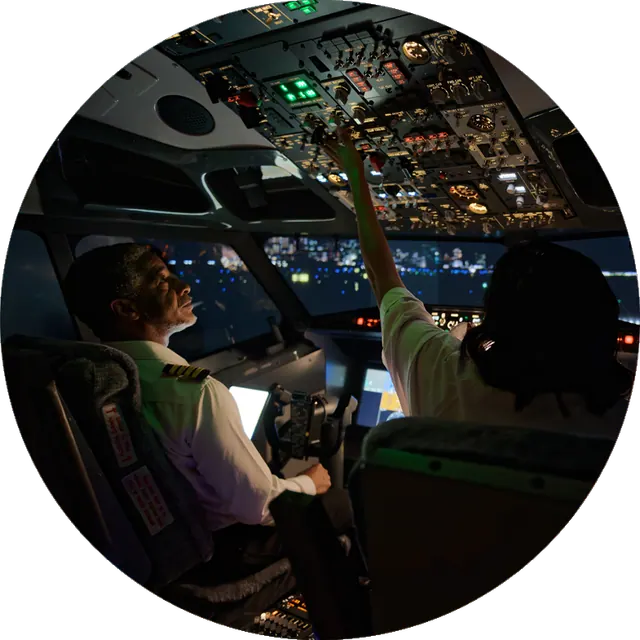
Pilots, cabin crew and controllers work early starts, nights and time-zone changes. Duty limits cap hours, not sleep obtained, and a fatigue lapse in flight or on the ground can be catastrophic.
Reg Watch
Regulatory change that affects how you manage fatigue in aviation: what has changed in the last 12 months, and what is on the way.
Upcoming changeExpected from 2027
The Workplace Fairness Act 2025, which will bar discrimination including on disability and mental health conditions, has passed but is not yet in force; MOM targets commencement around end-2027.
Regulatory changes checked as at 1 October 2026.
Regulation
Aviation is one of the few Singapore sectors with binding fatigue rules. The Air Navigation (121 - Commercial Air Transport by Large Aeroplanes) Regulations 2018 require Singapore airlines to establish a fatigue risk management programme, assess fatigue risk continuously and keep crew within the flight time limitations the regulations set. CAAS advisory circulars - AC 121-11-1 (revised January 2025), AC 121-11-2 for ultra-long-range flights and AC 135-11-1 for ANR-135 operators - describe what CAAS accepts.
 CAAS
Logos identify the regulator and don’t imply endorsement.
The Civil Aviation Authority of Singapore (CAAS) regulates crew fatigue for Singapore air operators through the Air Navigation Regulations, tied to the Air Operator Certificate. MOM and the baseline safety and employment law cover ground staff, engineers and other employees.
As an Air Operator Certificate holder you must establish a fatigue risk management programme, assess crew fatigue risk continuously, keep crew within the regulated flight time, duty and rest limits, and have procedures for controlled rest on the flight deck. The advisory circulars are guidance: they set out means of compliance CAAS accepts, not additional law. AC 121-11-2 sets CAAS's expectations for ultra-long-range flights, including crew complement and in-flight rest. Ground and engineering staff fall under the baseline.
Fatigue failures go to your licence to operate: CAAS can suspend or revoke an Air Operator Certificate, and the air operator certification regulations provide financial penalties of up to the higher of S$500,000 or 5% of annual revenue from the regulated activity (2026). Ground operations carry the baseline: up to S$500,000 for a company and S$200,000 and/or two years' jail for an individual (WSH Act maxima, 2026).
For an operator, financial penalties reach the higher of S$500,000 or 5% of annual revenue from the regulated activity (2026). The larger cost is operational: a varied or suspended certificate grounds the affected operation. Ground-side incidents carry baseline costs, including work injury compensation of up to S$269,000 for a death (from 1 November 2025).
On the record
No Singapore court, coroner, investigator or regulator has published a finding linking fatigue to an incident in aviation. Fatigue risk still falls under the Workplace Safety and Health Act duty and MOM's fatigue management guidelines.
Sources: Air Navigation Act 1966; Air Navigation (121) Regulations 2018, Division 11; Air Navigation (119 - Air Operator Certification) Regulations 2018; CAAS AC 121-11-1 (Rev 1, January 2025), AC 121-11-2, AC 135-11-1.
Fatigue-critical roles
The roles where a fatigued worker is most likely to cause serious harm, the tasks that carry the risk, and why fatigue builds up in them.
| Role | Risk | High-risk tasks | Why fatigue builds |
|---|---|---|---|
Pilot (captain / first officer)Rules
| Critical risk | Flying approaches and landings after extended duty or through the window of circadian low; multi-sector days; managing non-normal events at the end of a duty | Early report times, overnight flights, time-zone crossing, reserve and standby, short-notice roster changes |
Air traffic controller (CAAS)Rules
| Critical risk | Separating traffic on low-workload overnight positions, sometimes single-person; handling the morning surge at the end of a night shift; coordination and handovers | 24/7 rotating shifts with quick returns, night shifts, single-person night operations at some units |
Licensed aircraft engineerRules
| Critical risk | Night-shift line and base maintenance; flight-control rigging, torque and duplicate-inspection tasks; certifying release to service at the end of a long shift | Night shifts to meet first-wave departures, AOG overtime, 12 h shifts, rotating rosters |
Helicopter / charter pilotRules
| Critical risk | Single-pilot night aeromedical or charter flights after an on-call call-out; helicopter landings at unlit sites; IFR approaches at the end of duty | On-call and standby with night call-outs, single-pilot operations, remote bases |
Flight stewardess / steward (cabin crew)Rules
| High risk | Safety and emergency duties, evacuation command and in-flight incident response after long or overnight duties; door arming and cross-checks | Early starts, overnight and long-haul duties, multi-sector days, time-zone crossing, standby |
Ramp handling officer / baggage handlerRules
| High risk | Aircraft pushback and towing; baggage tug driving and loading near engines and stairs; refuelling hook-ups on overnight turns | Split shifts and starts from 04:00, night freight turns, overtime in peaks, outdoor work |
How the suite fits
Grades describe how strongly a product connects to an obligation. None discharges an obligation, and none carries a compliance warranty.
Was It Fatigue? structures a fatigue review of an occurrence. The prescriptive scheme requires none; with an approved FRMS, paragraph 20(4) of the Fifth Schedule requires you to identify fatigue's contribution to events. A structured judgement aid, not a determination of cause.
About Was It Fatigue?SleepWellBaby supports parents among your crew and ground staff through the most broken months of infant sleep. No Singapore aviation rule reaches sleep in new-parent households; it is offered as a benefit.
About SleepWellBabyRecommended bundle
Every bundle is priced on prevalence: your whole cohort gets access, and you pay for the share predicted to need each product. How pricing works.
Proactive fatigue risk: assess, manage and train, with sleep screening underneath.
Assess, manage, investigate: from the Census to the point of duty to the post-incident review.
Why this pairing in Singapore
Air Navigation (121) Regulations reg 179(3)(d) requires fatigue education; Awareness eLearning supplies it with a record. Fatiguefit4Duty supports ANR-91 reg 18(2), no flight with fatigue-reduced capacity; Sleepfit screens crew. Fatigue Lifecycle adds review for FRMS operators.
Tell us roughly how many people you employ. Your snapshot models how many are likely sleeping poorly and what it costs, from published research for aviation. Then choose who you’d cover, and we’ll take you to the right next step.
