Servicios penitenciarios y de custodia · Estados Unidos

El sueño y la fatiga en servicios penitenciarios y de custodia

Custodial officers work 24/7 rotating rosters with nights, overtime and extended shifts. Fatigue impairs vigilance, threat assessment and de-escalation where incidents escalate fast.

Fuerza laboral de Servicios penitenciarios y de custodia

A quién cubre esta página

  • Community corrections and probation
  • Immigration detention
  • Prisoner transport and court custody
  • Private prisons (contract operators)
  • Public prisons
  • Youth justice centers

Regulación

Quién la regula y qué espera

El detalle normativo y de investigación de esta página se muestra en inglés.

There is no dedicated federal fatigue law for corrections. Federal OSHA does not cover state or county employees, so most public correctional agencies are reached only in the 27 states plus Puerto Rico and the US Virgin Islands whose approved plans cover government workers; private operators are covered everywhere, and Bureau of Prisons staff sit under a federal-agency safety program that carries no fines. Shift and overtime limits come from labor agreements. Where states have legislated, the result has been reporting and premium pay, not a cap on hours.

Regulado por
  • Occupational Safety and Health AdministrationOSHA

Los logotipos identifican al regulador y no implican respaldo.

Quién la regula

OSHA's General Duty Clause, the ADA, FMLA and workers' compensation apply - but most correctional officers work for state or county government, so federal OSHA reaches them only in the 27 states whose approved plans cover public employees. Private prison operators get no such exemption, and federal Bureau of Prisons staff sit under a federal-agency safety program. Officer hours themselves are set mainly by labor agreement.

Sus obligaciones

No federal law caps a correctional officer's shift length or requires rest between shifts. Coverage is uneven: the General Duty Clause reaches private prison operators everywhere but public agencies only in the states whose approved plans cover government workers. PREA requires a documented staffing plan, reviewed at least annually, but sets no ratios and no hours limits for adult facilities. Colorado goes furthest - the department must set criteria for when an officer may work two consecutive shifts, and pay time and a half past eight and a half hours whenever an officer works twelve or more in a day.

Consecuencias

Where OSHA has jurisdiction, a fatigue-driven failure is citable under the General Duty Clause and abatement can be ordered. For most public agencies the exposure runs elsewhere: ADA failure-to-accommodate and FMLA interference claims, workers' compensation for fatigue-linked vehicle crashes and use-of-force injuries, grievance and arbitration over forced overtime, and civil claims where an assault, escape or in-custody death is traced to an unfilled post or an officer held over. A documented pattern of holding staff over is discoverable in every one of those proceedings.

Sanciones

OSHA maximums are at 2025 levels and remain in force for 2026: $16,550 per serious or other-than-serious violation, $165,514 per willful or repeat violation. The federal-agency program covering Bureau of Prisons staff provides for findings and abatement, not fines. No penalty attaches to hours worked, because no hours cap exists.

Fuentes: OSHA General Duty Clause, Occupational Safety and Health Act and State Plans; 29 CFR Part 1960; ADA; FMLA; PREA staffing plan rule (28 CFR 115.13); Colorado Rev. Stat. 17-1-115.8; Washington HB 1345 (2019); CRS report on federal prison staffing (2026); 2026 OSHA penalty schedule.

Puestos críticos por fatiga

Dónde más importa la fatiga en servicios penitenciarios y de custodia

Los puestos en los que un trabajador fatigado tiene más probabilidades de causar daños graves, las tareas que conllevan el riesgo y por qué se acumula la fatiga.

El detalle normativo y de investigación de esta página se muestra en inglés.

PuestoRiesgoTareas de alto riesgoPor qué se acumula la fatiga
Correctional officer / detention officer (jail deputy)
Reglas
Designación normativa
None specific - OSHA general duty for private operators and State Plan public employers; BOP via 29 CFR 1960
Horas y descanso
None federal; collective agreements; Colorado C.R.S. 17-1-115.8 double-shift criteria
Riesgo críticoNight unit checks and at-risk prisoner observations; cell extractions and use of force late in extended shifts; key, count and movement controlMandatory overtime and forced double shifts (16 h), 12 h rotations, understaffed nights
Transport officer (inmate transport)
Reglas
Designación normativa
None specific - OSHA general duty for private operators and State Plan public employers; BOP via 29 CFR 1960
Horas y descanso
None federal; collective agreements; Colorado C.R.S. 17-1-115.8 double-shift criteria
Riesgo altoDriving secure prisoner vehicles long distances; overnight hospital bed-watch escorts; court escorts after early startsEarly starts, long days, overnight hospital watches, long-distance transfers
Master control officer
Reglas
Designación normativa
None specific - OSHA general duty for private operators and State Plan public employers; BOP via 29 CFR 1960
Horas y descanso
None federal; collective agreements; Colorado C.R.S. 17-1-115.8 double-shift criteria
Riesgo altoMonitoring CCTV, alarms and door control overnight; controlling movements; coordinating response to incidents12 h shifts with nights, screen monotony, overtime
Juvenile detention officer
Reglas
Designación normativa
None specific - OSHA general duty for private operators and State Plan public employers; BOP via 29 CFR 1960
Horas y descanso
None federal; collective agreements; Colorado C.R.S. 17-1-115.8 double-shift criteria
Riesgo altoNight supervision of young people in custody; restraint decisions; at-risk welfare observations12 h shifts with nights, overtime from vacancies, high-stress incidents
Detention officer (ICE contract facility)
Reglas
Designación normativa
None specific - OSHA general duty for private operators and State Plan public employers; BOP via 29 CFR 1960
Horas y descanso
None federal; collective agreements; Colorado C.R.S. 17-1-115.8 double-shift criteria
Riesgo altoNight supervision of detainees; welfare checks of at-risk detainees; use of force and removal escorts12 h shifts with nights, overtime, overnight removal escorts

Riesgo de fatiga estacional

Cuándo aumenta el riesgo de fatiga en servicios penitenciarios y de custodia.

La estación por sí sola mueve poco el riesgo de fatiga. Los efectos más marcados vienen de semanas y cargas de trabajo concretas. Estos son los periodos que importan en servicios penitenciarios y de custodia en Estados Unidos en 2027, incluidos los que afectan a toda la población trabajadora.

  1. 14 Mar · Medido

    Clocks spring forward

    Fatal crashes up about 6% the following week; mining injuries up 5.7% the next Monday

  2. Jun to Aug · Medido

    Hottest nights, longest days

    Warm nights and long days shorten sleep

  3. 7 Nov · Medido

    Clocks go back

    No net change in crash risk; pedestrian risk rises in dark evenings

Medido: un estudio publicado encontró un cambio en el sueño, las lesiones o los accidentes. Documentado: un cambio registrado en la carga de trabajo o la exposición, como horas extra o despliegues. Las fechas son de 2027 y cambian cada año. Nuestra lectura de la evidencia publicada, actualizada cada noviembre. Los eventos se muestran en inglés.

Casos

Cuando la fatiga quedó registrada

Hallazgos y procesos publicados por reguladores, tribunales e investigadores en Estados Unidos.

El detalle normativo y de investigación de esta página se muestra en inglés.

  • ago 2024 · Virginia, United States

    Officer asleep on 14-hour overnight hospital guard post loses job; long hours explain but do not excuse, hearing officer rules

    • Legal

    A state corrections officer guarding an inmate-patient in an unsecured hospital room was found apparently asleep at about 5:22 am, around 11 hours into a shift that ran from about 6:00 pm to 8:00 am. The hearing officer accepted that long hours and feeling overworked may have contributed, but held that the officer was expected to report fit for duty and to ask for relief if he could not stay alert. The termination was upheld, with its effective date corrected and back pay for any premature termination.

    Caso US-corrections-07Informar de un error

Ver todas las noticias de servicios penitenciarios y de custodia

Cómo encaja la plataforma

Cómo se vincula cada producto con sus obligaciones

Las calificaciones describen con qué fuerza se vincula un producto a una obligación. Ninguno cumple por usted una obligación y ninguno conlleva una garantía de cumplimiento.

El detalle normativo y de investigación de esta página se muestra en inglés.

Sleepfit

Apoya su deber general de cuidado

No corrections rule requires sleep-health checks. Sleepfit supports your general duty case where OSHA reaches you, run as a voluntary, confidential program under the ADA. It identifies employees who may benefit from clinical evaluation; diagnosis stays with your clinicians.

Acerca de Sleepfit

Fatiguefit4Duty

Apoya su deber general de cuidado

Nothing requires a fitness check before a held-over shift. A structured check at mandatory-overtime call-out supports the general duty where OSHA reaches you, and evidences care where it does not.

Acerca de Fatiguefit4Duty

Awareness eLearning

Apoya su deber general de cuidado

No corrections rule names fatigue training. Training is voluntary, and it supports the general duty case where OSHA has jurisdiction and the record you build for grievance and civil proceedings.

Acerca de Awareness eLearning

Was It Fatigue?

Apoya su deber general de cuidado

No rule requires fatigue to be examined after an assault, escape or in-custody death. Structured analysis supports the record you will be asked for in grievance, tort and civil-rights proceedings.

Acerca de Was It Fatigue?

SleepWellBaby

No obligation is engaged here. Sleep support for officers with infants is a voluntary wellbeing measure, not a step any federal rule, state statute or PREA requirement asks you to take.

Acerca de SleepWellBaby

Nivel 4: errores relacionados con la fatiga

Cuando la fatiga se cuela, atrape el error.

Los controles de nivel 4 atrapan o detectan los errores relacionados con la fatiga antes de que causen daño. Otros los integran en los equipos, las tareas y los procedimientos: nosotros no los suministramos ni los respaldamos, y podemos indicarle proveedores. Estos son los tipos que se aplican en servicios penitenciarios y de custodia.

  • Procedural cross-check

    Two-person checks

    A second qualified person checks critical actions so one tired person's slip is caught.

    Lo que no hace: Both people may be fatigued on the same roster, so it relies on fatigue-aware rostering behind it.

    Ejemplos: Rail: two-person crews and call-outs. Aviation: two-pilot cross-checks. Utilities: switching verification. Hospitals: double checks.

  • Remove exposure

    Scheduling critical tasks away from the early-morning low

    Moves the highest-risk tasks out of the early-morning hours when errors are most likely.

    Lo que no hace: It reduces exposure but does not trap the error; it depends on planners knowing when fatigue peaks.

    Ejemplos: Maintenance: critical work scheduled off night shift. Hospitals: elective procedures in daytime.

  • Procedural cross-check

    Structured shift handover

    A fixed handover script and read-back at shift change catch what a tired outgoing worker forgets to mention.

    Lo que no hace: It covers the shift change only, not errors during the shift.

    Ejemplos: Hospitals: I-PASS or ISBAR. Ambulance: handover to emergency departments. Process plants and control rooms: structured shift logs.

  • Procedural cross-check

    Electronic welfare and patrol checks

    Each welfare check or patrol point is scanned on site and time-stamped, so missed checks on night shift show up straight away.

    Lo que no hace: It proves someone was present, not that they looked properly.

    Ejemplos: Prisons and police custody: cell checks. Security: patrol checkpoints. Mental health units: observation logging.

La mayor parte de la evidencia sobre la tecnología de detección de fatiga proviene de los propios proveedores. Pida una evaluación independiente antes de depender de ella.

En sectores como servicios penitenciarios y de custodia, confían en nosotros

Vea lo que el sueño y la fatiga significan para su fuerza laboral en servicios penitenciarios y de custodia.

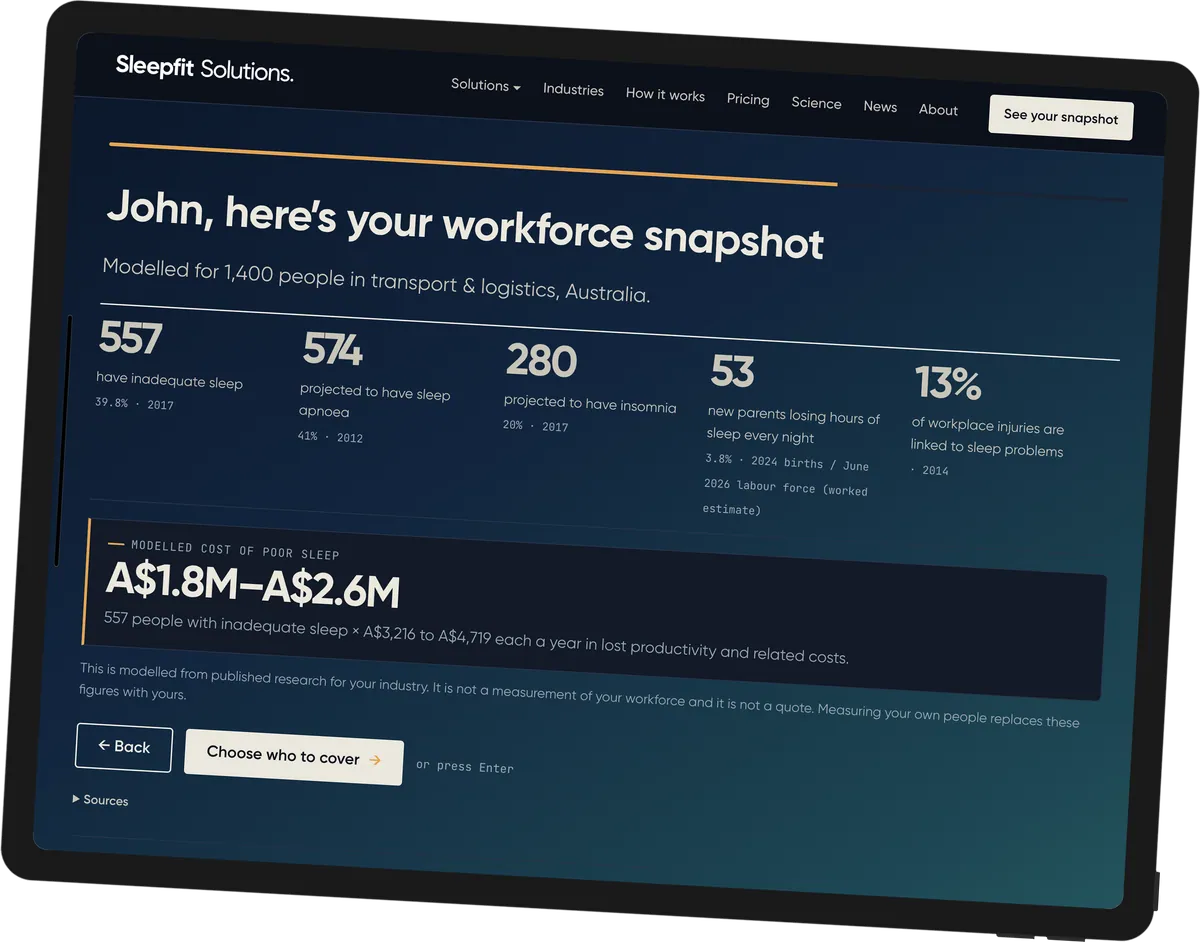
Indíquenos aproximadamente cuántas personas emplea. Su panorama estima cuántas probablemente duermen mal y cuánto cuesta, a partir de investigaciones publicadas sobre servicios penitenciarios y de custodia. Luego díganos en qué quiere enfocarse y le mostraremos cómo funcionaría el acceso abierto para usted y cuánto costaría.

Un ejemplo de instantánea de la fuerza laboral en una tableta: problemas de sueño modelados y el costo del sueño deficiente para 1.400 personas en transporte y logística.