





Evidence-based sleep and fatigue solutions

Better sleep. Safer work.

One platform for Risk & Safety, Health & Wellbeing and On-claim Recovery: use what you need. We help your people act on the sleep problems they never report, control fatigue where it’s a hazard, support recovery when an injury is affecting someone’s sleep, and show you the evidence.

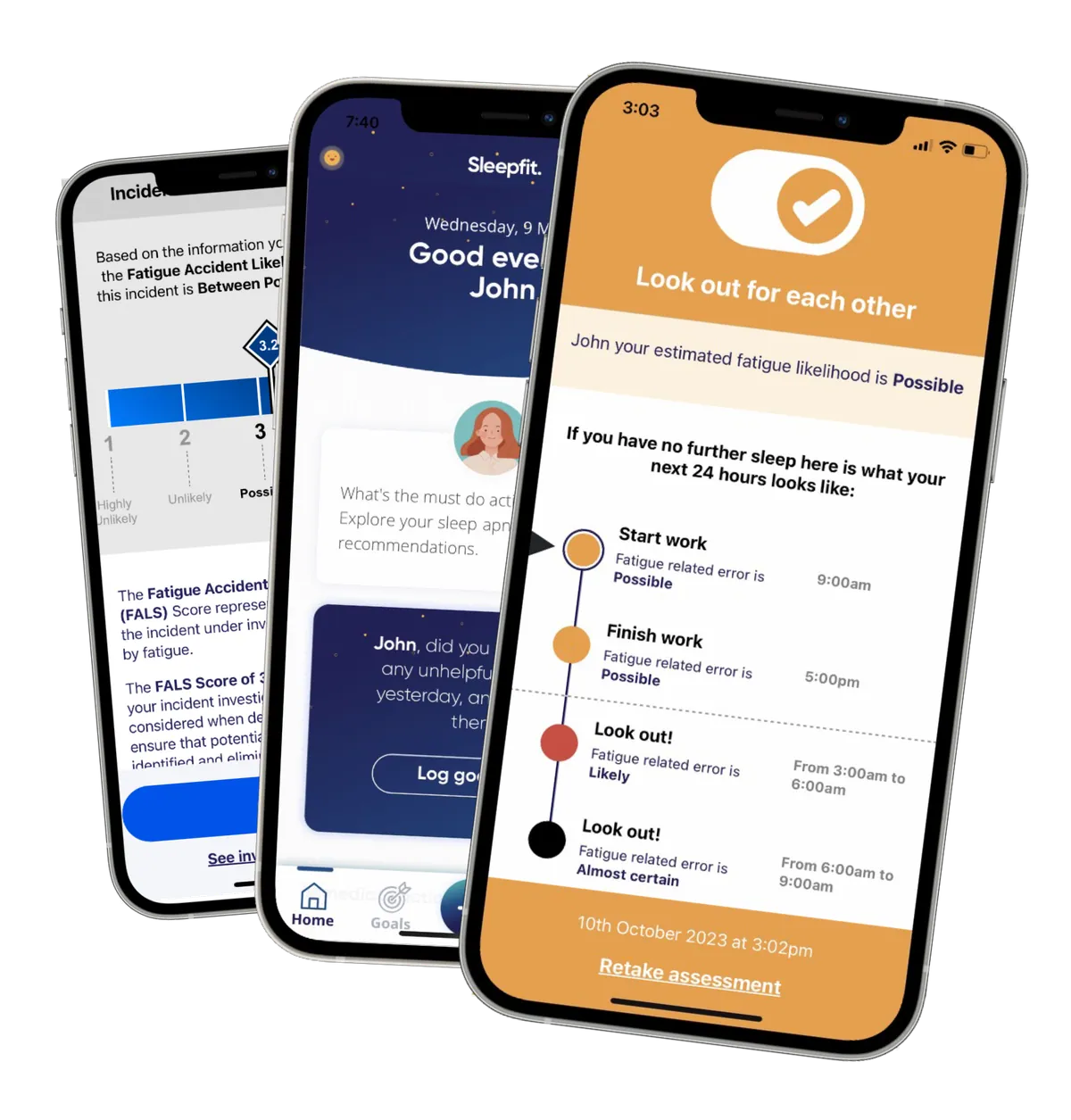
The Sleepfit app on three phones: an incident’s Fatigue Accident Likelihood score, the home screen, and a 24-hour fatigue forecast.

Trusted by

Solutions

From prevention to return to work.

Risk & Safety

Focus on fatigue as an occupational safety and health hazard: assess it, measure the sleep behind it and identify who may benefit from clinical evaluation, control it at the point of duty, train for it and investigate it.

Risk & Safety overview

Health & Wellbeing

On the same platform, focus on sleep health across your whole workforce: measure it and act on it, privately, including for new parents.

Health & Wellbeing overview

On-claim Recovery

When an injury or illness is affecting someone’s sleep: the case manager refers, the claimant completes a private sleep assessment and gets a plan and support, and repeats it every six weeks while the claim is open.

On-claim Recovery overview

Industries

What sleep and fatigue mean, industry by industry.

How sleep and fatigue affect safety, health and performance in your industry, who regulates it, and where each product fits.

33 industries in the United States, by how fatigue is governed

2 / 33

Fatigue-regulated

Named legal obligations to manage fatigue

9 / 33

Safety-critical

A recognized hazard in high-consequence work

9 / 33

Shift-based operations

Managed under the general duty of care, often on shifts

13 / 33

General workforce

A health, wellbeing and performance issue

What does it mean for your industry?

Search by industry or type of business, like trams, aged care or a coal mine.

All 33 industries

How it works

Measure first, then decide.

Start with a smaller group at standard rates, then open access to everyone, with the focus on Risk & Safety, Health & Wellbeing, or both.

  1. Days to weeks

    Scoping

    Your snapshot and a scoping session agree what to focus on and who starts, often with Fatiguefit where fatigue is a safety risk.

  2. 90 days

    Pilot

    A smaller group, such as a site, team or leadership group, starts at standard rates, with an interim read at day 45.

  3. Your decision

    Rollout

    Open it to everyone, or stop, on what you measured rather than a forecast.

How it works

Pricing

Open access to all. Pay for what you use.

Every solution, open to all your people, with no seats to count. An access fee opens the platform; after that you pay for what your people actually use, capped per person. No lock-in.

How open access works
All 100 people get access About 33 aren’t getting enough sleep

Science

Five levels of defense. We cover three.

Fatigue reaches harm through five independent levels. A control at one level does not substitute for a control at another, so we say where each product sits, and where we don’t operate.

Every product page says what the product establishes and what it doesn’t. We identify people who may benefit from clinical evaluation; we do not diagnose. Nothing we sell discharges a regulatory obligation.

The science and the evidence
  1. Level 1: Sleep opportunityFatiguefit*
  2. Level 2: Sleep obtainedSleepfit, Fatiguefit4Duty, SleepWellBaby
  3. Level 3: Behavioral symptoms at workFatiguefit4Duty
  4. Level 4: Fatigue-related errorsProvided by others
  5. Level 5: Fatigue-related incidentsWas It Fatigue?

* Optionally, we work with a partner to review your rosters as part of the Fatiguefit risk assessment.

Framework: Dawson D & McCulloch K, "Managing fatigue: it's about sleep", Sleep Medicine Reviews, 2005. Level 4 fatigue-proofing after Dawson, Chapman & Thomas, 2012.

News

Fatigue regulation is changing

The latest changes to fatigue rules, codes and guidance from regulators across the industries we cover, newest first.

All regulation changes
  • Regulation change · Oct 5, 2026

    From 5 October 2026, when a governor or FMCSA declares a regional emergency, drivers giving direct assistance are relieved of the hours-of-service limits for 30 days instead of 14.

    The relief removes the hours cap, not the fatigue risk: the duty not to require or permit a fatigued driver to drive still applies. Separately, from 12 October 2026 drivers outside Alaska can no longer use a paper medical examiner's certificate as proof of medical certification.

About

Founded in 2016, for two reasons.

Our founders came to sleep by different roads. Each road leads to a point of focus, and both meet on one platform.

About us

In partnership with

  • Personify Health
  • Tresillian
  • CQUniversity Appleton Institute
  • UTS
  • University of Sydney

As seen on

  • Channel 7
  • Channel 9
  • Channel 10
  • ABC
  • Sydney Morning Herald
  • Prime Mover
  • Kidspot
  • Essential Baby
  • HCF
  • Amazon Web Services

See what sleep and fatigue mean for your workforce.

Tell us your industry and roughly how many people you employ. Your snapshot models how many are likely sleeping poorly and what it costs you. Then tell us what you want to focus on, and we’ll show you how open access would work for you, and what it would cost.

A sample workforce snapshot on a tablet: modeled sleep problems and the cost of poor sleep for 1,400 people in transport and logistics.