Cuidado de adultos mayores y servicios para personas con discapacidad · Estados Unidos

El sueño y la fatiga en cuidado de adultos mayores y servicios para personas con discapacidad

Carers and nurses work nights, sleepovers and rotating shifts, often across two jobs. Fatigue raises the risk of medication errors, falls and manual-handling injury with vulnerable people.

Cambio normativo: 3 dic 2025

Fuerza laboral de Cuidado de adultos mayores y servicios para personas con discapacidad

A quién cubre esta página

  • Disability supported accommodation
  • Home care and community aged care
  • NDIS in-home support workers
  • Out-of-home care and residential youth care
  • Residential aged care

Cambios normativos

Qué ha cambiado y qué viene

Cambios normativos que afectan la forma en que gestiona la fatiga en cuidado de adultos mayores y servicios para personas con discapacidad: lo que cambió en los últimos 12 meses y lo que está por venir.

El detalle normativo y de investigación de esta página se muestra en inglés.

Cambio recienteDesde el 3 de diciembre de 2025

Específico de cuidado de adultos mayores y servicios para personas con discapacidad

An interim final rule published 3 December 2025 repealed the 2024 federal minimum staffing standards for nursing homes. The sufficient-staffing duty in 42 CFR 483.35 and state staffing laws still apply.

Ver el cambio

Cambios normativos revisados al 2 de noviembre de 2026.

Regulación

Quién la regula y qué espera

El detalle normativo y de investigación de esta página se muestra en inglés.

No federal rule limits how long a US nursing home worker may be on duty. The CMS minimum staffing standards - 3.48 total nurse hours per resident day and a registered nurse on site around the clock - were vacated by two federal courts, blocked by statute until 30 September 2034, and repealed by CMS with effect from 2 February 2026. What 42 CFR 483.35 requires today is sufficient staff on a 24-hour basis, a registered nurse for at least 8 consecutive hours a day 7 days a week, and a full-time director of nursing. Fatigue is not mentioned anywhere in it.

Regulado por
  • Centers for Medicare & Medicaid ServicesCMS

Los logotipos identifican al regulador y no implican respaldo.

Quién la regula

State governments (through nurse mandatory-overtime laws in sixteen states) and the federal Centers for Medicare & Medicaid Services (CMS, for facilities billing Medicare or Medicaid) are the relevant sector-specific regulators. The general US workplace-safety baseline - OSHA, the ADA, and the FMLA - applies underneath all of this.

Sus obligaciones

Staff sufficiently on a 24-hour basis, provide registered nurse services for at least 8 consecutive hours a day 7 days a week, and designate a registered nurse as full-time director of nursing, each subject to waiver. Your facility assessment under 42 CFR 483.71 must consider staffing needs unit by unit and shift by shift, with direct care staff involved in making it. Your QAPI program must track adverse resident events and analyze their causes. In Pennsylvania, Act 102 bars mandating a nurse aide beyond their scheduled shift.

Consecuencias

CMS survey deficiencies attach to staffing, not to hours. Insufficient staffing under 42 CFR 483.35 can be cited up to immediate jeopardy and, at the extreme, CMS can terminate the Medicare and Medicaid provider agreement, which ends the facility's revenue. OSHA reaches fatigue only through the General Duty Clause, and only where the hazard is recognized. In Pennsylvania and Maine a state labor department can fine you for mandating overtime. Workers' compensation covers the injured worker either way.

Sanciones

OSHA maximums are at 2025 levels and in force for 2026: $16,550 serious or other-than-serious, $165,514 willful or repeat, $16,550 per day failure to abate. Pennsylvania Act 102 fines run $100 to $1,000 per violation. New York Labor Law 167 penalties are up to $1,000, $2,000 and $3,000 for a first, second and third violation within 12 months. There is no federal fatigue penalty.

Fuentes: 42 CFR 483.35 nursing services; CMS interim final rule repealing the 2024 minimum staffing rule (December 2025); Pennsylvania Act 102 of 2008; NY Labor Law s167; OSHA General Duty Clause and 2026 penalty schedule; Americans with Disabilities Act; Family and Medical Leave Act.

Puestos críticos por fatiga

Dónde más importa la fatiga en cuidado de adultos mayores y servicios para personas con discapacidad

Los puestos en los que un trabajador fatigado tiene más probabilidades de causar daños graves, las tareas que conllevan el riesgo y por qué se acumula la fatiga.

El detalle normativo y de investigación de esta página se muestra en inglés.

PuestoRiesgoTareas de alto riesgoPor qué se acumula la fatiga
Certified nursing assistant (CNA) / state-tested nurse aide (STNA)
Reglas
Designación normativa
Nurse aide in a certified facility (42 CFR 483.35(d) training and competency); otherwise general duty
Horas y descanso
None federal; 42 CFR 483.35 requires sufficient staffing, not hours limits
Riesgo altoNight rounds alone or in pairs: hoist and two-person transfers, falls response, medication assistance, continence care and repositioning across a whole wingPermanent or rotating nights, sleepover or sleep-in shifts, 10-12 h shifts, multiple employers, 06:00-07:00 starts
Charge nurse (RN or LPN), skilled nursing / long-term care facility
Reglas
Designación normativa
Licensed nurse under 42 CFR 483.35(b): licensed nurse 24 h a day; RN 8 consecutive h a day, 7 days a week
Horas y descanso
None federal; some state overtime limits
Riesgo altoSole RN overnight: medication rounds and controlled-drug checks, recognizing deterioration and deciding on hospital transfer, falls assessment, supervising carersRotating nights as the only RN on site, 10-12 h shifts, agency fill and double shifts to keep 24/7 RN cover
Home health aide (HHA) / personal care aide (PCA)
Reglas
Designación normativa
Home health aide in a Medicare-certified agency (42 CFR 484.80 training and competency); otherwise general duty
Horas y descanso
None federal (FLSA overtime pay applies to most home care workers since 2015)
Riesgo altoDriving own car between 8-12 client homes a day, lone personal care and transfers without a second carer, medication prompting; early and late callsSplit or broken shifts 07:00-21:00 with unpaid gaps, tight travel windows, lone work, weekend runs, multiple employers
Direct support professional (DSP) - group home / ICF/IID
Reglas
Designación normativa
Direct care staff in an ICF/IID (42 CFR 483.430) or HCBS waiver setting; otherwise general duty
Horas y descanso
No federal hours cap for adults; FLSA prices overtime only
Riesgo altoActive nights in group homes: responding to behaviors of concern, applying authorized restrictive practices, seizure response, manual handling, driving residentsActive and sleepover nights, 24 h shifts in some services, short-staffed lone nights, rotating rosters

Riesgo de fatiga estacional

Cuándo aumenta el riesgo de fatiga en cuidado de adultos mayores y servicios para personas con discapacidad.

La estación por sí sola mueve poco el riesgo de fatiga. Los efectos más marcados vienen de semanas y cargas de trabajo concretas. Estos son los periodos que importan en cuidado de adultos mayores y servicios para personas con discapacidad en Estados Unidos en 2027, incluidos los que afectan a toda la población trabajadora.

  1. 14 Mar · Medido

    Clocks spring forward

    Fatal crashes up about 6% the following week; mining injuries up 5.7% the next Monday

  2. Jun to Aug · Medido

    Hottest nights, longest days

    Warm nights and long days shorten sleep

  3. 7 Nov · Medido

    Clocks go back

    No net change in crash risk; pedestrian risk rises in dark evenings

  4. Dec to Feb · Documentado

    Flu season

    Occupancy surge and overtime

Medido: un estudio publicado encontró un cambio en el sueño, las lesiones o los accidentes. Documentado: un cambio registrado en la carga de trabajo o la exposición, como horas extra o despliegues. Las fechas son de 2027 y cambian cada año. Nuestra lectura de la evidencia publicada, actualizada cada noviembre. Los eventos se muestran en inglés.

Casos

Cuando la fatiga quedó registrada

Hallazgos y procesos publicados por reguladores, tribunales e investigadores en Estados Unidos.

El detalle normativo y de investigación de esta página se muestra en inglés.

  • oct 2024 · Texas, United States

    Care facility pays $80,000 after firing night nurse with sleep disorder who asked to keep to agreed shifts

    • Legal
    • Financiero

    A rehabilitation and assisted living facility hired a night-shift nurse with a sleep disorder for three 12-hour shifts a week, then told her she must also work a fourth 12-hour shift every other week. When she asked, as a disability accommodation, to keep to the hours in the job posting, she was demoted and then dismissed. The Equal Employment Opportunity Commission sued under the Americans with Disabilities Act and the facility settled for $80,000 under a three-year consent decree.

    Caso US-agedcare-01Informar de un error

Ver todas las noticias de cuidado de adultos mayores y servicios para personas con discapacidad

Cómo encaja la plataforma

Cómo se vincula cada producto con sus obligaciones

Las calificaciones describen con qué fuerza se vincula un producto a una obligación. Ninguno cumple por usted una obligación y ninguno conlleva una garantía de cumplimiento.

El detalle normativo y de investigación de esta página se muestra en inglés.

Sleepfit

Apoya su deber general de cuidado

Gives your direct care workforce sleep apnea, insomnia and distress risk indicators. No CMS requirement names sleep-health checks, so this supports a recognized-hazard case, not a compliance step.

Acerca de Sleepfit

Fatiguefit4Duty

Apoya su deber general de cuidado

Checks fitness before medication rounds, transfers and lone overnight shifts. Neither CMS nor OSHA requires a fitness check in long-term care, so this supports a general duty argument.

Acerca de Fatiguefit4Duty

Awareness eLearning

Apoya su deber general de cuidado

Builds fatigue literacy across a rotating roster. Nurse aide training content at 42 CFR 483.152 does not include fatigue, so this adds coverage the federal rule does not ask you for.

Acerca de Awareness eLearning

Was It Fatigue?

Apoya su deber general de cuidado

42 CFR 483.75 requires you to track adverse resident events and analyze their causes, and it does not name fatigue. Was It Fatigue? supports that analysis by testing whether fatigue played a part. A structured judgment aid, not a determination of cause.

Acerca de Was It Fatigue?

SleepWellBaby

Supports staff whose sleep is broken by an infant at home. No US aged care regulation touches worker sleep, so this is a voluntary retention and wellbeing measure with no hook engaged.

Acerca de SleepWellBaby

Nivel 4: errores relacionados con la fatiga

Cuando la fatiga se cuela, atrape el error.

Los controles de nivel 4 atrapan o detectan los errores relacionados con la fatiga antes de que causen daño. Otros los integran en los equipos, las tareas y los procedimientos: nosotros no los suministramos ni los respaldamos, y podemos indicarle proveedores. Estos son los tipos que se aplican en cuidado de adultos mayores y servicios para personas con discapacidad.

  • Procedural cross-check

    Two-person checks

    A second qualified person checks critical actions so one tired person's slip is caught.

    Lo que no hace: Both people may be fatigued on the same roster, so it relies on fatigue-aware rostering behind it.

    Ejemplos: Rail: two-person crews and call-outs. Aviation: two-pilot cross-checks. Utilities: switching verification. Hospitals: double checks.

  • Remove exposure

    Scheduling critical tasks away from the early-morning low

    Moves the highest-risk tasks out of the early-morning hours when errors are most likely.

    Lo que no hace: It reduces exposure but does not trap the error; it depends on planners knowing when fatigue peaks.

    Ejemplos: Maintenance: critical work scheduled off night shift. Hospitals: elective procedures in daytime.

  • Trap the error

    Barcode medication checks

    Scanning the patient's wristband and the medicine before it is given confirms the right patient, drug and dose, even when the nurse is tired.

    Lo que no hace: It cannot catch a wrong order entered correctly, and workarounds weaken it.

    Ejemplos: Hospitals: bedside scanning of wristband and medicine.

  • Trap the error

    Electronic prescribing checks

    Electronic prescribing checks each order against dose ranges, allergies and interactions before it reaches the pharmacist or nurse.

    Lo que no hace: It can create new error types and alert fatigue, and does not verify that the dose was given.

    Ejemplos: Hospitals: e-prescribing with decision support.

  • Procedural cross-check

    Independent double checks

    A second qualified person separately checks the key steps of a high-risk medicine task.

    Lo que no hace: It degrades into a signature ritual if overused, and both checkers may be fatigued at the same time.

    Ejemplos: Hospitals and aged care: insulin, opioids, anticoagulants and chemotherapy.

  • Procedural cross-check

    Structured shift handover

    A fixed handover script and read-back at shift change catch what a tired outgoing worker forgets to mention.

    Lo que no hace: It covers the shift change only, not errors during the shift.

    Ejemplos: Hospitals: I-PASS or ISBAR. Ambulance: handover to emergency departments. Process plants and control rooms: structured shift logs.

  • Detect non-response

    Lone-worker alarms

    Raises an alarm when a lone worker falls, stops moving or misses a scheduled check-in.

    Lo que no hace: It responds after something has gone wrong and is not a fatigue measure.

    Ejemplos: Security patrols, utility field crews and home-care visits.

La mayor parte de la evidencia sobre la tecnología de detección de fatiga proviene de los propios proveedores. Pida una evaluación independiente antes de depender de ella.

En cuidado de adultos mayores y servicios para personas con discapacidad y sectores afines, confían en nosotros

Vea lo que el sueño y la fatiga significan para su fuerza laboral en cuidado de adultos mayores y servicios para personas con discapacidad.

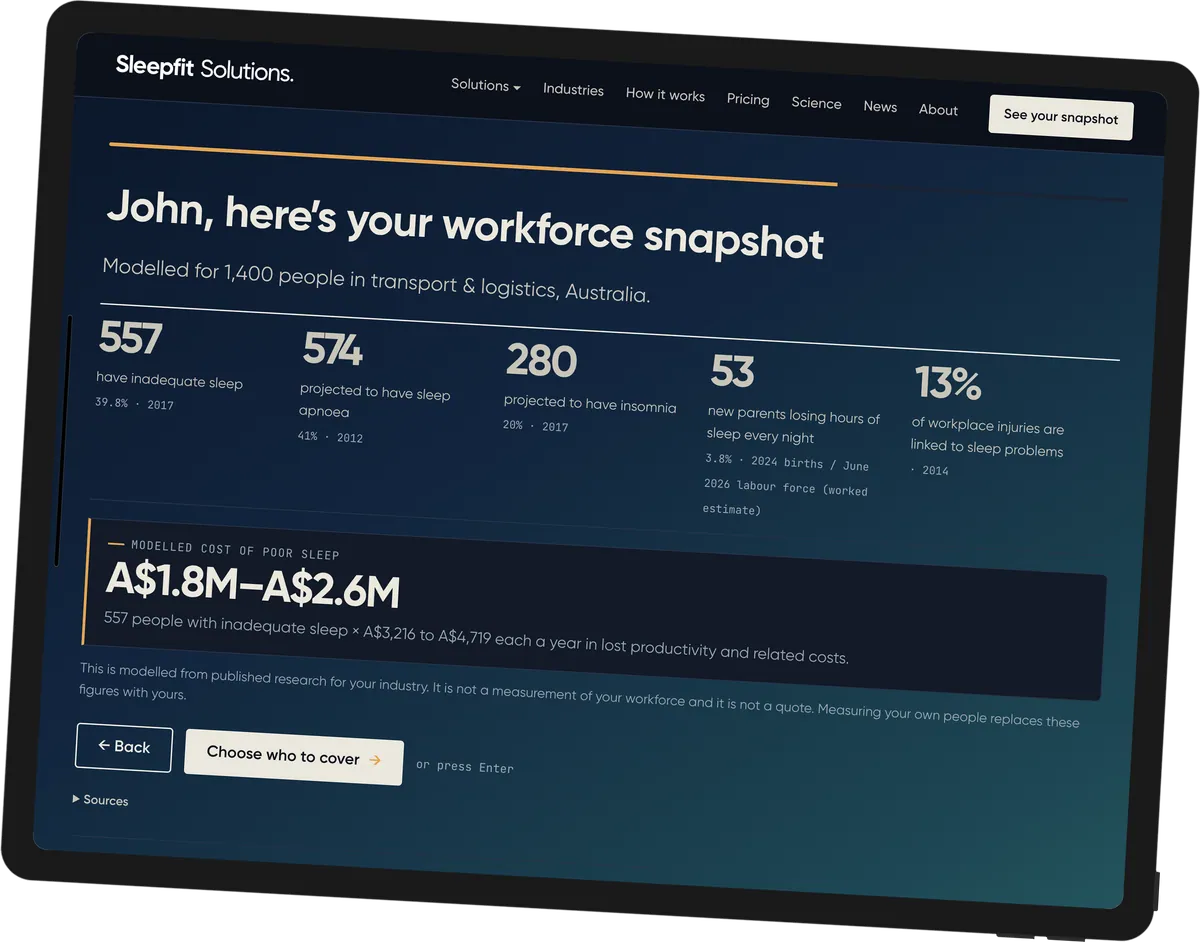
Indíquenos aproximadamente cuántas personas emplea. Su panorama estima cuántas probablemente duermen mal y cuánto cuesta, a partir de investigaciones publicadas sobre cuidado de adultos mayores y servicios para personas con discapacidad. Luego díganos en qué quiere enfocarse y le mostraremos cómo funcionaría el acceso abierto para usted y cuánto costaría.

Un ejemplo de instantánea de la fuerza laboral en una tableta: problemas de sueño modelados y el costo del sueño deficiente para 1.400 personas en transporte y logística.