Defensa y fuerzas armadas · Estados Unidos

El sueño y la fatiga en defensa y fuerzas armadas

Personnel face high operational tempo, short and broken sleep and long deployments; defense civilians work shifts too. Fatigue degrades vigilance and decisions where errors can be fatal.

Fuerza laboral de Defensa y fuerzas armadas

A quién cubre esta página

  • Armed forces
  • Defense civilians

Regulación

Quién la regula y qué espera

El detalle normativo y de investigación de esta página se muestra en inglés.

Defense sits outside the ordinary regulatory picture for uniformed personnel: military personnel and uniquely military operations are excluded from OSHA by executive order, and the department sets its own fatigue policy. DoD Instruction 1010.10 asks component heads to build at least seven hours of sleep per 24 hours into duty schedules, training plans and battle plans, but only as mission requirements permit. The surface Navy goes further, requiring circadian watchbills and a minimum 7.5-hour sleep opportunity every 24 hours. The civilian workforce and on-base contractors are covered by ordinary workplace safety law.

Regulado por
  • U.S. Department of DefenseDoD

Los logotipos identifican al regulador y no implican respaldo.

Quién la regula

Federal OSHA does not reach uniformed personnel or military-unique operations - a 1980 executive order sets that exclusion. The Department of Defense runs its own safety and fatigue policy, with the surface Navy adding a crew endurance instruction. DoD's 700,000 civilian employees are covered by the federal-agency safety program, and contractors on base are covered by OSHA as private employers. GAO provides oversight.

Sus obligaciones

Uniformed personnel are outside OSHA, so the obligation is the department's own. DoD Instruction 1010.10 directs component heads to mitigate sleep deprivation and to build at least seven hours of sleep per 24 hours into schedules and plans, as mission requirements permit. The surface Navy's crew endurance instruction of 11 December 2020 is firmer: circadian watchbills, a minimum 7.5-hour sleep opportunity per 24 hours, and workdays that should not routinely exceed twelve. Air Force flight operations carry mandatory crew rest rules. Civilian staff are covered by the federal-agency safety program, the ADA and FMLA.

Consecuencias

There is no OSHA fine for uniformed personnel; fatigue failures surface through mishap investigation boards, Inspector General complaints, relief of commanders and Congressional oversight, and they are paid for in readiness. In March 2026 the Government Accountability Office reported that most service members still sleep six hours or fewer a night against the department's own seven-hour figure, and that three of the nine fatigue recommendations it made in 2024 remain open. For civilian staff the exposure is safety findings and abatement plus accommodation and leave claims; contractors face standard OSHA citation.

Sanciones

No civil penalty attaches to fatigue for uniformed personnel, and the federal-agency program covering civilian staff provides for findings and abatement rather than fines. On-base private contractors face standard OSHA maximums, at 2025 levels in force for 2026: $16,550 serious, $165,514 willful or repeat.

Fuentes: Executive Order 12196 (1980); 29 CFR Part 1960; DoD Instruction 1010.10; Naval Surface Forces crew endurance instruction 3120.2A (2020); GAO reports GAO-24-105917 (2024) and GAO-21-366 (2021); NTSB Marine Accident Report MAR-19/01.

Puestos críticos por fatiga

Dónde más importa la fatiga en defensa y fuerzas armadas

Los puestos en los que un trabajador fatigado tiene más probabilidades de causar daños graves, las tareas que conllevan el riesgo y por qué se acumula la fatiga.

El detalle normativo y de investigación de esta página se muestra en inglés.

PuestoRiesgoTareas de alto riesgoPor qué se acumula la fatiga
Military aviator (USAF, USN/USMC, Army Aviation)
Reglas
Designación normativa
Uniformed service member - outside OSHA (EO 12196); DoDI 1010.10 sleep targets 'as mission requirements permit'
Horas y descanso
Service crew-rest rules (e.g. AFMAN 11-202 Vol 3, OPNAVINST 3710.7) - internal
Riesgo críticoNight and NVG flying; long-range and air-to-air refuelling sorties; low-level flying; operations across time zones after short restEarly and night sorties, surge flying in exercises and operations, deployments across time zones, standby
Officer of the deck (OOD) / surface warfare officer
Reglas
Designación normativa
Uniformed service member - outside OSHA (EO 12196); DoDI 1010.10 sleep targets 'as mission requirements permit'
Horas y descanso
COMNAVSURFPAC/LANTINST 3120.2A: circadian watchbills, 7.5 h sleep opportunity in 24 h (internal)
Riesgo críticoBridge and operations-room watchkeeping on 1-in-2 or 1-in-3 rotations; restricted-water navigation; replenishment at sea; combat system operationWatch rotations fragmenting sleep, long periods at sea, drills during rest
Motor transport operator (Army 88M; USMC 3531)
Reglas
Designación normativa
Uniformed service member - outside OSHA (EO 12196); DoDI 1010.10 sleep targets 'as mission requirements permit'
Horas y descanso
Service instructions only; no enforceable DoD-wide fatigue standard
Riesgo críticoDriving heavy and armored vehicles in convoy at night and under NVG; road moves after exercise night shifts; ammunition and fuel transportExercises and deployments with sleep restriction, 24 h operations, long road moves
Aircraft maintainer (crew chief, weapons loader)
Reglas
Designación normativa
Uniformed service member - outside OSHA (EO 12196); DoDI 1010.10 sleep targets 'as mission requirements permit'
Horas y descanso
Service instructions only; no enforceable DoD-wide fatigue standard
Riesgo críticoNight-shift maintenance and arming of aircraft; flight-control and weapons-loading tasks; surge maintenance during exercisesShift work with surges, flight-line night shifts, deployed 12 h shifts
Security forces / military police sentry
Reglas
Designación normativa
Uniformed service member - outside OSHA (EO 12196); DoDI 1010.10 sleep targets 'as mission requirements permit'
Horas y descanso
Service instructions only; no enforceable DoD-wide fatigue standard
Riesgo altoNight sentry and gate duty with live weapons; armed guard of munitions and aircraft; vigilance patrolsNight guard rotations (e.g. 2-on/4-off) on top of the normal working day, monotony
Explosive ordnance disposal (EOD) technician
Reglas
Designación normativa
Uniformed service member - outside OSHA (EO 12196); DoDI 1010.10 sleep targets 'as mission requirements permit'
Horas y descanso
Service instructions only; no enforceable DoD-wide fatigue standard
Riesgo altoRender-safe procedures on explosive ordnance; ammunition inspection and repair; night call-outs to IED and EOD tasksOn-call duty with night call-outs, deployments, long tasks in heat and protective equipment

Riesgo de fatiga estacional

Cuándo aumenta el riesgo de fatiga en defensa y fuerzas armadas.

La estación por sí sola mueve poco el riesgo de fatiga. Los efectos más marcados vienen de semanas y cargas de trabajo concretas. Estos son los periodos que importan en defensa y fuerzas armadas en Estados Unidos en 2027, incluidos los que afectan a toda la población trabajadora.

  1. 14 Mar · Medido

    Clocks spring forward

    Fatal crashes up about 6% the following week; mining injuries up 5.7% the next Monday

  2. Jun to Aug · Medido

    Hottest nights, longest days

    Warm nights and long days shorten sleep

  3. 7 Nov · Medido

    Clocks go back

    No net change in crash risk; pedestrian risk rises in dark evenings

Medido: un estudio publicado encontró un cambio en el sueño, las lesiones o los accidentes. Documentado: un cambio registrado en la carga de trabajo o la exposición, como horas extra o despliegues. Las fechas son de 2027 y cambian cada año. Nuestra lectura de la evidencia publicada, actualizada cada noviembre. Los eventos se muestran en inglés.

Casos

Cuando la fatiga quedó registrada

Hallazgos y procesos publicados por reguladores, tribunales e investigadores en Estados Unidos.

El detalle normativo y de investigación de esta página se muestra en inglés.

  • may 2020 · Florida, United States

    Fatigued fighter pilot lands too fast at night; $176m jet destroyed

    • Seguridad
    • Financiero

    On a night sortie a fighter jet touched down at about 202 knots, far above normal landing speed, and the aircraft was destroyed after its flight controls fought the pilot's inputs; the pilot ejected with non-life-threatening injuries. The accident investigation board found that cognitive degradation due to fatigue substantially contributed. The pilot had frequently been getting poor, interrupted sleep and rated his own cognitive degradation well above his usual baseline at the end of the mission.

    Caso US-defence-03Informar de un error

Caso 1 de 15

Ver todas las noticias de defensa y fuerzas armadas

Cómo encaja la plataforma

Cómo se vincula cada producto con sus obligaciones

Las calificaciones describen con qué fuerza se vincula un producto a una obligación. Ninguno cumple por usted una obligación y ninguno conlleva una garantía de cumplimiento.

El detalle normativo y de investigación de esta página se muestra en inglés.

Sleepfit

Apoya su deber general de cuidado

No US rule requires sleep-health checks of military or civilian defense staff; DoDI 1010.10 encourages adequate sleep for service members. Sleepfit supports it and your 29 CFR 1960 program. It identifies employees who may benefit from clinical evaluation; diagnosis stays with your clinicians.

Acerca de Sleepfit

Fatiguefit4Duty

Apoya su deber general de cuidado

No US rule sets a fitness-for-duty fatigue check for defense staff; DoDI 1010.10 encourages sleep for service members. Fatiguefit4Duty supports your fatigue program. A fitness-for-duty check, not a fitness-for-duty decision - the duty call stays with you.

Acerca de Fatiguefit4Duty

Awareness eLearning

Apoya su deber general de cuidado

No binding rule names fatigue training for defense staff or contractors; DoDI 1010.10 promotes adequate sleep without a curriculum. Awareness eLearning supplies fatigue and sleep content with a completion record.

Acerca de Awareness eLearning

Was It Fatigue?

Apoya su deber general de cuidado

No defense rule makes fatigue a required element of a mishap investigation. Was It Fatigue? supports your mishap board with a structured account of sleep and duty history. A structured judgment aid, not a determination of cause.

Acerca de Was It Fatigue?

SleepWellBaby

No obligation is engaged here. Sleep support for civilian staff with infants is a voluntary wellbeing measure, outside both the military instructions and the federal-agency safety program.

Acerca de SleepWellBaby

Nivel 4: errores relacionados con la fatiga

Cuando la fatiga se cuela, atrape el error.

Los controles de nivel 4 atrapan o detectan los errores relacionados con la fatiga antes de que causen daño. Otros los integran en los equipos, las tareas y los procedimientos: nosotros no los suministramos ni los respaldamos, y podemos indicarle proveedores. Estos son los tipos que se aplican en defensa y fuerzas armadas.

  • Trap the error

    Flight-deck warning systems

    Warn the crew of a stall, rising terrain or conflicting traffic in time to recover.

    Lo que no hace: They warn of a dangerous aircraft state from any cause; they do not monitor crew fatigue.

    Ejemplos: Airlines and air ambulance: stall warning, terrain and traffic collision avoidance.

  • Procedural cross-check

    Two-person checks

    A second qualified person checks critical actions so one tired person's slip is caught.

    Lo que no hace: Both people may be fatigued on the same roster, so it relies on fatigue-aware rostering behind it.

    Ejemplos: Rail: two-person crews and call-outs. Aviation: two-pilot cross-checks. Utilities: switching verification. Hospitals: double checks.

  • Remove exposure

    Scheduling critical tasks away from the early-morning low

    Moves the highest-risk tasks out of the early-morning hours when errors are most likely.

    Lo que no hace: It reduces exposure but does not trap the error; it depends on planners knowing when fatigue peaks.

    Ejemplos: Maintenance: critical work scheduled off night shift. Hospitals: elective procedures in daytime.

  • Remove exposure

    Safe travel home after shifts

    Buses, shuttles, taxis or rest rooms so tired workers do not drive home after night or extended shifts.

    Lo que no hace: It protects the commute only, not on-shift performance.

    Ejemplos: Mining: bus-in bus-out. Hospitals: taxi vouchers or rest rooms after night shift.

La mayor parte de la evidencia sobre la tecnología de detección de fatiga proviene de los propios proveedores. Pida una evaluación independiente antes de depender de ella.

En defensa y fuerzas armadas y otros sectores, confían en nosotros

Vea lo que el sueño y la fatiga significan para su fuerza laboral en defensa y fuerzas armadas.

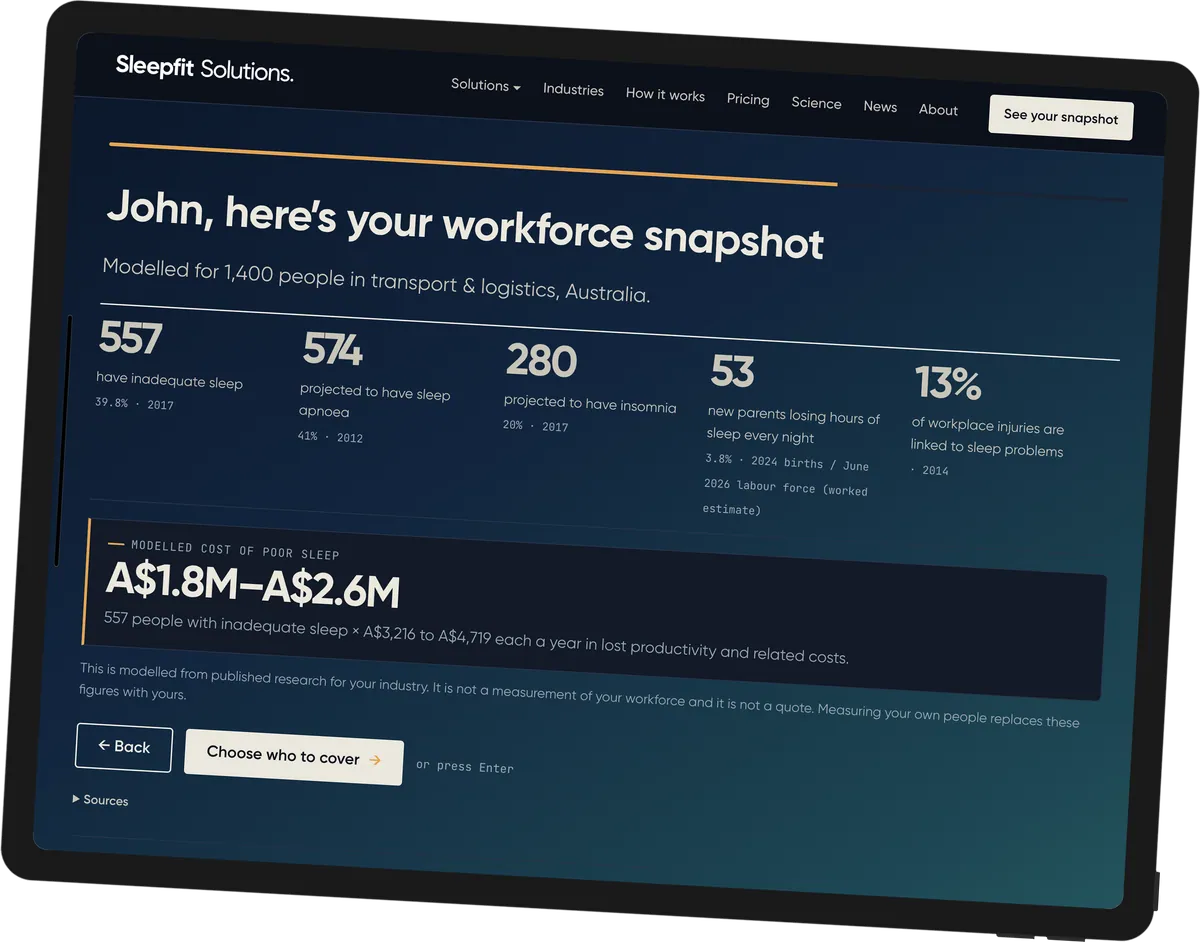
Indíquenos aproximadamente cuántas personas emplea. Su panorama estima cuántas probablemente duermen mal y cuánto cuesta, a partir de investigaciones publicadas sobre defensa y fuerzas armadas. Luego díganos en qué quiere enfocarse y le mostraremos cómo funcionaría el acceso abierto para usted y cuánto costaría.

Un ejemplo de instantánea de la fuerza laboral en una tableta: problemas de sueño modelados y el costo del sueño deficiente para 1.400 personas en transporte y logística.