
Analyse des incidents et des accidents

Was It Fatigue?

Analyse structurée après incident pour déterminer si la fatigue a contribué à un événement, et par quelle voie.

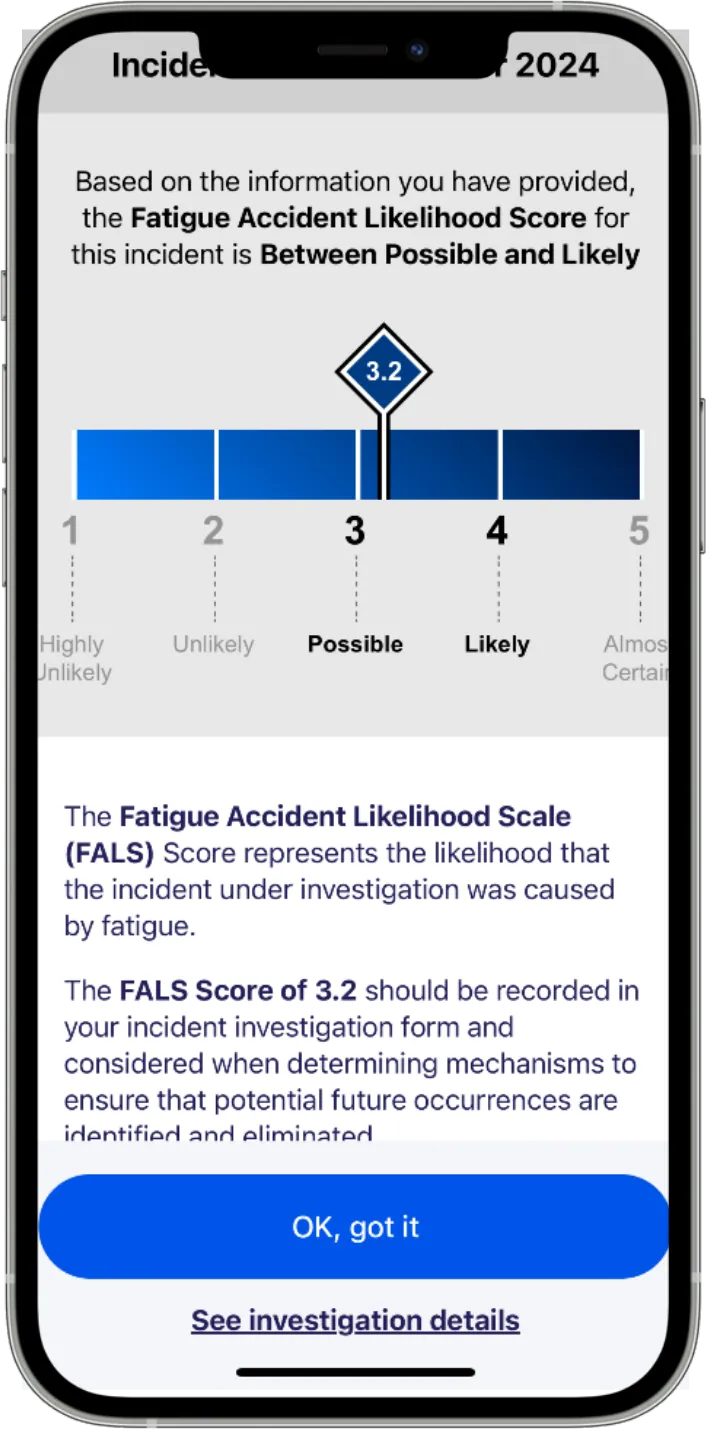
A Was It Fatigue? finding on a phone: a Fatigue Accident Likelihood Score of 3.2, between Possible and Likely, with how to record it.

Le problème

Les incidents graves doivent faire l’objet d’une enquête. Peu d’enquêtes examinent sérieusement la fatigue.

La fatigue est facile à invoquer et difficile à établir après coup. Les enquêtes ont tendance soit à la manquer, soit à lui attribuer la faute sans examiner les autres explications.

Was It Fatigue? donne à vos enquêteurs une façon cohérente et reproductible de poser la question, et un dossier qui montre que les autres explications ont été examinées.

See how Was It Fatigue? works Watch the video · 0:33
Presented by Professor Drew Dawson

The size of the problem

National figures for Canada, from published research. They are modelled, not measured in your workforce.

  • 13%of workplace injuries are linked to sleep problems2014
  • 33%get less than 7 hours' sleep2017 (CHMS 2007-2013)
  • C$2 030lost productivity per affected employee each year
Sources
  1. Uehli K, et al. Sleep problems and work injuries: a systematic review and meta-analysis. Sleep Medicine Reviews, 2014.
  2. Chaput J-P, Wong SL, Michaud I. Duration and quality of sleep among Canadians aged 18 to 79. Health Reports (Statistics Canada), 2017.
  3. Rosekind MR, et al. The Cost of Poor Sleep: Workplace Productivity Loss and Associated Costs. Journal of Occupational and Environmental Medicine, 2010;52(1):91-98, applied to average earnings in Canada (Statistics Canada, Survey of Employment, Payrolls and Hours, May 2026).

Cas

The biggest incidents fatigue played a part in

Findings from investigators, coroners and courts in Canada that fatigue contributed, the most harmful first.

Les cas sont présentés en anglais.

  • janv. 2004 · Ontario, Canada

    Charter pilot on about 5 hours' sleep after cross-continent trip takes off iced and overweight; 10 killed

    • Sécurité
    • Financier

    A single-engine turboprop on a charter flight took off from an island airstrip in freezing precipitation, about 15 percent over its maximum weight and with ice on the airframe, and struck the frozen surface of a lake, killing the pilot and all nine passengers. The Transportation Safety Board of Canada found the decision to take off was out of character for the pilot and was likely affected by stress and fatigue. The night before, he had returned from a trip to California across three time zones and could have slept at most 5 hours 15 minutes before reporting for duty at 4:45 am.

    Cas CA-aviation-05Signaler une erreur
Voir toutes les actualités sur la fatigue

Comment ça fonctionne

A structured answer to “was it fatigue?”

After an incident or near miss, investigators work through a structured method: was fatigue present, and was the error the kind fatigue produces once other explanations are tested? It sits at the last level of defence, after something has gone wrong, and feeds each finding back into the levels before it: rosters, sleep and in-shift controls.

  1. Step 01

    Événement

    Un enquêteur ouvre une évaluation liée à un incident précis.

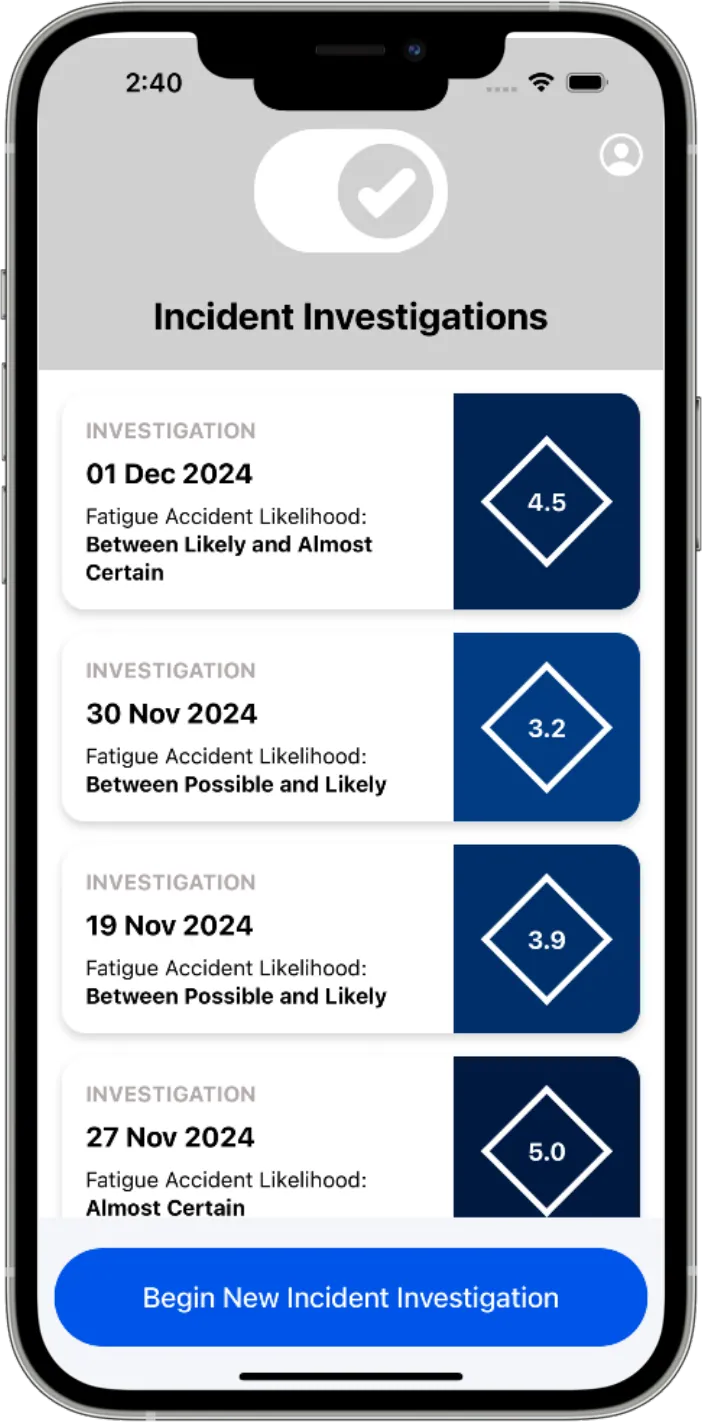
    The Was It Fatigue? investigations list on a phone, each with its Fatigue Accident Likelihood, and a button to begin a new investigation.
  2. Step 02

    La fatigue était-elle présente?

    Le Fatigue Likelihood Score (cote de probabilité de fatigue), établi à partir de quatre questions: endormissement juste avant l’événement, symptômes comportementaux au cours des quinze minutes précédentes, historique de sommeil et d’éveil antérieur, et possibilité de sommeil selon l’horaire de travail.

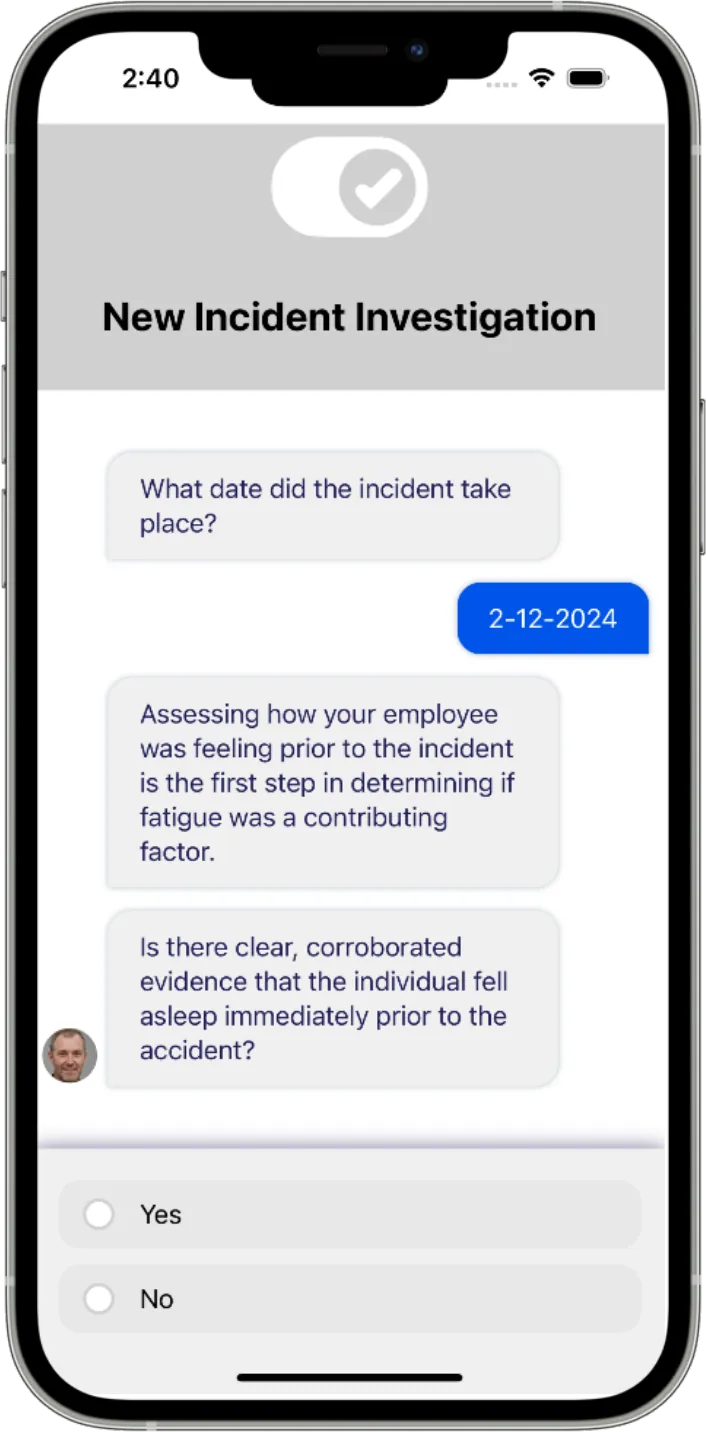
    A new Was It Fatigue? investigation on a phone: the date of the incident, then whether there is clear evidence the person fell asleep immediately before it.
  3. Step 03

    S’agit-il d’une erreur de type fatigue?

    Le Fatigue Error Likelihood Score (cote de probabilité d’erreur liée à la fatigue) examine les autres explications à chaque niveau avant d’attribuer l’erreur à la fatigue.

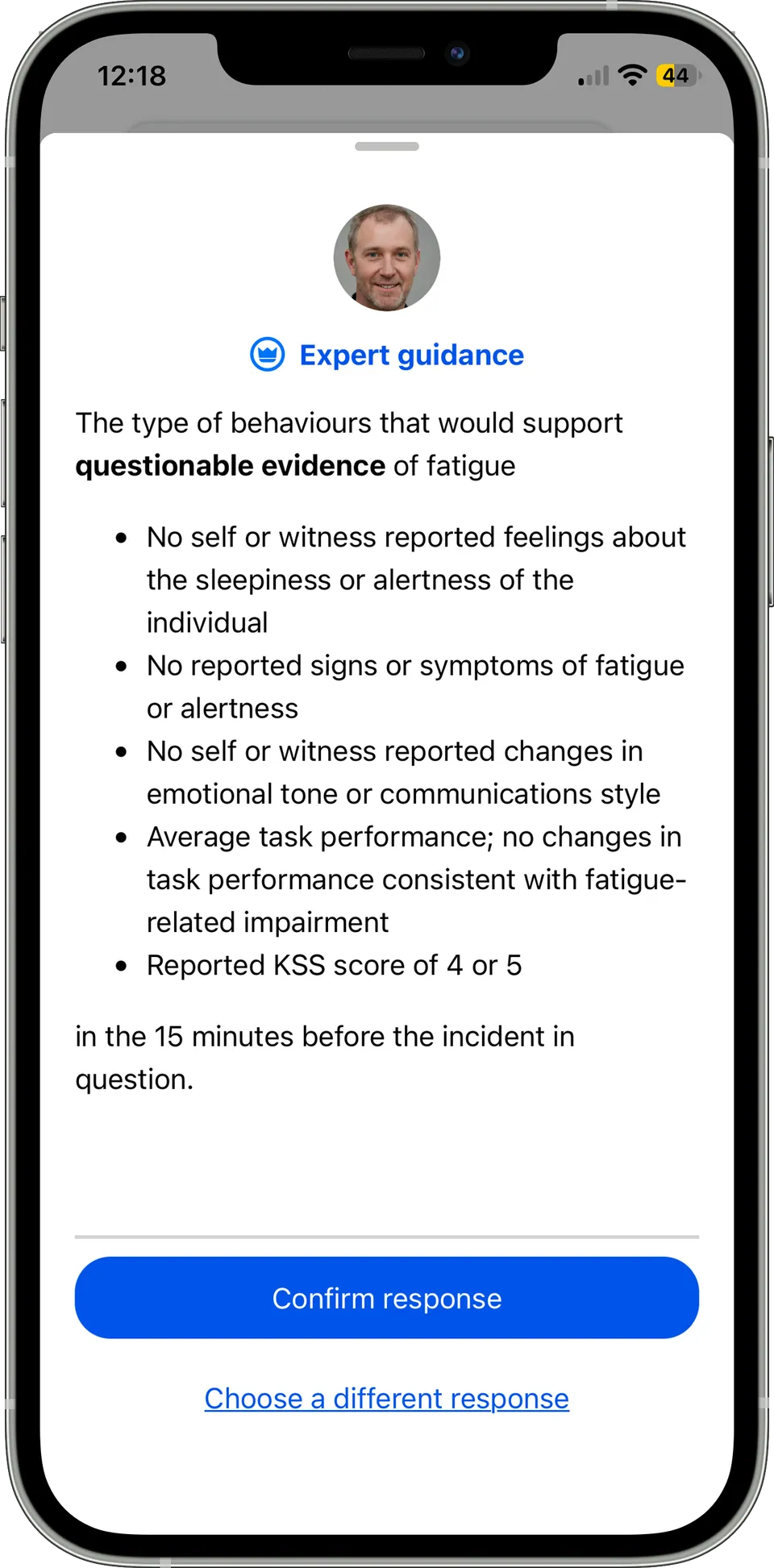
    Expert guidance in Was It Fatigue?: the behaviours that would support questionable evidence of fatigue in the 15 minutes before the incident, with a button to confirm the response.
  4. Step 04

    Conclusion combinée

    Un Fatigue Attributable Likelihood Score (cote de probabilité attribuable à la fatigue) sur une échelle de 1 à 5, avec la voie nommée, qui alimente les contrôles liés aux horaires, au sommeil et pendant le quart.

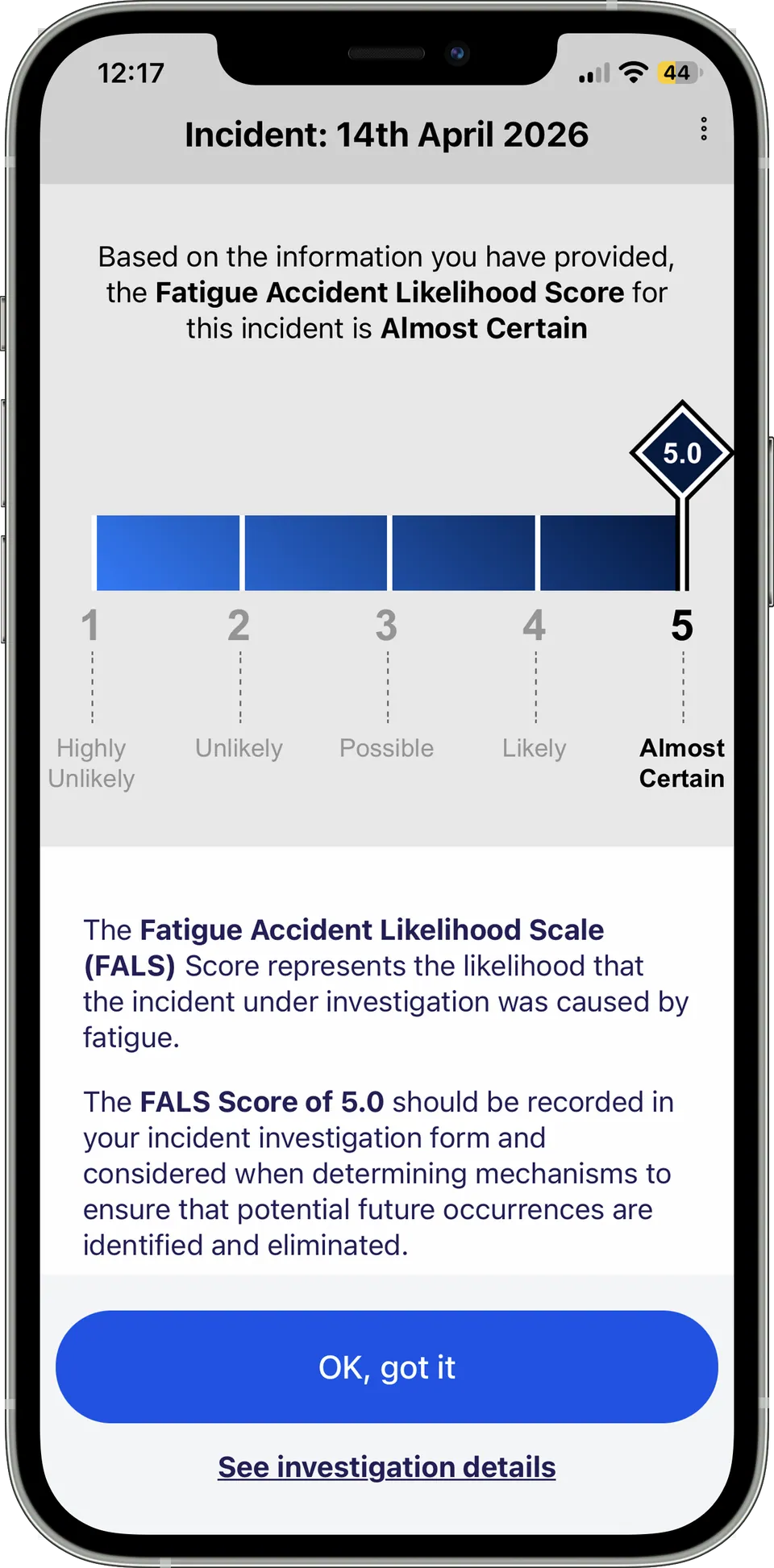
    A Was It Fatigue? finding: a Fatigue Accident Likelihood Score of 5.0, Almost Certain, with what the score means and how to record it.

After an incident, fatigue is either missed or blamed without testing the alternatives. Neither helps the people involved, and neither tells you which control failed. I wanted investigators to have a consistent way to ask the question properly, and a record that shows they did.

Daniel PlattCofondateur et chef de la direction

Rollout

How we roll it out

  1. Scope

    Agree which events call for an assessment, and who investigates.

  2. Set up

    Investigator access, fitted to your existing incident process.

  3. Train

    Investigators learn the method and work a first case together with us.

  4. Review

    Findings feed back into roster, sleep and in-shift controls.

Ce que voit le client

Qui voit quoi

Chaque dossier nomme la voie de la fatigue et documente les autres explications examinées. Le prix est fondé sur le volume d’enquêtes, et non sur l’effectif: c’est le seul produit de la gamme tarifé par événement.

Un prix fondé sur la prévalence, pas sur l’effectif. Comment fonctionne la tarification.

  • Your investigators

    The full record

    • Every answer and score
    • The alternative explanations tested
    • The fatigue pathway named
  • The employer

    One record per event

    • A structured, repeatable investigation record
    • Findings to feed back into roster, sleep and in-shift controls

Données probantes

Ce que nous pouvons démontrer

Sa conception exige à la fois la présence de fatigue et une erreur portant la signature de la fatigue, et examine les autres explications tout au long du processus. C’est ce qui l’empêche de conclure à un lien de causalité à partir de la seule fatigue.

C’est le seul produit de la gamme qui examine tous les niveaux, y compris le caractère adéquat des horaires, de façon rétrospective après un événement.

Ce que le produit n’établit pas

L’outil est rétrospectif. Il ne prédit pas d’événement, ne dimensionne pas une population, et une seule enquête n’établit pas une tendance. Ce n’est pas un instrument validé et aucune validation n’est revendiquée à son égard. Les dossiers produits peuvent faire l’objet d’une communication de la preuve.

In practice

Rail · North America

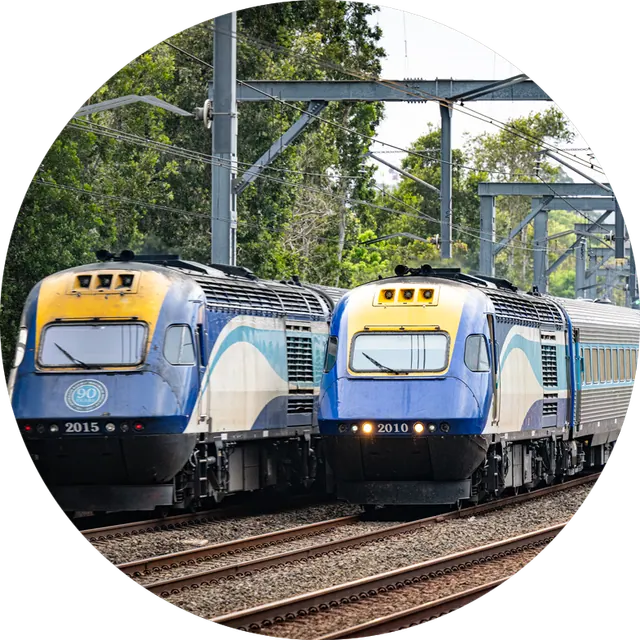
A Class I railroad uses Was It Fatigue? to determine whether fatigue contributed to an incident or near miss.

Its investigators ask the same structured questions after every event, so each record assesses how likely it is that fatigue was present and that the error was the kind fatigue produces, and shows which other explanations were tested.

FAQs

Questions we’re often asked

Who uses it?

Your investigators, who open an assessment against a specific incident or near miss.

How does it avoid blaming fatigue by default?

It requires both the presence of fatigue and an error of the kind fatigue produces, and tests alternative explanations at every level before attributing an error to fatigue.

What does the finding look like?

A Fatigue Attributable Likelihood Score on a 1–5 band with the fatigue pathway named, which feeds back into roster, sleep and in-shift controls.

Is it a validated instrument?

No, and no validation claim is made for it. It is a structured, repeatable method. It is retrospective: it does not predict an event, and one investigation does not establish a pattern. Records produced are discoverable.

How is it priced?

On investigation volume, not headcount: it is the only event-priced product in the suite.

How is investigation data protected?

The platform is certified to ISO/IEC 27001:2022.

Parcours

Pour aller plus loin

Was It Fatigue? et la réglementation dans 33 secteurs (Canada)

1 / 33

La réglementation nomme cette étape

32 / 33

Soutient votre devoir général de diligence

Voyez comment Was It Fatigue? s’inscrit dans la réglementation de votre secteur, et par quoi d’autre nous commencerions.

Les 33 secteurs

Autres solutions liées à Was It Fatigue?

Interested in Was It Fatigue? for your organisation?

Tell us a little about your organisation and which solutions you’re looking at, and our team will be in touch.

A Was It Fatigue? finding on a phone: a Fatigue Accident Likelihood Score of 3.2, between Possible and Likely, with how to record it.