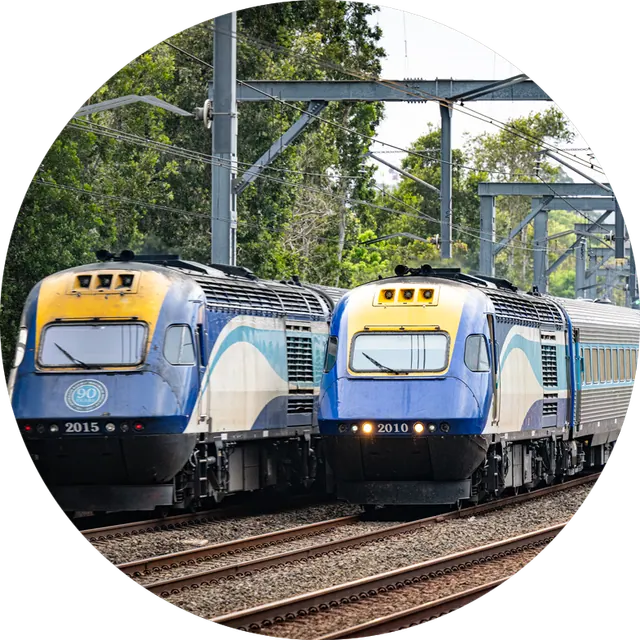
Transport ferroviaire · Canada

Le sommeil et la fatigue : transport ferroviaire

Drivers, signallers and controllers work 24/7 rotating rosters with early starts and nights. A fatigue lapse can mean a signal passed at danger, a collision or a derailment.

Réglementation modifiée : 22 juin 2026Changement prévu : 30 janv. 2027

Main-d’œuvre du secteur Transport ferroviaire

Ce que couvre cette page

  • Light rail and trams
  • Mining company railways (voir aussi Mines et ressources)
  • Passenger rail - metro, suburban and intercity
  • Rail freight - heavy haul and intermodal
  • Rail infrastructure managers and track maintenance
  • Rolling stock maintenance depots
  • Short line and regional railroads

Veille réglementaire

Ce qui a changé, et ce qui s’en vient

Les changements réglementaires qui touchent votre gestion de la fatigue en transport ferroviaire : ce qui a changé au cours des 12 derniers mois, et ce qui s’en vient.

Les détails réglementaires et les données de recherche de cette page sont présentés en anglais.

Changement récentDepuis le 22 juin 2026

Propre au secteur transport ferroviaire

New Railway Personnel Training and Qualifications Regulations (registered 22 June 2026) require crew resource management training for operating employees and rail traffic controllers, in force 1 July 2028.

Voir le changement

Changement à venirPrévu à compter de 30 janvier 2027D’ici 12 mois

Thermal stress duties (SOR/2026-10) apply from 30 January 2027; the new training regulations from 1 July 2028. Transport Canada targets proposed Railway Safety Management System amendments in Fall 2027; the 2022 Fatigue Management System proposal has no timetable.

Changements réglementaires vérifiés au 1 octobre 2026.

Réglementation

Qui la réglemente, et ce qui est attendu

Les détails réglementaires et les données de recherche de cette page sont présentés en anglais.

Rail is the one industry where Canada goes well beyond the general baseline. The Duty and Rest Period Rules for Railway Operating Employees, in force since May 2023 for freight and November 2024 for passenger rail, govern how long train crews can work and how much rest they must get. But Canada's own safety investigators say the rule doesn't go far enough: it covers only train crews, not roles like signal controllers and maintenance staff. A broader fix has been proposed but not finalized, and the TSB has issued 16 fatigue-related safety warnings since 2011.

Réglementé par
  • Transport CanadaTransport Canada

Les logos identifient le régulateur et n’impliquent aucune approbation.

Qui la réglemente

Rail is a genuine exception to Canada's 'baseline is all there is' pattern. Transport Canada regulates rail under the Railway Safety Act and has approved the Duty and Rest Period Rules for Railway Operating Employees, a rail-specific fatigue regime. The Transportation Safety Board (TSB), Canada's independent accident investigator, names fatigue management a current priority on its 2025 Watchlist and tracks the rule's gaps.

Vos obligations

Federally regulated railways must run operating employees - locomotive engineers, conductors, yardmen, pilots, remote-control and light-rail operators - within Transport Canada's Duty and Rest Period Rules: a 12-hour maximum duty period, at least 12 hours' rest at the home terminal and 10 hours in accommodation away from it, 8 of them undisturbed, and cumulative caps of 60 hours in any 7 days and 192 hours in any 28 days. Every federally regulated railway must also hold a Fatigue Management Plan. Rail traffic controllers and maintenance-of-way staff sit outside these rules and are covered only by general federal health, safety and hours-of-work law.

Conséquences

Transport Canada rail safety inspectors can order an unsafe practice stopped and can assess administrative monetary penalties for operating otherwise than in accordance with an approved rule, without any prosecution. A duty and rest breach that contributes to an accident also engages the general federal health and safety enforcement track, and the Transportation Safety Board can investigate independently and publish what it finds. That record carries weight: the Board has sent Transport Canada 16 fatigue-related safety advisories and information letters since 2011 and still says progress on rail fatigue is slow, so a railway with a thin fatigue record operates under sustained scrutiny.

Sanctions

Operating otherwise than in accordance with a rule approved under the Railway Safety Act - the Duty and Rest Period Rules included - carries an administrative monetary penalty of up to $250,000 for a corporation and $50,000 for an individual, issued without going to court. As a federally regulated employer, a railway also faces Canada Labor Code fines to $1,000,000 and up to 2 years' imprisonment for serious safety contraventions. 2026 figures.

Sources: Transportation Safety Board of Canada, Watchlist 2025 (fatigue management, multi-modal); Duty and Rest Period Rules for Railway Operating Employees; Transport Canada / Railway Safety Act; Railway Association of Canada industry materials on duty and rest period rules.

Postes critiques

Là où la fatigue compte le plus en transport ferroviaire

Les postes où un travailleur fatigué risque le plus de causer un préjudice grave, les tâches qui portent ce risque, et pourquoi la fatigue s’y accumule.

Les détails réglementaires et les données de recherche de cette page sont présentés en anglais.

PosteRisqueTâches à risque élevéPourquoi la fatigue s’accumule
Locomotive engineer
Règles
Désignation réglementaire
Operating employee (Duty and Rest Period Rules for Railway Operating Employees); position critical to safe railway operations (Railway Medical Rules)
Heures et repos
Duty and Rest Period Rules: capped duty periods, minimum rest before duty, cumulative limits; KSS self-assessment condition (s 5.1)
Risque critiqueOperating freight trains on long subdivisions in remote terrain; train handling on grades; signal vigilance through the nightFreight on-call service with irregular starts, long runs, away-from-home terminal rest, winter operations
Rail traffic controller (RTC)
Règles
Désignation réglementaire
Position critical to safe railway operations (Railway Medical Rules); not an operating employee under the Duty and Rest Period Rules
Heures et repos
No rail-specific hours rule for RTCs (TSB-flagged gap); CLC Part III 8 h between shifts
Risque critiqueSetting routes and controlling train movements overnight; issuing manual authorities and track occupancy permits in degraded working; protecting worksites12 h night shifts in 24/7 signal boxes and control centers; low-traffic vigilance overnight then morning peak
Track foreman (holder of track occupancy permit)
Règles
Désignation réglementaire
None specific - CLC Part II general duty; not an operating employee
Heures et repos
CLC Part III 8 h between shifts; no rail-specific rule for maintenance-of-way
Risque critiqueEstablishing track protection or lookout working for track gangs; calling workers clear of approaching trains; handing back possessions on timeNight and weekend possessions, back-to-back shutdown shifts, travel to remote worksites, drive home after nights
Conductor
Règles
Désignation réglementaire
Operating employee (Duty and Rest Period Rules for Railway Operating Employees); position critical to safe railway operations (Railway Medical Rules)
Heures et repos
Duty and Rest Period Rules: capped duty periods, minimum rest before duty, cumulative limits; KSS self-assessment condition (s 5.1)
Risque critiqueIn charge of a freight train: switching, dangerous goods documents, protecting the train, inspections at nightFreight on-call with irregular starts, away-from-home rest
Track maintainer; on-track equipment operator
Règles
Désignation réglementaire
None specific - CLC Part II general duty
Heures et repos
CLC Part III 8 h between shifts
Risque élevéOperating tampers, ballast regulators and road-rail vehicles in night possessions; working near live lines; machine travel to and from siteNight possessions, long shutdown shifts, remote work and travel, drive home after nights
Yard foreman / yard helper (remote control operator)
Règles
Désignation réglementaire
Operating employee (Duty and Rest Period Rules for Railway Operating Employees); position critical to safe railway operations (Railway Medical Rules)
Heures et repos
Duty and Rest Period Rules: capped duty periods, minimum rest before duty, cumulative limits; KSS self-assessment condition (s 5.1)
Risque élevéCoupling and uncoupling, riding and controlling moves in yards at night; remote-control locomotive operation; hand points24/7 yard shifts, night work, short-notice overtime, outdoor work in all weather

Cas

Quand la fatigue a laissé une trace

Constatations et poursuites publiées par les organismes de réglementation, les tribunaux et les enquêteurs (Canada).

Les détails réglementaires et les données de recherche de cette page sont présentés en anglais.

  • déc. 2020 · Quebec, Canada

    Signal maintainer on 52-hour night weeks puts hi-rail unit on wrong track; passenger train hits it at nearly 83 mph

    • Sécurité

    A national railway's signal maintainer working long consecutive night shifts put his hi-rail track unit on the north main track when he meant to use the south track. An intercity passenger train struck the empty, stationary unit at nearly 83 mph and dragged it about 2,500 feet. The TSB found he had probably built up a sleep debt from many consecutive night shifts and daytime sleep, and warned that such schedules create high-risk situations.

    Cas CA-rail-30Signaler une erreur

Cas 1 sur 30

Voir toutes les actualités : transport ferroviaire

Comment la suite s’inscrit

Comment chaque produit se rattache à vos obligations

Les cotes décrivent dans quelle mesure un produit se rattache à une obligation. Aucun ne vous acquitte d’une obligation, et aucun ne comporte de garantie de conformité.

Les détails réglementaires et les données de recherche de cette page sont présentés en anglais.

Fatiguefit4Duty

La réglementation nomme cette étape

Section 5.1 of the Duty and Rest Period Rules requires operating crews to self-assess prior sleep and the Karolinska Sleepiness Scale before duty. Fatiguefit4Duty performs the step named at s 5.1. A fitness-for-duty check, not a fitness-for-duty decision - the duty call stays with you.

À propos de Fatiguefit4Duty

Awareness eLearning

La réglementation nomme cette étape

Section 13.1(l) of the Duty and Rest Period Rules requires your fatigue management plan to train employees on the causes and symptoms of fatigue, alertness strategies and self-assessment with the Karolinska Sleepiness Scale. Awareness eLearning supplies the content named at s 13.1(l).

À propos de Awareness eLearning

Was It Fatigue?

La réglementation nomme cette étape

Section 13.1(k) of the Duty and Rest Period Rules requires your fatigue management plan to investigate incidents where fatigue may have contributed, including hours awake and recent duty. Was It Fatigue? performs that named step. A structured judgment aid, not a determination of cause.

À propos de Was It Fatigue?

Sleepfit

Soutient une obligation précise

The Railway Medical Rules require periodic medical assessment of employees in safety critical positions, and that assessment names sleep apnea. No instrument is named. Sleepfit supports it by screening between assessments. It screens; diagnosis stays with your clinicians.

À propos de Sleepfit

SleepWellBaby

No Canadian rail rule reaches sleep in new-parent households. SleepWellBaby is offered as a benefit to parents across your railway workforce, not as a compliance step under the Duty and Rest Period Rules.

À propos de SleepWellBaby

Forfait recommandé

Par où nous commencerions en transport ferroviaire

Chaque forfait est tarifé selon la prévalence : toute votre cohorte y a accès, et vous payez pour la proportion qui devrait avoir besoin de chaque produit. Comment fonctionne la tarification.

Pourquoi ce choix (Canada)

Duty and Rest Period Rules s 5.1 names a pre-duty self-assessment with the KSS; Fatiguefit4Duty performs that step. Section 13.1(l) names training content, which Awareness eLearning supplies; Sleepfit screens between Railway Medical Rules assessments. Fatigue Lifecycle adds the s 13.1(k) review.

Ce que le sommeil et la fatigue représentent pour votre effectif en transport ferroviaire.

Indiquez-nous environ combien de personnes vous employez. Votre portrait estime combien dorment probablement mal et ce que cela coûte, à partir de la recherche publiée pour le secteur transport ferroviaire. Choisissez ensuite qui couvrir, et nous vous mènerons à la bonne étape suivante.

Un exemple d’aperçu de la main-d’œuvre sur une tablette : troubles du sommeil modélisés et coût du mauvais sommeil pour 1 400 personnes dans le transport et la logistique.