Mines et ressources · Canada

Le sommeil et la fatigue : mines et ressources

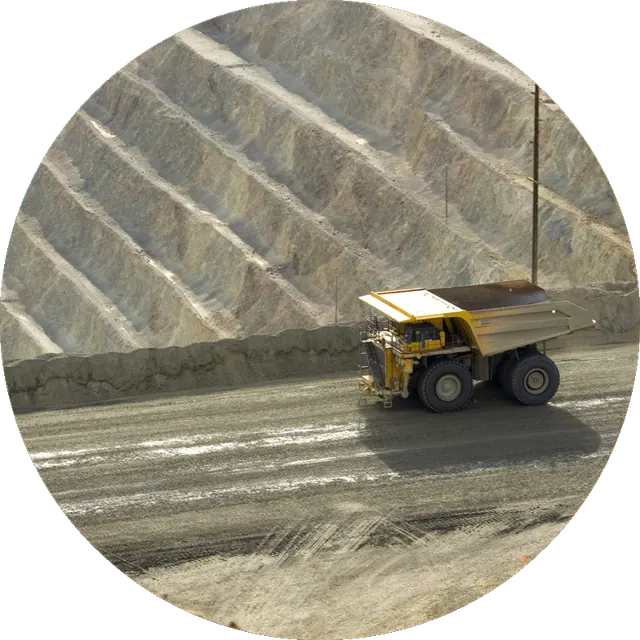
Crews work 12-hour rotating shifts, nights and FIFO or DIDO rosters, then often drive long distances home. Fatigue around heavy mobile plant and processing hazards can be fatal.

Réglementation modifiée : 22 juin 2026

Main-d’œuvre du secteur Mines et ressources

Ce que couvre cette page

  • Coal mining - open cut and underground
  • FIFO camps and site services on a mine (voir aussi Commerce de détail et hôtellerie-restauration)
  • Gold, copper, nickel and other metal ore mining
  • Iron ore mining
  • Mineral exploration and drilling
  • Mineral processing on a mining lease (voir aussi Fabrication)
  • Mining contractors - drill and blast, load and haul, underground development
  • Mining tyre and maintenance services on site
  • Quarrying - hard rock, sand and gravel

Veille réglementaire

Ce qui a changé, et ce qui s’en vient

Les changements réglementaires qui touchent votre gestion de la fatigue en mines et ressources : ce qui a changé au cours des 12 derniers mois, et ce qui s’en vient.

Les détails réglementaires et les données de recherche de cette page sont présentés en anglais.

Changement récentDepuis le 22 juin 2026

Propre au secteur mines et ressources

In BC, the revised Mines Code (effective 22 June 2026) names fatigue as a form of impairment that can bar a person from entering or remaining at a mine. It also requires a bullying, harassment and violence program and updates exposure-limit adjustments for shifts longer than 8 hours.

Voir le changement


Changements réglementaires vérifiés au 2 novembre 2026.

Réglementation

Qui la réglemente, et ce qui est attendu

Les détails réglementaires et les données de recherche de cette page sont présentés en anglais.

Mine safety in Canada is provincial and the rules differ province to province. Ontario's Regulation 854 (Mines and Mining Plants) is a technical code - ground control, ventilation, explosives, hoisting - with no fatigue or shift-length requirement. British Columbia's Health, Safety and Reclamation Code for Mines sets no hours limit either; its shift adjustment provision lowers airborne contaminant exposure limits on shifts longer than eight hours, an industrial hygiene rule rather than a fatigue one. Saskatchewan's Mines Regulations, 2018 is the one mining code with a maximum hours provision, and it binds hoist operators alone.

Qui la réglemente

Mining is regulated province by province, so who enforces what depends on where you operate: Ontario's Ministry of Labor under the Occupational Health and Safety Act and Regulation 854, British Columbia's Chief Inspector of Mines under the Mines Act and the Health, Safety and Reclamation Code, Saskatchewan's mines inspectorate, and Alberta OHS. None of them administers a general fatigue or hours-of-work standard for miners.

Vos obligations

What you owe depends on the province. Everywhere you owe the general duty to take every reasonable precaution for worker safety, and fatigue falls inside it as a recognized hazard - British Columbia's OHS Regulation says so in terms, directing employers and workers to treat fatigue as a source of impairment. On top sit the technical duties of your province's mining code (ground control, ventilation, explosives, hoisting) and that province's employment standards rest minimums, which differ: Ontario guarantees 11 consecutive hours free each day and 8 between shifts, other provinces set their own. No mining code requires a fatigue program.

Conséquences

Fatigue is enforced through the general safety duty, not a fatigue offence, and the route depends on the province. In Ontario the Ministry of Labor prosecutes under the Occupational Health and Safety Act; in British Columbia mine safety sits with the Chief Inspector of Mines under the Mines Act, with its own inspection, order and prosecution powers. Mining draws close regulatory attention everywhere on its fatality record, so a fatigued operator behind a fall-of-ground, hoisting or mobile-equipment incident is examined as any other failure to control a known hazard - and a due diligence defense is built from the fatigue program you held before the incident, not after.

Sanctions

Maximum fines are set province by province and are not uniform. Ontario's, in force in 2026: up to $2,000,000 for a corporation (raised from $1.5 million in October 2023), $1,500,000 for a director or officer and $500,000 for any other individual (both set in 2022), plus a $500,000 minimum fine since December 2024 where a repeat offence kills or seriously injures a worker. British Columbia, Alberta and Saskatchewan set their own, different maximums.

Sources: Ontario Occupational Health and Safety Act and Regulation 854 (Mines and Mining Plants); BC Health, Safety and Reclamation Code for Mines (2026) and Mines Act; Saskatchewan Mines Regulations, 2018; WorkSafeBC OHS Regulation ss.4.19-4.20; provincial employment standards legislation.

Postes critiques

Là où la fatigue compte le plus en mines et ressources

Les postes où un travailleur fatigué risque le plus de causer un préjudice grave, les tâches qui portent ce risque, et pourquoi la fatigue s’y accumule.

Les détails réglementaires et les données de recherche de cette page sont présentés en anglais.

PosteRisqueTâches à risque élevéPourquoi la fatigue s’accumule
Heavy hauler operator (oil sands) / haul truck driver
Règles
Désignation réglementaire
None specific - provincial mines regs (Ont. Reg 854; BC HSRC; Alberta OHS Code); NWT/Nunavut mine regs fatigue element (unverified)
Heures et repos
Provincial ESA with mining averaging agreements; camp rotations (e.g. 7/7, 14/14)
Risque critiqueDriving a 200-300 t haul truck through the 02:00-06:00 window; ramp descents, dumping at crest/edge, intersections with light vehicles; monotony between loads12 h day/night rotations on fly-in or camp schedules (7/7, 14/14), winter darkness, long drives out of camp at rotation end
Underground equipment operator (LHD/scoop operator), Common Core miner
Règles
Désignation réglementaire
None specific - provincial mines regs (Ont. Reg 854; BC HSRC; Alberta OHS Code); NWT/Nunavut mine regs fatigue element (unverified); Ontario Common Core training
Heures et repos
Provincial ESA, e.g. Ont. ESA: 11 h daily rest, 8 h between shifts, 48 h/wk unless agreed
Risque critiqueOperating loaders (LHD/bogger), continuous miners or shuttle cars in confined headings; tele-remote bogging at the stope brow; vehicle-pedestrian interaction in low light12 h rotating day/night underground with no daylight cues, heat, FIFO swings, long travel in and out of the decline
Hoist operator (hoistman)
Règles
Désignation réglementaire
Hoist operator (Saskatchewan Mines Regs 2018 ss 10-82, 10-83; Ont. Reg 854 hoisting)
Heures et repos
Saskatchewan: hoist-operator hours limits in ss 10-82, 10-83 (not read); elsewhere provincial ESA
Risque critiqueDriving the shaft winder carrying people and rock; signalling, speed and overwind control; long low-stimulus monitoring through the night8-12 h shifts incl. nights, long low-stimulus monitoring, often alone in the winder house
Shift boss / supervisor
Règles
Désignation réglementaire
Supervisor under provincial mines regs (Ont. Reg 854; BC HSRC shiftboss certificate)
Heures et repos
Provincial ESA, e.g. Ont. ESA: 11 h daily rest, 8 h between shifts, 48 h/wk unless agreed
Risque critiquePre-shift and in-shift inspection for gas, ground and ventilation; deciding whether crews may enter; gas testing and reporting at the end of a night shift12 h rotating shifts with inspections timed at the start of each shift, including the 04:00-06:00 low
Blaster
Règles
Désignation réglementaire
Certified blaster (provincial blasting certificate, e.g. BC HSRC Part 8; Ont. Reg 854)
Heures et repos
Provincial ESA, e.g. Ont. ESA: 11 h daily rest, 8 h between shifts, 48 h/wk unless agreed
Risque élevéCharging and tying-in blast holes, misfire handling, clearing and guarding the blast area, firing near shift change; re-entry decisions after the blastBlasting at shift change or end of night shift, time pressure to fire on schedule, 12 h rotations
Mine dispatcher / control room operator
Règles
Désignation réglementaire
None specific - provincial mines regs (Ont. Reg 854; BC HSRC; Alberta OHS Code); NWT/Nunavut mine regs fatigue element (unverified)
Heures et repos
Provincial ESA, e.g. Ont. ESA: 11 h daily rest, 8 h between shifts, 48 h/wk unless agreed
Risque élevéMonitoring autonomous haul fleets and gas/ventilation telemetry overnight; isolating and recovering autonomous trucks; coordinating emergency response12 h night shifts on screens in remote operations centers, low stimulation and high vigilance demand
Millwright / heavy-duty mechanic (mine)
Règles
Désignation réglementaire
None specific - provincial mines regs (Ont. Reg 854; BC HSRC; Alberta OHS Code); NWT/Nunavut mine regs fatigue element (unverified)
Heures et repos
Provincial ESA, e.g. Ont. ESA: 11 h daily rest, 8 h between shifts, 48 h/wk unless agreed
Risque élevéIsolation and lock-out of HV and mobile plant, work under raised loads, haul truck tyre changes, conveyor repairs during night shutdowns12 h rotating shifts, night shutdowns and call-outs, overtime during planned shutdowns
Rotational camp worker driving home
Règles
Désignation réglementaire
None specific - general duty; commuting outside provincial OHS jurisdiction in most cases
Heures et repos
Provincial ESA, e.g. Ont. ESA: 11 h daily rest, 8 h between shifts, 48 h/wk unless agreed
Risque élevéDriving 1-4 h home or to the airport after the final 12 h night shift; driving light vehicles on unsealed mine roads at shift changeDrive-out on the last day of a swing after consecutive night shifts, often with sleep debt carried over

Risque de fatigue saisonnier

Quand le risque de fatigue augmente en mines et ressources.

La saison seule fait peu varier le risque de fatigue. Les effets les plus marqués viennent de semaines et de charges de travail précises. Voici les périodes qui comptent en mines et ressources au Canada en 2027, y compris celles qui touchent toute la main-d’œuvre.

  1. 14 Mar · Mesuré

    Clocks spring forward (not most of Saskatchewan)

    Injury and crash risk rise the following week

  2. Jun to Aug · Documenté

    Longest days, warmest nights

    Sleep shortest in summer; more so further from the equator

Mesuré : une étude publiée a constaté un changement du sommeil, des blessures ou des collisions. Documenté : un changement consigné de la charge de travail ou de l’exposition, comme les heures supplémentaires ou les déploiements. Les dates valent pour 2027 et changent chaque année. Notre lecture des données publiées, mise à jour chaque novembre. Les événements sont affichés en anglais.

Cas

Quand la fatigue a laissé une trace

Constatations et poursuites publiées par les organismes de réglementation, les tribunaux et les enquêteurs (Canada).

Les détails réglementaires et les données de recherche de cette page sont présentés en anglais.

juill. 1966 · New Brunswick, Canada

Supreme Court holds mine worker who kept driving while sleepy fully liable for supervisor's death

  • Sécurité
  • Juridique

After a 12-hour shift at a mine development and a night out, a mine worker drove his supervisor home in the early hours, felt sleepy and wanted to stop but dozed off before he could, and the car hit a culvert, killing his passenger. The lower courts dismissed the family's claim on the basis the passenger had accepted the risk. The Supreme Court of Canada reversed this, holding that knowingly continuing to drive while sleepy was conduct a passenger could not reasonably foresee, so the passenger bore no blame.

Cas CA-mining-01Signaler une erreur

Voir toutes les actualités : mines et ressources

Comment la plateforme s’inscrit

Comment chaque produit se rattache à vos obligations

Les cotes décrivent dans quelle mesure un produit se rattache à une obligation. Aucun ne vous acquitte d’une obligation, et aucun ne comporte de garantie de conformité.

Les détails réglementaires et les données de recherche de cette page sont présentés en anglais.

Sleepfit

Soutient votre devoir général de diligence

Canadian mining law is provincial and territorial, and the health obligation that holds across Canada is the general duty to protect worker health. No sleep-health check is required of you. Sleepfit supports that duty. It identifies employees who may benefit from clinical evaluation; diagnosis stays with your clinicians.

Évalué en fonction de la réglementation en vigueur (États-Unis).

À propos de Sleepfit

Fatiguefit4Duty

Soutient votre devoir général de diligence

Across Canada's provincial and territorial mining regimes, the fitness obligation that holds everywhere is the general duty. Fatiguefit4Duty supports it for safety-sensitive roles. A fitness-for-duty check, not a fitness-for-duty decision - the duty call stays with you.

Évalué en fonction de la réglementation en vigueur (États-Unis).

À propos de Fatiguefit4Duty

Awareness eLearning

Soutient votre devoir général de diligence

Across Canada's mining regimes, the training obligation that holds everywhere is your general duty to provide information, instruction and training. Awareness eLearning supplies fatigue and sleep content with a completion record for site crews.

Évalué en fonction de la réglementation en vigueur (États-Unis).

À propos de Awareness eLearning

Was It Fatigue?

Soutient votre devoir général de diligence

Across Canada's mining regimes, the investigation obligation that holds everywhere is the general duty to investigate accidents. Was It Fatigue? supports a structured look at sleep and roster history. A structured judgment aid, not a determination of cause.

Évalué en fonction de la réglementation en vigueur (États-Unis).

À propos de Was It Fatigue?

SleepWellBaby

No Canadian mining rule reaches sleep in new-parent households. SleepWellBaby is offered as a benefit to parents on your sites and rosters, including fly-in fly-out crews, not as a compliance step.

À propos de SleepWellBaby

Niveau 4 : erreurs liées à la fatigue

Quand la fatigue passe, attrapez l’erreur.

Les contrôles de niveau 4 interceptent ou détectent les erreurs liées à la fatigue avant qu’elles ne causent des dommages. D’autres les intègrent aux équipements, aux tâches et aux procédures : nous ne les fournissons pas et ne les cautionnons pas, et nous pouvons vous orienter vers des fournisseurs. Voici les types qui s’appliquent au secteur mines et ressources.

  • Detect fatigue in the task

    In-cab fatigue and distraction detection

    A camera watches the operator's eyes, gaze and head position and alerts them, and often a monitoring center, at signs of drowsiness or distraction.

    Ce qu’il ne fait pas: It reacts once impairment shows; it does not predict fatigue, measure sleep or fix rosters.

    Exemples: Road freight and buses: in-cab cameras with 24/7 monitoring. Mining: haul-truck operator monitoring. Warehousing: forklift kits.

  • Detect fatigue in the task

    Wearable alertness monitoring

    A cap or glasses worn by the operator measure brain activity or eyelid movement and give a live drowsiness score and alerts.

    Ce qu’il ne fait pas: It only works when worn correctly, flags impairment in the moment and does not address the sleep loss behind it.

    Exemples: Mining: EEG caps or alertness glasses for haul-truck operators. Road transport: glasses for long-haul drivers.

  • Trap the error

    Collision avoidance for mobile plant

    Detects nearby vehicles and people and warns, advises or automatically slows or stops the machine.

    Ce qu’il ne fait pas: It traps the interaction, not the impairment, and does not replace site design or other controls.

    Exemples: Mining: proximity detection on haul trucks and underground machines. Ports and construction: people-and-plant separation.

  • Procedural cross-check

    Two-person checks

    A second qualified person checks critical actions so one tired person's slip is caught.

    Ce qu’il ne fait pas: Both people may be fatigued on the same roster, so it relies on fatigue-aware rostering behind it.

    Exemples: Rail: two-person crews and call-outs. Aviation: two-pilot cross-checks. Utilities: switching verification. Hospitals: double checks.

  • Remove exposure

    Scheduling critical tasks away from the early-morning low

    Moves the highest-risk tasks out of the early-morning hours when errors are most likely.

    Ce qu’il ne fait pas: It reduces exposure but does not trap the error; it depends on planners knowing when fatigue peaks.

    Exemples: Maintenance: critical work scheduled off night shift. Hospitals: elective procedures in daytime.

  • Remove exposure

    Safe travel home after shifts

    Buses, shuttles, taxis or rest rooms so tired workers do not drive home after night or extended shifts.

    Ce qu’il ne fait pas: It protects the commute only, not on-shift performance.

    Exemples: Mining: bus-in bus-out. Hospitals: taxi vouchers or rest rooms after night shift.

  • Procedural cross-check

    Permit-to-work and isolation checks

    Hazardous work cannot start until a permit is issued, isolations are proven and a second authorized person signs off.

    Ce qu’il ne fait pas: It controls whether work starts, not how well it is done.

    Exemples: Process plants: control of work. Utilities: access permits. Construction: isolation before maintenance.

La plupart des données sur la technologie de détection de la fatigue proviennent des fournisseurs eux-mêmes. Demandez une évaluation indépendante avant de vous y fier.

En mines et ressources et dans des secteurs voisins, ils nous font confiance

Ce que le sommeil et la fatigue représentent pour votre effectif en mines et ressources.

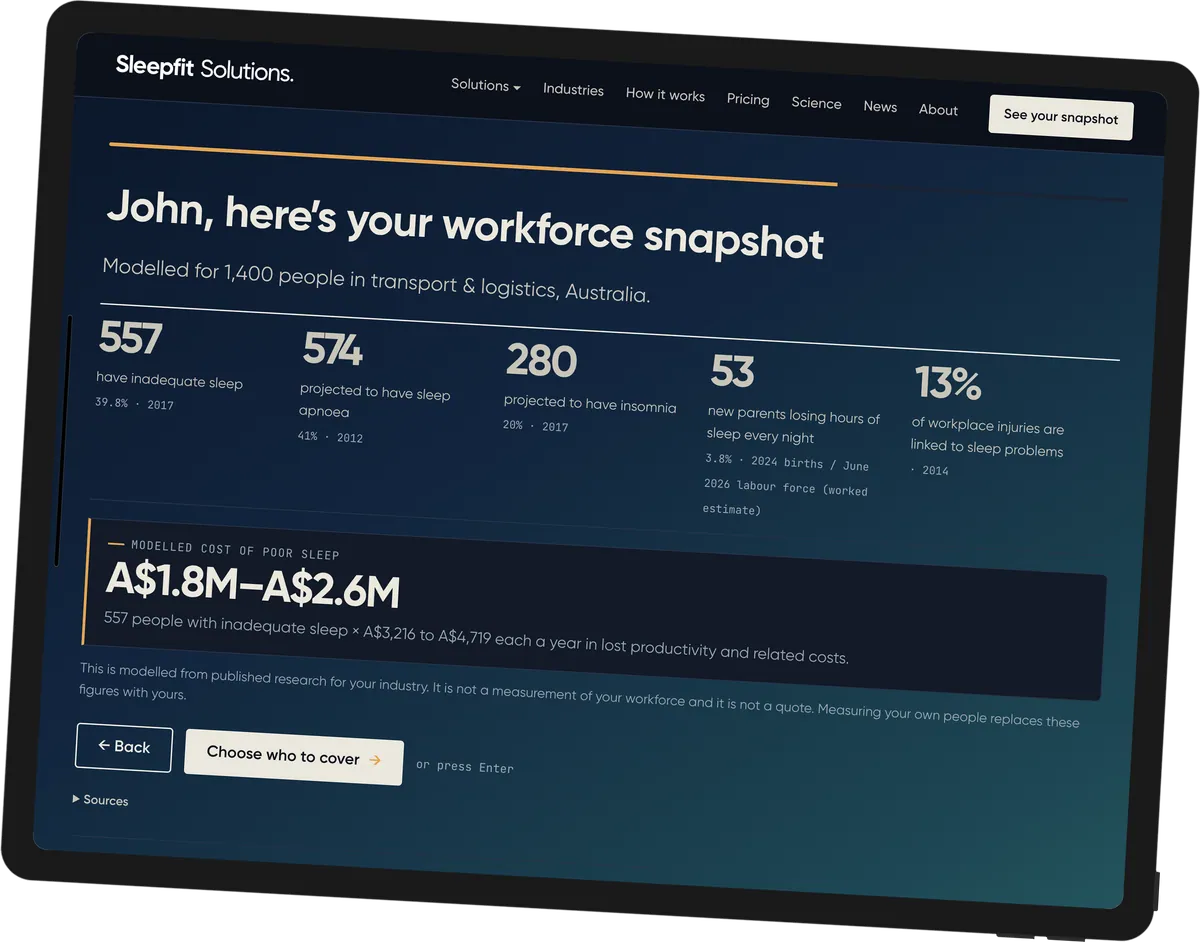
Indiquez-nous environ combien de personnes vous employez. Votre portrait estime combien dorment probablement mal et ce que cela coûte, à partir de la recherche publiée pour le secteur mines et ressources. Dites-nous ensuite sur quoi vous voulez mettre l’accent, et nous vous montrerons comment l’accès ouvert fonctionnerait pour vous et ce qu’il coûterait.

Un exemple d’aperçu de la main-d’œuvre sur une tablette : troubles du sommeil modélisés et coût du mauvais sommeil pour 1 400 personnes dans le transport et la logistique.