
Évaluation du risque de fatigue en temps réel

Fatiguefit4Duty

Évaluation structurée au début du quart, qui combine le sommeil que la personne a réellement obtenu au cours des 24 et 48 dernières heures avec son degré de vigilance actuel.

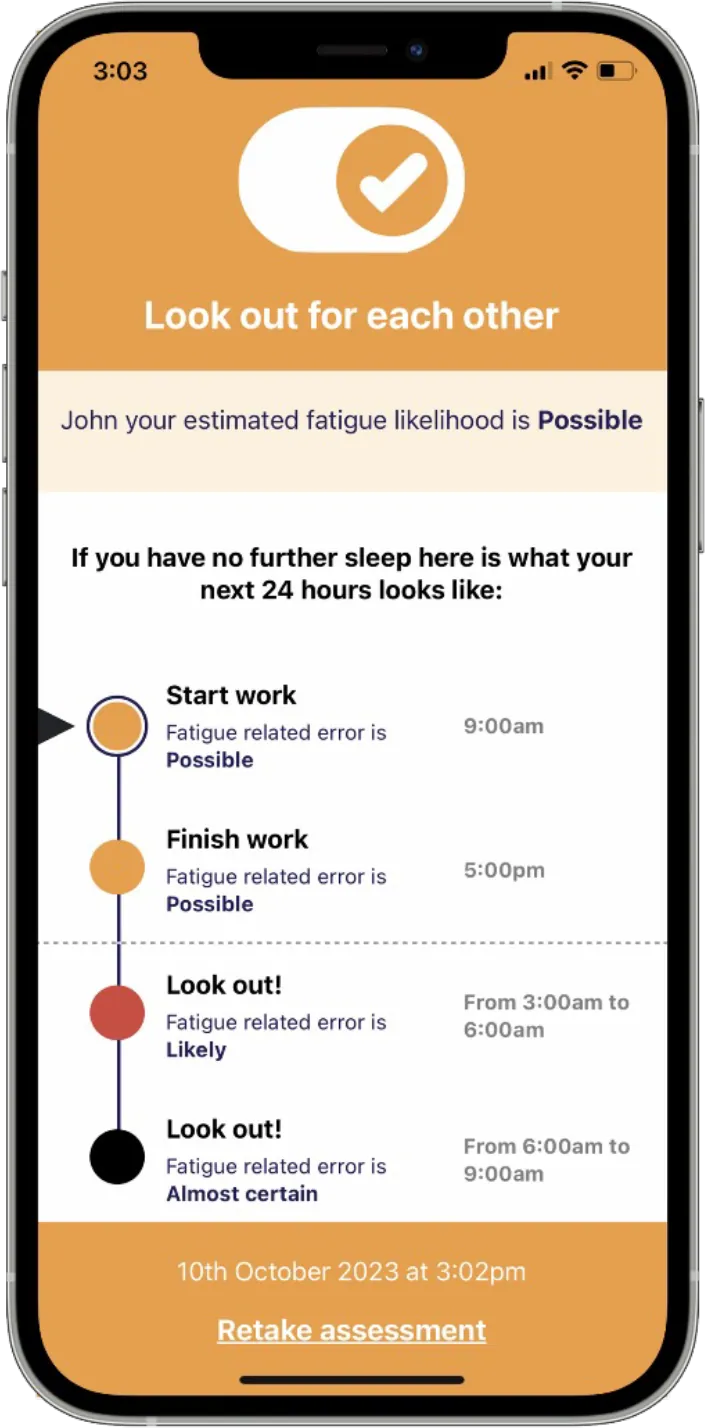
A Fatiguefit4Duty result on a phone: John’s estimated fatigue likelihood is Possible, with his fatigue-related error risk over the next 24 hours if he gets no further sleep.

Le problème

Un horaire conforme peut quand même mettre au travail une équipe fatiguée

Le prédicteur opérationnel de la détérioration liée à la fatigue est l’historique de sommeil et d’éveil antérieur, et non les heures de service. Les règles sur les heures de service ne voient pas la nuit passée auprès d’un enfant malade ni le trouble du sommeil que personne n’a diagnostiqué.

Fatiguefit4Duty pose, au début du quart, les questions qui prédisent réellement la détérioration, et place la réponse devant la personne qui doit prendre la décision.

How do you know your employees are fit to start work? Watch the video · 1:45
Presented by Professor Drew Dawson

The size of the problem

National figures for Canada, from published research. They are modelled, not measured in your workforce.

  • 33%get less than 7 hours' sleep2017 (CHMS 2007-2013)
  • 13%of workplace injuries are linked to sleep problems2014
  • C$2 030lost productivity per affected employee each year
Sources
  1. Chaput J-P, Wong SL, Michaud I. Duration and quality of sleep among Canadians aged 18 to 79. Health Reports (Statistics Canada), 2017.
  2. Uehli K, et al. Sleep problems and work injuries: a systematic review and meta-analysis. Sleep Medicine Reviews, 2014.
  3. Rosekind MR, et al. The Cost of Poor Sleep: Workplace Productivity Loss and Associated Costs. Journal of Occupational and Environmental Medicine, 2010;52(1):91-98, applied to average earnings in Canada (Statistics Canada, Survey of Employment, Payrolls and Hours, May 2026).

Cas

When no one checked who was fit for duty

Published cases from Canada where people started or kept working without enough sleep, and fatigue was never measured or treated as a hazard.

Les cas sont présentés en anglais.

  • janv. 2004 · Ontario, Canada

    Charter pilot on about 5 hours' sleep after cross-continent trip takes off iced and overweight; 10 killed

    • Sécurité
    • Financier

    A single-engine turboprop on a charter flight took off from an island airstrip in freezing precipitation, about 15 percent over its maximum weight and with ice on the airframe, and struck the frozen surface of a lake, killing the pilot and all nine passengers. The Transportation Safety Board of Canada found the decision to take off was out of character for the pilot and was likely affected by stress and fatigue. The night before, he had returned from a trip to California across three time zones and could have slept at most 5 hours 15 minutes before reporting for duty at 4:45 am.

    Cas CA-aviation-05Signaler une erreur
Voir toutes les actualités sur la fatigue

Comment ça fonctionne

A fitness-for-duty check at the start of the shift

Each person records the sleep they actually got in the last 24 and 48 hours and how alert they feel now. That covers two levels of defence at once: whether the sleep was obtained, and whether fatigue is showing at work. Elevated risk goes to the leader with the controls you have set for the role and task, before the work starts.

  1. Step 01

    Déclenchement

    Un superviseur déclenche l’évaluation au début du quart. Environ trente secondes, sur un téléphone, et elle fonctionne hors ligne.

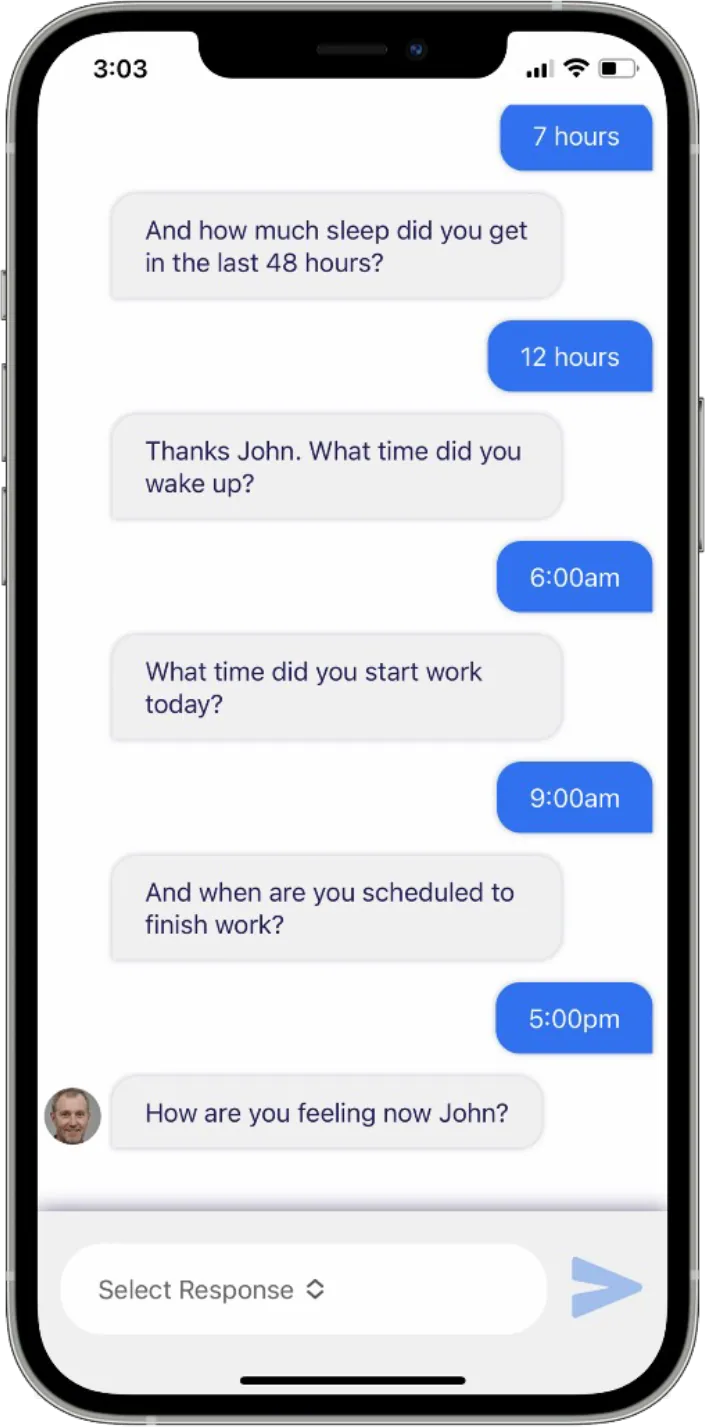
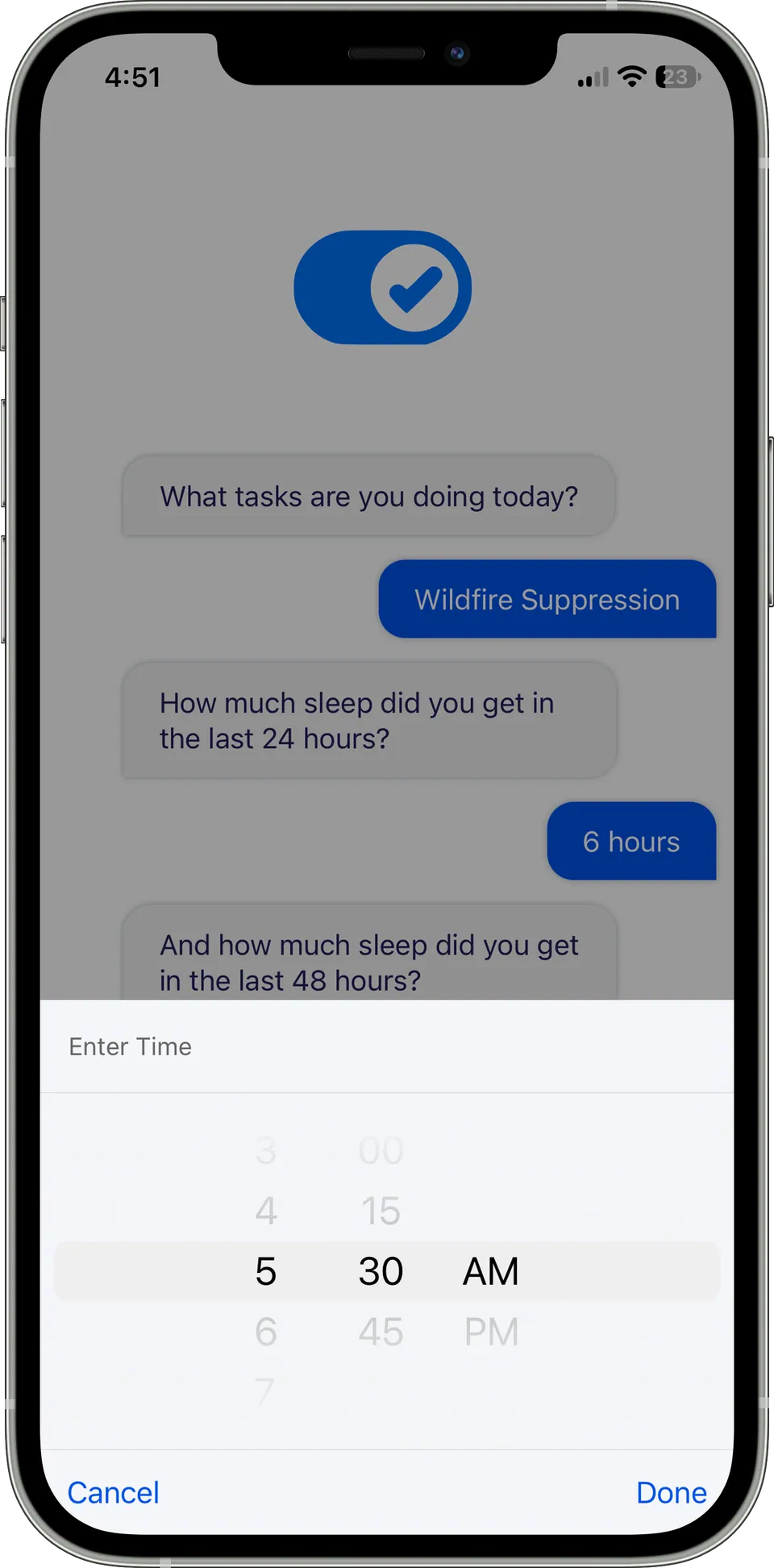
    A Fatiguefit4Duty assessment starting on a phone: which tasks are you doing today (wildfire suppression), how much sleep in the last 24 and 48 hours, and when did you wake.
  2. Step 02

    Sommeil et vigilance

    Sommeil obtenu au cours des 24 et 48 dernières heures, temps d’éveil et somnolence actuelle selon la Karolinska Sleepiness Scale.

    Fatiguefit4Duty asking about sleep in the last 24 and 48 hours, wake time and start time, with answers chosen from a list.
  3. Step 03

    Indication du risque

    La probabilité, établie à partir de l’historique de sommeil et d’éveil antérieur, combinée à une cote de conséquence attribuée selon le rôle, dans un calcul conforme à ISO 31000.

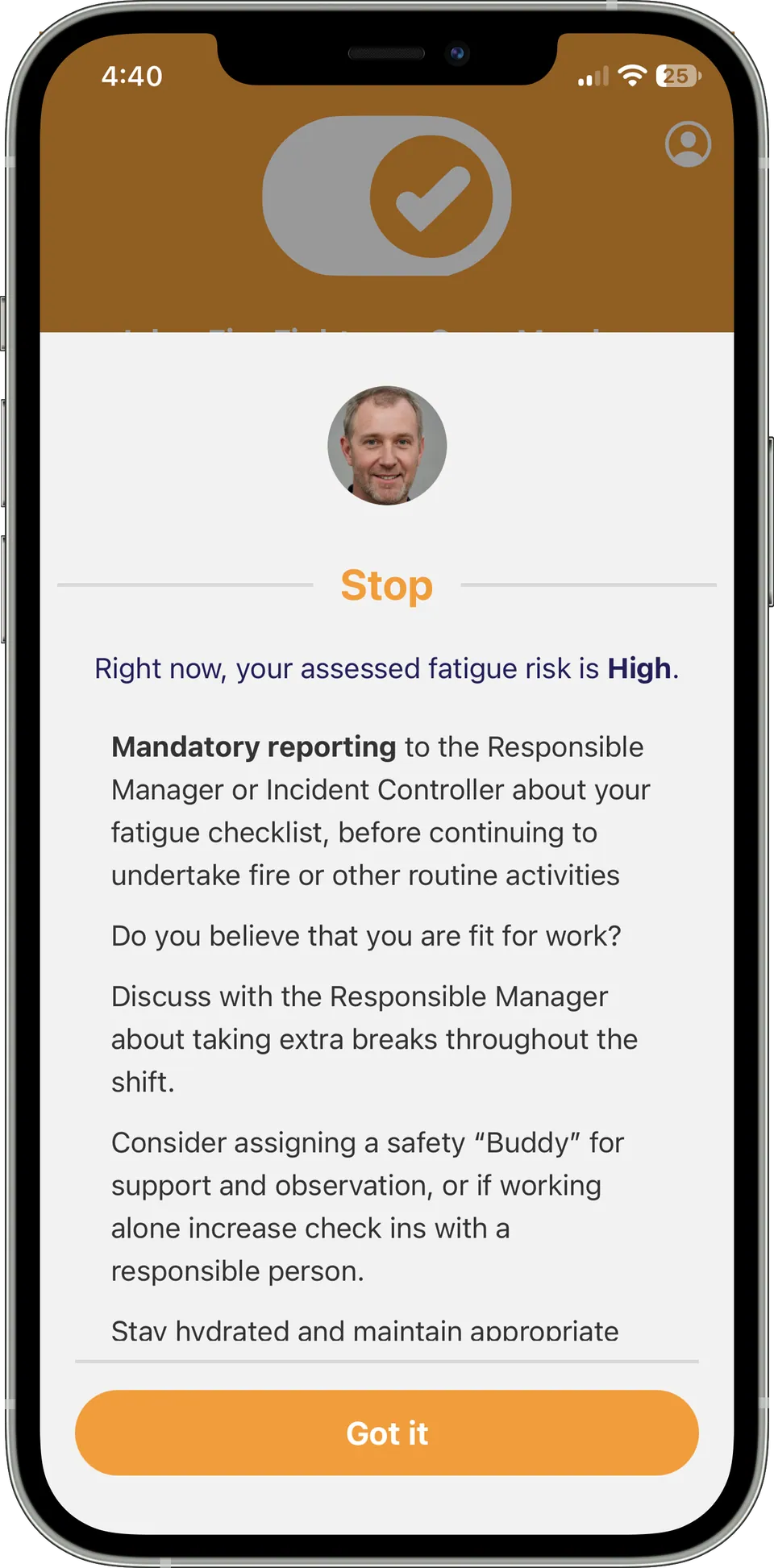
    A Fatiguefit4Duty result on a phone: Stop, the assessed fatigue risk right now is High, with mandatory reporting to the responsible manager and controls such as extra breaks and a safety buddy.
  4. Step 04

    Transmise au responsable

    Le résultat est transmis au chef d’équipe ou au gestionnaire de la sécurité, avec les contrôles par rôle et par tâche que vous avez configurés. La décision vous revient.

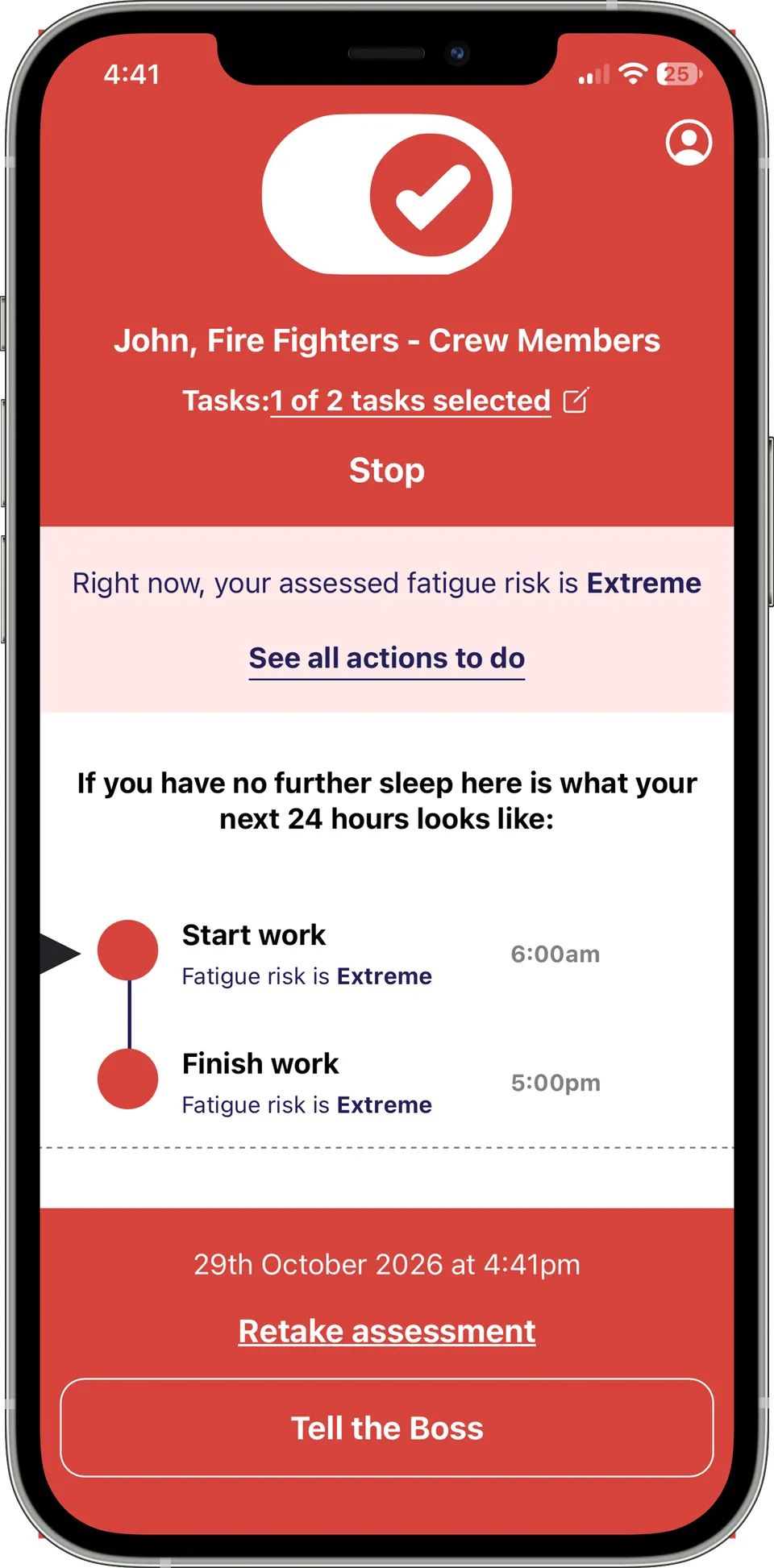
    A Fatiguefit4Duty result for a fire-fighting crew member: Stop, the assessed fatigue risk right now is Extreme for the next 24 hours, with the actions to take and a Tell the Boss button.

Most workplaces check whether someone is fit for duty without asking how they slept. A roster can’t see a night with a sick child. Thirty seconds at the start of a shift asks, and puts the answer in front of whoever makes the call.

Daniel PlattCofondateur et chef de la direction

Rollout

How we roll it out

  1. Scope

    Agree the roles in scope and a consequence rating for each.

  2. Configure

    Set the controls for each band and who sees each result.

  3. Train and launch

    Supervisors learn to prompt the assessment and act on the result.

  4. Review

    Aggregate reporting by cohort, location and craft, and tune the controls.

Ce que voit le client

Qui voit quoi

Contrairement à Sleepfit, ce résultat n’est pas privé: il sert à éclairer une décision de contrôle au début du quart. Les seuils des catégories et leur justification vous sont communiqués.

Un prix fondé sur la prévalence, pas sur l’effectif. Comment fonctionne la tarification.

  • The worker

    Answers about their own sleep

    • The thirty-second assessment, on a phone
  • Team leader or safety manager

    The risk indication, by design

    • Each person’s risk indication at the start of duty
    • The role- and task-based controls you configured
  • The employer

    Patterns across the operation

    • Aggregate reporting by cohort, location and craft
    • Band thresholds and how they were derived

Données probantes

Ce que nous pouvons démontrer

Le volet probabilité repose sur l’historique de sommeil et d’éveil antérieur, la donnée individuelle d’aptitude au travail la mieux appuyée par les données probantes.

L’approche suit la littérature publiée sur la gestion des risques liés à la fatigue (Dawson & McCulloch, 2005; Dawson & Sprajcer, 2020). La notation, les catégories et les seuils sont les nôtres, et aucune étude de validation n’est revendiquée à leur égard.

Ce que le produit n’établit pas

L’outil produit une indication du risque à l’échelle du rôle et de la tâche. Il ne détermine pas l’aptitude au travail, ne pose pas de diagnostic et n’autorise ni ne retire un employé du travail. Cette décision vous revient, selon votre propre procédure. C’est une méthode défendable, et non un instrument validé, et nous ne la présentons pas comme telle.

FAQs

Questions we’re often asked

Does it decide whether someone can work?

No. It gives a risk indication at role and task level, shown to the team leader or safety manager with the controls you have configured. It does not clear or stand down an employee: that decision stays with you, under your own procedure.

How long does it take, and does it need a signal?

Around thirty seconds on a phone at the start of duty, and it works offline.

What does it ask?

The sleep a person got in the last 24 and 48 hours, how long they have been awake, and how sleepy they feel now on the Karolinska Sleepiness Scale, combined with a consequence rating set for each role.

Is it a validated instrument?

No, and we don’t describe it as one. It follows the published fatigue risk management literature, but the scoring, bands and thresholds are our own and no validation study is claimed for them. The thresholds and how they were derived are published to you.

Who sees an individual’s result?

The team leader or safety manager, by design: the result exists to inform a control decision at the start of duty, so it is not private to the worker. You also get aggregate reporting by cohort, location and craft.

Can someone delete their account?

Yes. Anyone can ask for their account and its personal data to be deleted; the steps are on its delete-account page. Deletion can’t be undone.

Parcours

Pour aller plus loin

Fatiguefit4Duty et la réglementation dans 33 secteurs (Canada)

1 / 33

La réglementation nomme cette étape

1 / 33

Soutient une obligation précise

26 / 33

Soutient votre devoir général de diligence

5 / 33

Un avantage volontaire, pas une exigence réglementaire

Voyez comment Fatiguefit4Duty s’inscrit dans la réglementation de votre secteur, et par quoi d’autre nous commencerions.

Les 33 secteurs

Autres solutions liées à Fatiguefit4Duty

Interested in Fatiguefit4Duty for your organisation?

Tell us a little about your organisation and which solutions you’re looking at, and our team will be in touch.

A Fatiguefit4Duty result on a phone: John’s estimated fatigue likelihood is Possible, with his fatigue-related error risk over the next 24 hours if he gets no further sleep.