Agriculture · Canada

Le sommeil et la fatigue : agriculture

Seasonal peaks bring very long days, early starts and night harvesting or milking, often alone and far from help. Fatigue at the wheel of vehicles and machinery is a serious injury risk.

Réglementation modifiée : 1 oct. 2026

Main-d’œuvre du secteur Agriculture

Ce que couvre cette page

  • Aquaculture - salmon, oysters, mussels
  • Beef and sheep farming and pastoral stations
  • Broadacre cropping and grain
  • Cattle feedlots
  • Dairy farming
  • Horticulture and seasonal harvest
  • Shearing and agricultural contracting
  • Vineyards (voir aussi Transformation des aliments et des boissons)

Veille réglementaire

Ce qui a changé, et ce qui s’en vient

Les changements réglementaires qui touchent votre gestion de la fatigue en agriculture : ce qui a changé au cours des 12 derniers mois, et ce qui s’en vient.

Les détails réglementaires et les données de recherche de cette page sont présentés en anglais.

Changement récentDepuis le 1 octobre 2026

S’applique à tous les secteurs (Canada)

In Quebec, since 1 October 2025 every establishment must have a prevention program (20 or more workers) or action plan that identifies and analyses risks, including psychosocial risks, and update it every year. Most employers had one year to put it in place, a period that ended in October 2026.

Voir le changement


Changements réglementaires vérifiés au 2 novembre 2026.

Réglementation

Qui la réglemente, et ce qui est attendu

Les détails réglementaires et les données de recherche de cette page sont présentés en anglais.

Agriculture is where Canadian law gives workers less, not more. Ontario farm employees in primary production are excluded from the Employment Standards Act rules on daily and weekly hours, daily rest, time off between shifts, weekly rest, eating periods and overtime - and from minimum wage, public holidays and vacation pay. British Columbia excludes farm workers from the hours and overtime Part altogether; Saskatchewan exempts primary production from most standards; Alberta exempts farms from hours and overtime, and exempts operations with five or fewer waged non-family employees entirely. Safety law is not exempted where there are paid workers.

Qui la réglemente

Provincial labor ministries, safety regulators and workers' compensation boards cover farms like other employers - but every major farming province also runs an agricultural carve-out that strips out hours, rest and overtime protection. In Ontario it is O. Reg. 285/01 under the Employment Standards Act, 2000, and a separate regulation, O. Reg. 414/05, governs how the Occupational Health and Safety Act applies to farms.

Vos obligations

There is no statutory hours ceiling or mandated rest period for primary farm work in Ontario, British Columbia, Alberta or Saskatchewan, so your rostering is limited by nothing but your own judgment. The exemptions are narrow: they cover primary production. Processing, packing beyond initial washing and grading, retail, trucking, and in Ontario landscape gardening, all keep the ordinary hours, break and overtime rules. Safety law is untouched: Ontario's Occupational Health and Safety Act applies to every farming operation with a paid worker, so fatigue must be managed as a hazard under the duty to take every precaution reasonable in the circumstances.

Conséquences

Working farm employees long hours without rest is not an employment standards offence, so that enforcement route does not exist here. Three others do. If a fatigue-related incident occurs, the provincial safety regulator can issue orders and prosecute, and the absence of any hours rule is no defense - the general duty still asks what precautions you took. If the exemption is claimed for work that is really processing, packing, retail or transport, the employment standards branch can order back pay covering unpaid overtime, minimum wage, public holidays and vacation pay for the whole misclassified period, with penalties on top. And every fatigue-related injury still becomes a workers' compensation claim.

Sanctions

There is no fine for working farm employees long hours, because no hours rule applies to them. Where the exemption is misapplied, employment standards orders cover unpaid wages, overtime, holiday and vacation pay for the affected period, plus penalties. Where a fatigue-related incident leads to a safety prosecution, Ontario's 2026 maximums apply: $2,000,000 for a corporation, $1,500,000 for a director or officer and $500,000 for any other individual.

Sources: Ontario Employment Standards Act, 2000 and O. Reg. 285/01; Ontario Ministry of Labour guidance on agricultural employees; Ontario OHSA s.66 and O. Reg. 414/05 (farming operations); BC Employment Standards Regulation s.34.1; Alberta and Saskatchewan employment standards guidance.

Postes critiques

Là où la fatigue compte le plus en agriculture

Les postes où un travailleur fatigué risque le plus de causer un préjudice grave, les tâches qui portent ce risque, et pourquoi la fatigue s’y accumule.

Les détails réglementaires et les données de recherche de cette page sont présentés en anglais.

PosteRisqueTâches à risque élevéPourquoi la fatigue s’accumule
Combine operator
Règles
Désignation réglementaire
None specific - general duty (provincial OHS Act; CLC Part II s 124 for federal works)
Heures et repos
Farm employees exempt from provincial hours rules in several provinces (e.g. Ont. O. Reg 285/01)
Risque critiqueRunning headers, chaser bins and forage harvesters through the night, moving wide machinery on public roads, auger and PTO workHarvest runs of 14-18 h days for weeks, night harvesting when conditions allow, contractors moving between farms
Farm worker (livestock)
Règles
Désignation réglementaire
None specific - general duty (provincial OHS Act; CLC Part II s 124 for federal works)
Heures et repos
Provincial ESA, e.g. Ont. ESA: 11 h daily rest, 8 h between shifts, 48 h/wk unless agreed
Risque critiqueNight checks during calving and lambing, quad bike and side-by-side use on slopes, handling cattle in yards, lone work far from helpBroken sleep for 6-10 weeks of calving or lambing, early starts, lone work
Grain truck driver
Règles
Désignation réglementaire
Commercial vehicle driver (Commercial Vehicle Drivers Hours of Service Regs SOR/2005-313; provincial HOS, NSC Standard 9); farm vehicles often outside federal HOS (provincial rules)
Heures et repos
SOR/2005-313: 13 h driving and 14 h on duty per day, 8 h off before driving, 10 h off per day; 70 h/7 d or 120 h/14 d
Risque critiqueCarting grain and produce from paddock to silo through the night at harvest, overloaded-axle risk, long queues at receival sites, rural roadsHarvest-season 14 h+ days, night carting, queuing, short sleep between loads
Dairy herdsperson
Règles
Désignation réglementaire
None specific - general duty (provincial OHS Act; CLC Part II s 124 for federal works)
Heures et repos
Provincial ESA, e.g. Ont. ESA: 11 h daily rest, 8 h between shifts, 48 h/wk unless agreed
Risque élevé04:00 milking in rotary or herringbone sheds, handling cows at close quarters, chemical teat dips and cleaning, then tractor workSplit shifts from 03:30-04:30 plus afternoon milking, 11-12 day rosters, long days
Seasonal agricultural worker (SAWP)
Règles
Désignation réglementaire
None specific - general duty (provincial OHS Act; CLC Part II s 124 for federal works)
Heures et repos
Ont. farm employees exempt from ESA hours (O. Reg 285/01)
Risque élevéNight packhouse grading lines at peak, ladder and platform picking, driving co-workers in vans at dawnPeak-season 10-12 h days 6-7 days a week, piece rates, shared accommodation, long van commutes

Risque de fatigue saisonnier

Quand le risque de fatigue augmente en agriculture.

La saison seule fait peu varier le risque de fatigue. Les effets les plus marqués viennent de semaines et de charges de travail précises. Voici les périodes qui comptent en agriculture au Canada en 2027, y compris celles qui touchent toute la main-d’œuvre.

  1. 14 Mar · Mesuré

    Clocks spring forward (not most of Saskatchewan)

    Injury and crash risk rise the following week

  2. Jun to Aug · Documenté

    Longest days, warmest nights

    Sleep shortest in summer; more so further from the equator

  3. Jul to Aug · Documenté

    Wildfire season

    Deployments cut sleep

  4. Sep to Oct · Mesuré

    Harvest

    Farm injuries peak at planting and harvest

Mesuré : une étude publiée a constaté un changement du sommeil, des blessures ou des collisions. Documenté : un changement consigné de la charge de travail ou de l’exposition, comme les heures supplémentaires ou les déploiements. Les dates valent pour 2027 et changent chaque année. Notre lecture des données publiées, mise à jour chaque novembre. Les événements sont affichés en anglais.

Cas

Quand la fatigue a laissé une trace

Constatations et poursuites publiées par les organismes de réglementation, les tribunaux et les enquêteurs (Canada).

Les détails réglementaires et les données de recherche de cette page sont présentés en anglais.

  • sept. 2023 · Quebec, Canada

    Acutely fatigued trawler master who stayed at the helm through a 3-day redfish trip slow to respond as vessel sinks; three die

    • Sécurité

    The master of a stern trawler stayed at the helm for most of a three-day redfish trip with only occasional breaks, and gear failures disrupted his and the crew's sleep. About four hours after the crew stood down to rest, the overloaded vessel began to sink during the night. The Transportation Safety Board found that the master was acutely fatigued, which likely reduced his ability to recognize and respond to the emergency. Three of the six people on board died.

    Cas CA-agriculture-09Signaler une erreur

Voir toutes les actualités : agriculture

Comment la plateforme s’inscrit

Comment chaque produit se rattache à vos obligations

Les cotes décrivent dans quelle mesure un produit se rattache à une obligation. Aucun ne vous acquitte d’une obligation, et aucun ne comporte de garantie de conformité.

Les détails réglementaires et les données de recherche de cette page sont présentés en anglais.

Sleepfit

Soutient votre devoir général de diligence

No Canadian agricultural rule requires sleep-health checks for farm workers. Sleepfit supports your general duty to protect worker health under provincial OHS law, such as s 25(2)(h) of Ontario's OHS Act. It identifies employees who may benefit from clinical evaluation; diagnosis stays with your clinicians.

À propos de Sleepfit

Fatiguefit4Duty

Soutient votre devoir général de diligence

No Canadian agricultural rule names a point-of-duty fatigue check. Fatiguefit4Duty supports your general duty under provincial OHS law. A fitness-for-duty check, not a fitness-for-duty decision - the duty call stays with you.

À propos de Fatiguefit4Duty

Awareness eLearning

Soutient votre devoir général de diligence

Your duty to give farm workers the information, instruction and training they need, under provincial OHS law, such as s 25(2)(a) of Ontario's OHS Act, does not name fatigue. Awareness eLearning supplies fatigue and sleep content with a completion record.

À propos de Awareness eLearning

Was It Fatigue?

Soutient votre devoir général de diligence

Your duty to investigate workplace incidents under provincial OHS law does not name fatigue in agricultural work. Was It Fatigue? supports that investigation. A structured judgment aid, not a determination of cause.

À propos de Was It Fatigue?

SleepWellBaby

No Canadian agricultural rule reaches sleep in new-parent households. SleepWellBaby is offered as a benefit to parents on your farms; it is not a compliance step and sits outside your health and safety obligations.

À propos de SleepWellBaby

Niveau 4 : erreurs liées à la fatigue

Quand la fatigue passe, attrapez l’erreur.

Les contrôles de niveau 4 interceptent ou détectent les erreurs liées à la fatigue avant qu’elles ne causent des dommages. D’autres les intègrent aux équipements, aux tâches et aux procédures : nous ne les fournissons pas et ne les cautionnons pas, et nous pouvons vous orienter vers des fournisseurs. Voici les types qui s’appliquent au secteur agriculture.

  • Detect fatigue in the task

    In-cab fatigue and distraction detection

    A camera watches the operator's eyes, gaze and head position and alerts them, and often a monitoring center, at signs of drowsiness or distraction.

    Ce qu’il ne fait pas: It reacts once impairment shows; it does not predict fatigue, measure sleep or fix rosters.

    Exemples: Road freight and buses: in-cab cameras with 24/7 monitoring. Mining: haul-truck operator monitoring. Warehousing: forklift kits.

  • Trap the error

    Driver assistance and emergency braking

    The vehicle brakes or steers to prevent or soften a crash when the driver does not react in time.

    Ce qu’il ne fait pas: It reduces crash likelihood or severity; it does not detect or manage fatigue.

    Exemples: Trucks and buses: autonomous emergency braking. Fleet cars: lane keeping.

  • Procedural cross-check

    Two-person checks

    A second qualified person checks critical actions so one tired person's slip is caught.

    Ce qu’il ne fait pas: Both people may be fatigued on the same roster, so it relies on fatigue-aware rostering behind it.

    Exemples: Rail: two-person crews and call-outs. Aviation: two-pilot cross-checks. Utilities: switching verification. Hospitals: double checks.

  • Remove exposure

    Scheduling critical tasks away from the early-morning low

    Moves the highest-risk tasks out of the early-morning hours when errors are most likely.

    Ce qu’il ne fait pas: It reduces exposure but does not trap the error; it depends on planners knowing when fatigue peaks.

    Exemples: Maintenance: critical work scheduled off night shift. Hospitals: elective procedures in daytime.

La plupart des données sur la technologie de détection de la fatigue proviennent des fournisseurs eux-mêmes. Demandez une évaluation indépendante avant de vous y fier.

Dans des secteurs comme agriculture, ils nous font confiance

Ce que le sommeil et la fatigue représentent pour votre effectif en agriculture.

Indiquez-nous environ combien de personnes vous employez. Votre portrait estime combien dorment probablement mal et ce que cela coûte, à partir de la recherche publiée pour le secteur agriculture. Dites-nous ensuite sur quoi vous voulez mettre l’accent, et nous vous montrerons comment l’accès ouvert fonctionnerait pour vous et ce qu’il coûterait.

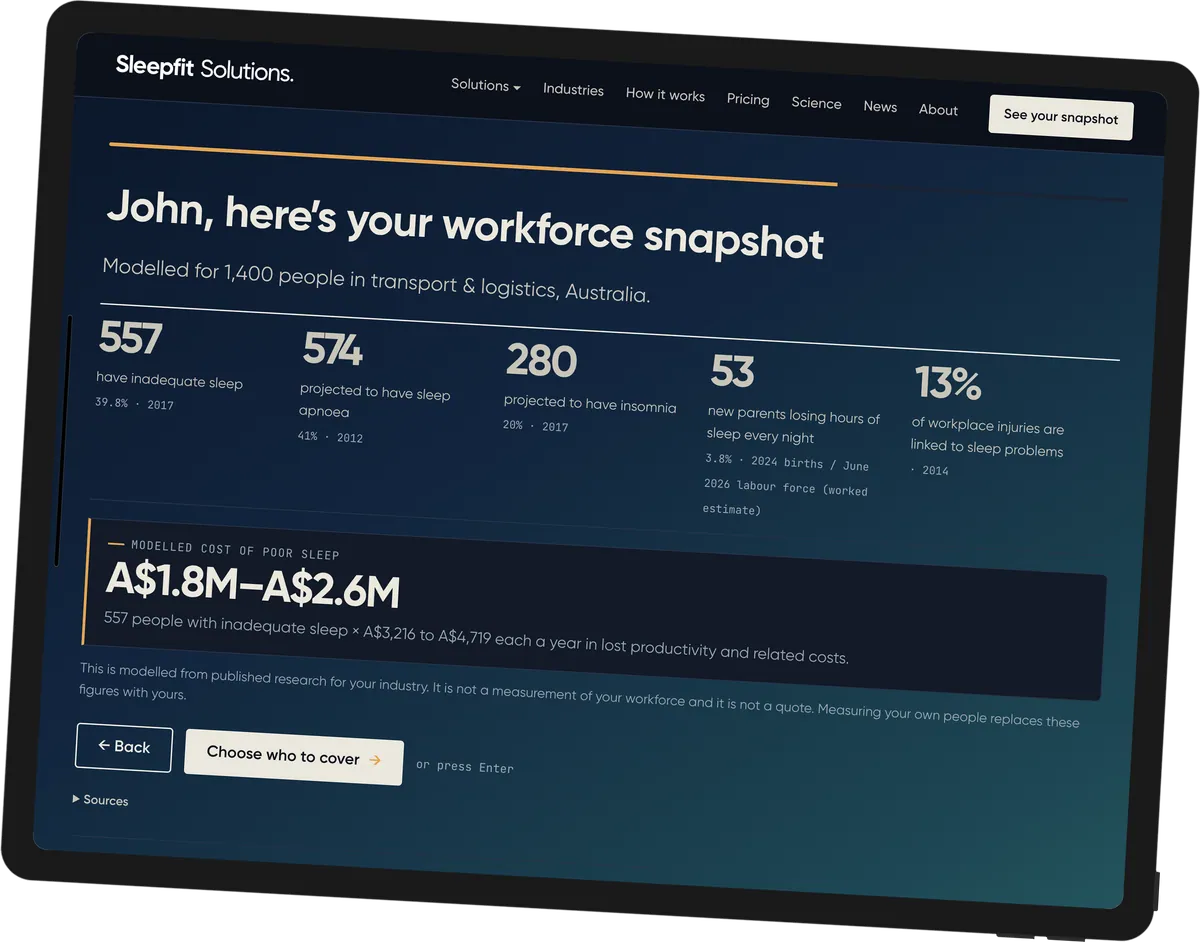
Un exemple d’aperçu de la main-d’œuvre sur une tablette : troubles du sommeil modélisés et coût du mauvais sommeil pour 1 400 personnes dans le transport et la logistique.